Beyond ChatGPT: what chatbots mean for the future
TL;DR
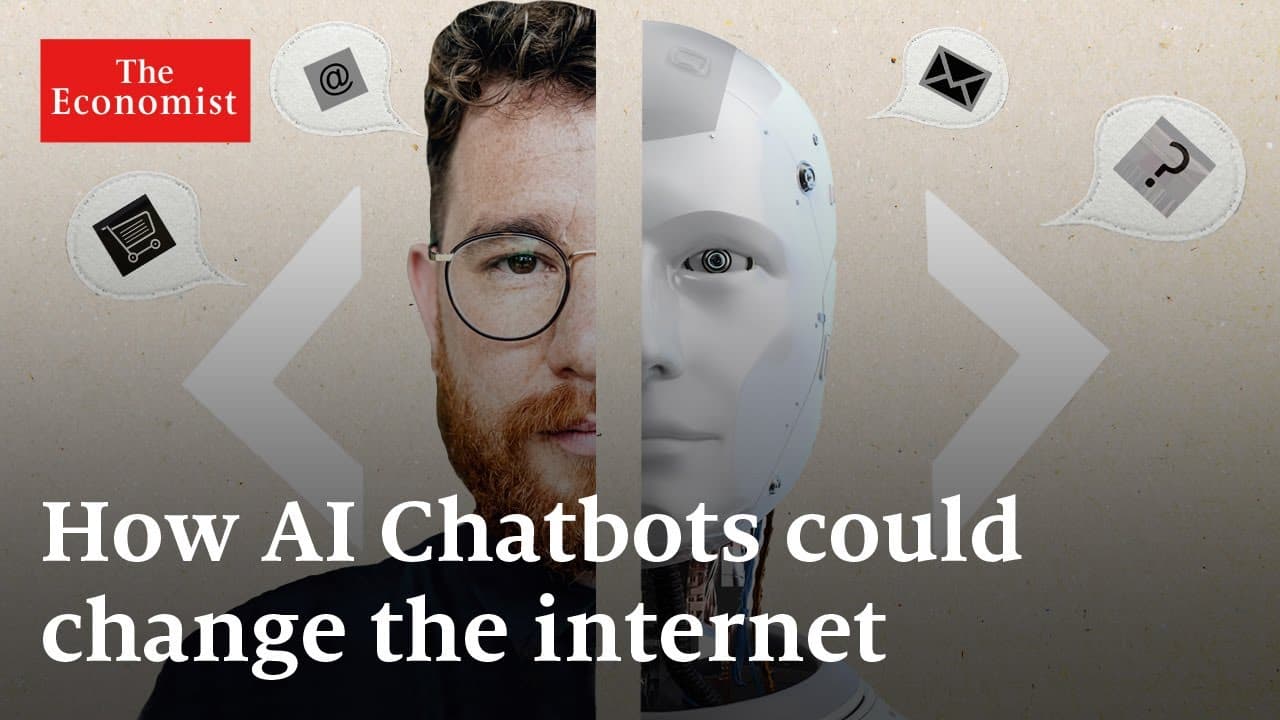
AI chatbots could reshape the internet by offering conversational help with searches, writing, and creative tasks, but their inability to distinguish truth from fiction creates serious reliability risks. Trained on billions of texts, they predict likely words rather than understand facts, sometimes producing convincing falsehoods called hallucinations. Their potential to disrupt a search market where Google earned around $150bn from ads in 2021, and to foster emotional bonds, makes the wider consequences worth examining.
Transcript
Whether it’s turning on its creator in “Ex Machina”... ...or looking for love in “AI” or “Her”... Hello, I’m here Artificial intelligence permeates Hollywood’s blockbusters I’ll be back But now, with the arrival of chatbots like ChatGPT... ...suddenly AI seems a lot closer to fact than fiction This has caused more excitement in the tech world... ... Read More
Key Insights
- 👨🔬 Generative AI chatbots have the potential to disrupt the search engine industry and offer a more personalized experience.
- 💁 Reliability is a concern, as chatbots may produce inaccurate, plagiarized, or misleading information based on the data they were trained on.
- 🤨 Chatbots can evoke emotional responses and the "ELIZA effect" raises ethical and societal questions about forming relationships with AI companions.
- 🤔 The internet's vibrancy and critical thinking skills may be hampered if people rely solely on chatbots for information and content discovery.
- 👥 Chatbots could be used to spread misinformation and falsehoods, potentially amplifying the flood of misinformation strategies employed by certain individuals or groups.
Install to Summarize YouTube Videos and Get Transcripts
Explore YouTube Video Summarizer or Get YouTube Transcript Extractor
Questions & Answers
Q: What do AI chatbots mean for the future of the internet and our relationship with machines?
AI chatbots could become an alternative front door to the internet by answering questions, explaining terms, suggesting holidays, and helping with writing. However, their convincing errors and ability to evoke emotional responses raise concerns about misinformation, trust, and people forming bonds with machines.
Q: How do generative AI chatbots work?
They are trained on billions of texts from the internet and learn which words are most likely to follow others for a given subject. They generate responses by repeatedly predicting the next word, making them resemble a highly sophisticated form of autocomplete.
Q: What can generative AI chatbots create?
Beyond answering questions, generative AI chatbots can write essays, poems, and songs. Some can also produce art or music from text prompts.
Q: How could chatbots disrupt internet search?
A chatbot may be more useful than a conventional search engine for tasks such as choosing a holiday destination, understanding a technical term, or getting help with an essay. Microsoft and Google are adding chat functions to their search engines, while China’s Baidu has followed suit.
Q: Why is so much money at stake in AI-powered search?
Google’s revenue from search ads reached around $150bn in 2021, making search a lucrative business vulnerable to disruption. Venture-capital investment in generative AI totaled over $1bn the following year as investors hoped a new technology company might challenge Google.
Q: Why can AI chatbots give inaccurate answers?
Chatbots do not understand right and wrong or true and false; they construct answers from patterns in the billions of words they have read. Because they may give an academic paper and a fictional story equal weight, they can present unsupported claims as accurate.
Q: What is an AI chatbot hallucination?
A hallucination occurs when a chatbot combines or reflects information in a way that produces a claim that is not actually true. The result may sound realistic even though it has no basis in reality.
Q: What is the ELIZA effect, and why does it matter for modern chatbots?
The ELIZA effect describes people developing feelings toward a machine through conversation. In 1966, Joseph Weizenbaum’s ELIZA simulated reflective listening, and volunteers appeared to form feelings for it despite knowing it was a machine; modern chatbots can similarly evoke attachment during extended interactions.
Summary & Key Takeaways
-
AI chatbots, powered by generative AI technology, have improved significantly and can now provide intelligent and lifelike responses.
-
Chatbots have the potential to disrupt the search engine industry, with companies like Google and Microsoft incorporating chat functions into their platforms.
-
However, concerns over the reliability of chatbot responses, plagiarism, misinformation, and the potential loss of critical thinking skills arise as chatbots rely on text from the internet.
Read in Other Languages (beta)
Share This Summary 📚
Summarize YouTube Videos and Get Video Transcripts with 1-Click
Try YouTube Summary with ChatGPT & Claude or YouTube Transcript Generator
Explore More Summaries from The Economist 📚





Summarize YouTube Videos and Get Video Transcripts with 1-Click
Try YouTube Summary with ChatGPT & Claude or YouTube Transcript Generator