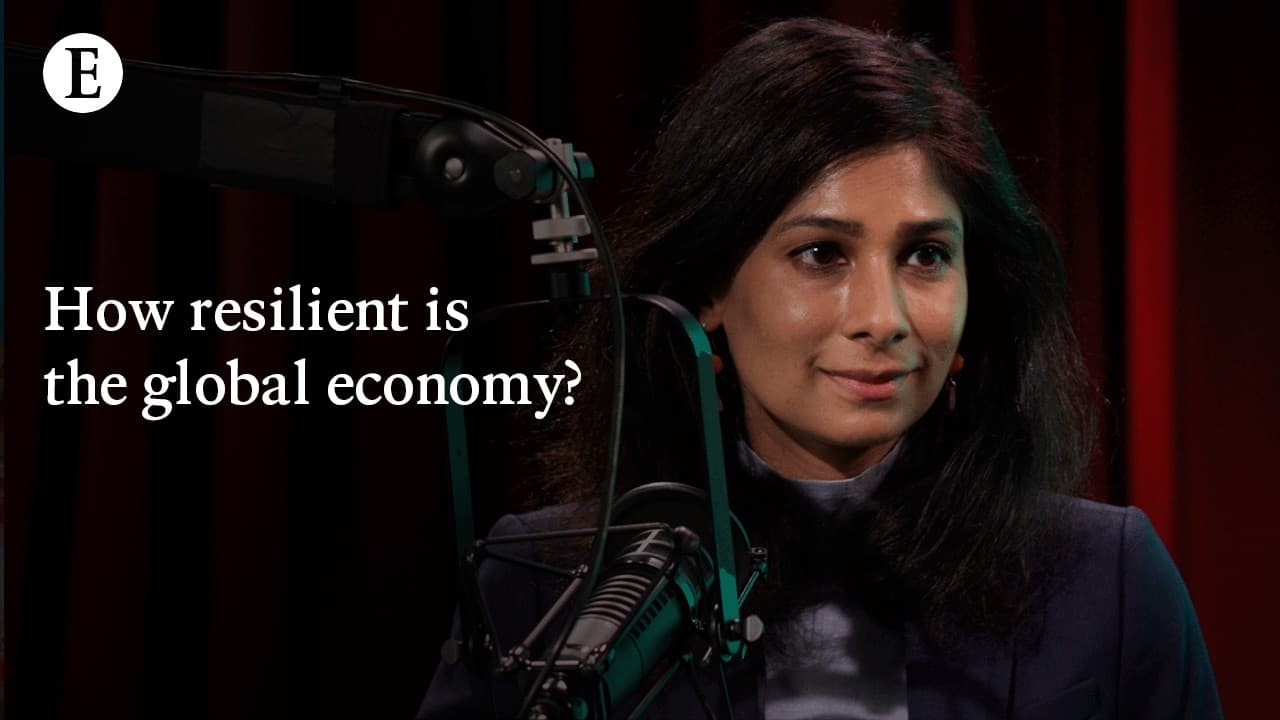
How Does Former IMF Chief Economist Gita Gopinath Say Rich World Economies Can Fix Rising Debt?
TL;DR
Rich economies can confront rising debt by closing the structural gap between steadily increasing government spending and relatively flat revenue. Gita Gopinath highlights aging-related health and retirement costs, while global debt is forecast to exceed 100% of GDP by 2030. Read on to understand the fiscal imbalance, the difficulty of reversing temporary spending, and the financial risks that could intensify it.
Transcript
Gita, welcome to Money Talks. Hi, Mike. It's pleasure to be on your show. So, you spent a while at the IMF. You were there as chief economist and then you were there as first deputy managing director. It's a bit of a mouthful. Um, tell me a bit about those jobs. It was obviously a very interesting period the last seven years. You've had uh the pand... Read More
Key Insights
- Emerging-market policymaking is more mature than it was previously, making sound policy somewhat less dependent on whether the United States actively promotes international economic norms. This institutional progress helped emerging markets withstand several recent shocks without producing as many crises as might once have been expected.
- Recent global resilience has not been tested by a financial crisis in a major economy. The previous six years included a pandemic, war, inflation, rising interest rates, commodity shocks, and fragmentation, but no major financial crisis capable of exposing vulnerabilities across markets and countries.
- United States financial markets appear highly confident, with a booming stock market and very thin corporate borrowing spreads. A sharp reversal or major financial event could have much larger global consequences, particularly for emerging markets, than the shocks experienced during the preceding six years.
- Non-bank financial institutions now play a much larger role in corporate lending and access to finance. Because a major financial crisis has not yet substantially involved these institutions, their behavior and interconnected exposures represent an important source of uncertainty during future market turbulence.
- Private credit is harder to monitor than public-market activity because lending relationships and other financial exposures can be difficult to establish quickly when a company fails. This reduced transparency may complicate efforts to understand and contain financial stress as it spreads through the system.
- Government spending has risen relative to GDP over roughly 25 years while government revenue relative to GDP has remained comparatively flat. This growing mismatch reflects a structural fiscal problem, since policies introduced as temporary and targeted measures are often politically difficult to reverse.
- Global debt is forecast in the discussion to exceed 100 percent of GDP by 2030. Advanced economies can no longer assume they can borrow indefinitely without consequences, as fiscal pressures have already become recurring political and economic concerns in countries including France and the United Kingdom.
- Entitlement spending is central to repairing rich-country budgets because aging will increase health and retirement costs. Tax enforcement, collection, and selected tax increases can contribute, but Gopinath argues that longer and healthier lives support raising retirement ages as part of a credible fiscal solution.
- "I would say that emerging market policym has matured to a point where it is somewhat less reliant on whether the US is advocating for it or not." (2:42)
- "And so we've not had a crisis a financial crisis that's involved non-bank financial institutions in a big way." (4:22)
- "So it is a it is a major problem." (6:36)
Install to Summarize YouTube Videos and Get Transcripts
Explore YouTube Video Summarizer or Get YouTube Transcript Extractor
Questions & Answers
Q: How can rich economies address rising public debt?
They must address the structural mismatch between the spending expected from governments and the revenue governments collect. Revenue relative to GDP stayed relatively flat over the last 25 years, while government spending relative to GDP continuously increased.
Q: Why are advanced economies on an unsustainable fiscal trajectory?
Advanced economies face growing spending associated with aging, including health and retirement costs. This pressure compounds the broader disconnect between government spending and collected revenue.
Q: How high is global debt forecast to rise by 2030?
Global debt relative to GDP is forecast to reach over 100% by 2030. Gita Gopinath describes this outlook as a major problem.
Q: Why is temporary government spending difficult to reverse?
Policies introduced as temporary and targeted measures are very difficult to roll back. Gopinath uses pandemic spending as an example of expenditures that countries could increase temporarily but then struggled to reverse.
Q: Why have emerging markets remained resilient through recent shocks?
Gita Gopinath says emerging-market policymaking has matured and is somewhat less reliant on whether the United States advocates for it. Recent shocks included the pandemic, inflation, higher interest rates, and commodity-price disruption following Russia's invasion of Ukraine.
Q: What financial risk does Gita Gopinath worry about?
She worries about financial-market turbulence in the United States because the previous six years had not included a financial crisis in a major economy. She says a big financial event could affect emerging markets differently and have much larger consequences for the world.
Q: Why could a future financial crisis unfold differently from previous crises?
Non-bank financial institutions now play a much bigger role in corporate lending and access to finance. Gopinath notes that there has not yet been a major financial crisis involving these institutions in a big way.
Q: Why is private credit difficult to monitor?
When companies fail, it can be very difficult to establish their lending relationships and other financial exposures quickly. The retreat from public credit markets makes those connections less visible.
Summary & Key Takeaways
-
Gita Gopinath describes joining the IMF in January 2019, shortly before a succession of global disruptions. The pandemic, Russia’s invasion of Ukraine, inflation, widespread interest-rate increases, geopolitics, and geoeconomic fragmentation made her tenure turbulent, but they also provided valuable experience working through crises with IMF staff and member countries.
-
Emerging-market policy has matured and become less dependent on active support from the United States. However, recent resilience has not been tested by a financial crisis in a major economy. A large American market event could affect emerging markets differently, particularly because non-bank financial institutions now play a greater role in lending.
-
Rich countries face a structural mismatch between public expectations and government revenue. Spending relative to GDP has risen while revenue has remained comparatively flat, and temporary measures are difficult to reverse. Gopinath argues that entitlement reform, including higher retirement ages, is essential because tax measures alone cannot sustainably close the growing fiscal gap.
Read in Other Languages (beta)
Share This Summary 📚
Summarize YouTube Videos and Get Video Transcripts with 1-Click
Try YouTube Summary with ChatGPT & Claude or YouTube Transcript Generator
Explore More Summaries from The Economist 📚





Summarize YouTube Videos and Get Video Transcripts with 1-Click
Try YouTube Summary with ChatGPT & Claude or YouTube Transcript Generator