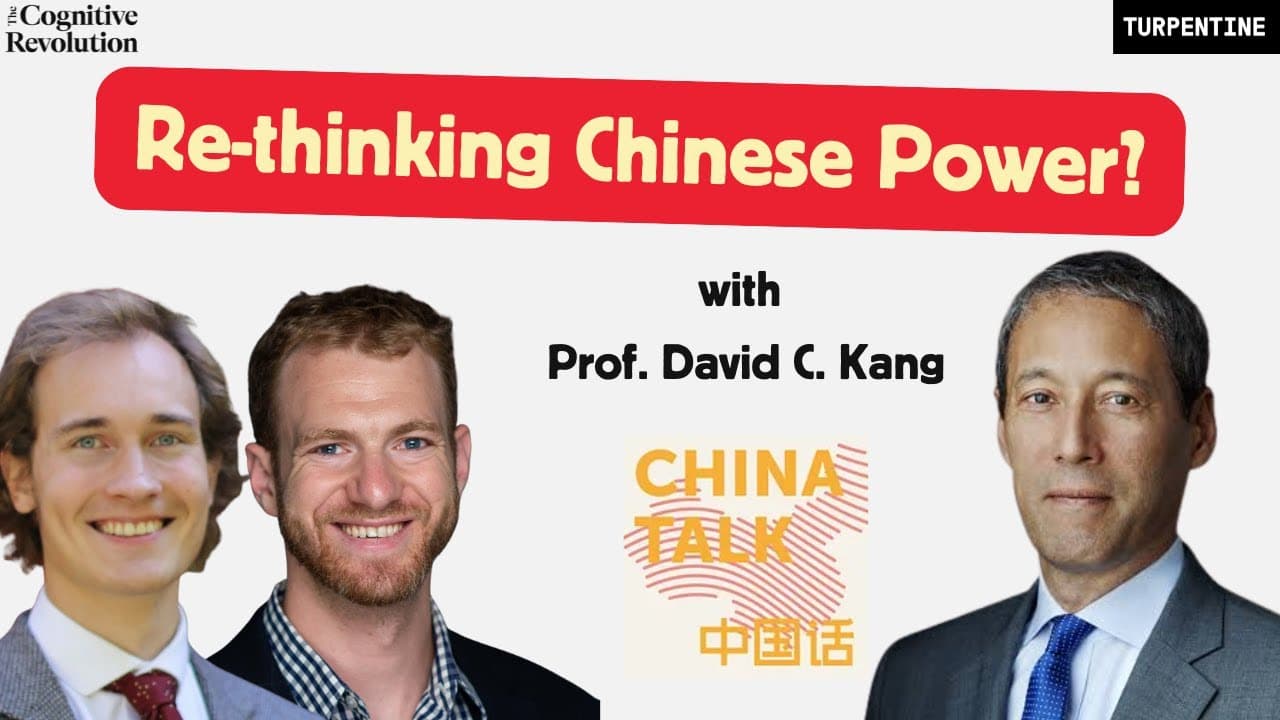
Is a US-China Thucydides Trap Unavoidable? David C. Kang on the ChinaTalk Podcast
TL;DR
A US-China Thucydides Trap is not presented as unavoidable: David C. Kang argues that East Asian history offers a different model from European power transitions. From around 1000 until the 19th century, the region experienced remarkable geopolitical stability, while China remained dominant without seeking to conquer Korea, Japan, or Vietnam. Read on to see why internal challenges may matter more than conflict between the two powers.
Transcript
Hello and welcome back to the Cognitive Revolution. Today I'm excited to share a fascinating crossover episode from the China Talk podcast hosted by Jordan Schneider and Michaela of the Onhumans podcast and featuring David C. Kong, professor of international relations at USC and author of Beyond Power Transitions: The Long Peace in East Asia. While... Read More
Key Insights
- East Asian history shows a stable geopolitical system where China maintained dominance without conquest.
- Professor Kang argues that Western paradigms may not apply to East Asian international relations.
- The Thucydides Trap, often used to describe US-China relations, may not be inevitable.
- Internal challenges in China and the US could be more significant than external threats.
- From 1000 to the 19th century, East Asia experienced remarkable stability compared to Europe.
- The Song Dynasty's fall was due to internal issues, not external conquest.
- Korea, Japan, and Vietnam maintained peace with China through cultural compatibility.
- The concept of power transitions in Asia differs from the European experience.
Install to Summarize YouTube Videos and Get Transcripts
Explore YouTube Video Summarizer or Get YouTube Transcript Extractor
Questions & Answers
Q: Is a US-China Thucydides Trap unavoidable?
David C. Kang argues that conflict between the United States and China should not be treated as inevitable. East Asian history suggests that a dominant regional power and smaller neighboring states can maintain long periods of stability without following European patterns of power-transition warfare.
Q: What does David C. Kang think people misunderstand about East Asian international relations?
He says scholars often treat patterns drawn from European history as universal. Studying East Asia on its own terms reveals different forms of war, territorial competition, and power transition.
Q: What does East Asian history suggest about great-power transitions?
Kang argues that the land grabs, wars, and power transitions familiar from European history were not equally common among China, Japan, Korea, and Vietnam. These states sometimes fought, but their relations with one another were remarkably peaceful over long periods.
Q: How stable was East Asia from around 1000 to the 19th century?
The discussion describes East Asia as remarkably stable from around the year 1000 until the 19th century. During the same broad period, Europe experienced near-constant warfare between competing powers.
Q: Why did China not conquer Korea, Japan, or Vietnam?
Although China was practically always the region’s dominant power, it did not seek to conquer Korea, Japan, or Vietnam. The discussion attributes their consistent peace to compatible cultures, mutual understanding, and recognition of China’s centrality.
Q: Why are internal challenges important to US-China relations?
Kang says great powers repeatedly stumbled for internal reasons rather than because of external pressure or great-power war. He therefore considers the considerable internal challenges facing both China and the United States potentially more important than their relations with each other.
Q: How does David C. Kang’s argument relate to US-China AI competition?
The introduction notes that much AI analysis treats a US-China Thucydides Trap as inevitable and their AI competition as existential. Kang’s historical framework offers an alternative perspective by questioning whether European analogies reliably predict China’s future use of power.
Q: Does the ChinaTalk discussion fully endorse Kang’s view?
No. Jordan Schneider pushes back at several points and is more confident that a containment-style policy toward China is needed, while Kang presents East Asian history as an alternative framework. The discussion also acknowledges that the future is unwritten and that Kang’s paradigm may or may not produce correct predictions.
Summary & Key Takeaways
-
Professor David C. Kang argues that East Asian history, marked by stability and mutual understanding, challenges the Western notion of inevitable conflict between rising and declining powers. He suggests that internal challenges within China and the US may be more significant than the often-discussed Thucydides Trap.
-
The conversation explores how historical East Asian relations, particularly China's dominance without conquest, offer an alternative framework to the conventional Western perspectives on international relations.
-
The discussion highlights the importance of understanding regional dynamics on their own terms, suggesting that the US-China competition narrative dominating AI discourse might overlook crucial internal factors affecting both nations.
Read in Other Languages (beta)
Share This Summary 📚
Summarize YouTube Videos and Get Video Transcripts with 1-Click
Try YouTube Summary with ChatGPT & Claude or YouTube Transcript Generator
Explore More Summaries from Cognitive Revolution "How AI Changes Everything" 📚






Summarize YouTube Videos and Get Video Transcripts with 1-Click
Try YouTube Summary with ChatGPT & Claude or YouTube Transcript Generator