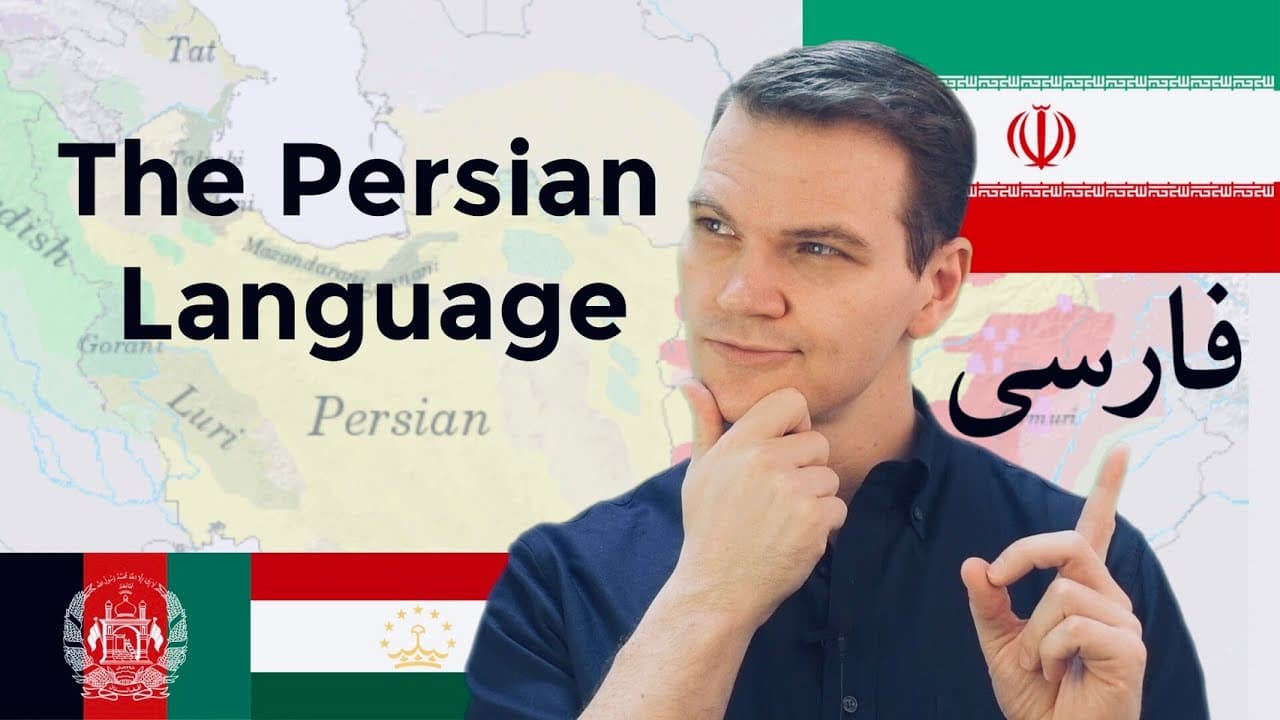
The Persian Language IN DEPTH
TL;DR
The video explores Persian language features, including script, grammar, and pronunciation.
Transcript
hello everyone welcome to the Laing focused Channel and my name is Paul today we're going to focus on the features of the Persian language around three years ago I made a video about Persian and that was actually the very first language profile video on this channel but that video focused mainly on the history of the language so I wanted to add ano... Read More
Key Insights
- Persian is a pluricentric language with three standard varieties: Iranian Persian, Dari, and Tajik, each with unique dialects.
- The Persian script is a modified Arabic script, adding four characters to distinguish consonant sounds not present in Arabic.
- Persian is an Indo-European language, sharing cognate vocabulary with other Indo-European languages like French and Spanish.
- Arabic vocabulary significantly influences Persian, especially in literature, though its usage varies by formality and context.
- Persian grammar is relatively straightforward, with no grammatical gender and simple noun cases marked by prepositions or postpositions.
- Persian uses a subject-object-verb (SOV) word order, with verbs typically appearing at the end of sentences.
- Compound verbs are prevalent in Persian, formed by combining a noun or adjective with a simple verb like 'to have' or 'to become.'
- The Persian language distinguishes between formal written language and colloquial spoken language, which can pose challenges for learners.
Install to Summarize YouTube Videos and Get Transcripts
Explore YouTube Video Summarizer or Get YouTube Transcript Extractor
Questions & Answers
Q: What are the standard varieties of Persian language?
Persian is a pluricentric language with three standard varieties: Iranian Persian, Dari, and Tajik. Each variety is spoken in different regions, with Iranian Persian prevalent in Iran, Dari in Afghanistan, and Tajik in Tajikistan. These varieties have unique dialects and are sometimes referred to collectively as Farsi.
Q: How does the Persian script differ from Arabic?
The Persian script is a modified form of the Arabic script. It includes 28 characters from Arabic but adds four additional characters to represent consonant sounds not found in Arabic. This makes Persian an abjad, where short vowels are typically not indicated in writing, posing a challenge for learners unfamiliar with the script.
Q: What is the influence of Arabic on Persian vocabulary?
Arabic has significantly influenced Persian vocabulary, particularly in literature and formal contexts. Many Arabic words have been adopted into Persian, with some having native Persian equivalents. The extent of Arabic vocabulary usage varies with the formality and style of speech or writing, with more Arabic terms appearing in formal contexts.
Q: What are some key features of Persian grammar?
Persian grammar is relatively straightforward, lacking grammatical gender and definite articles. Noun cases are simple, marked by prepositions or postpositions. The language uses a subject-object-verb (SOV) word order, and adjectives follow nouns, connected by a particle. These features make Persian grammar accessible to learners.
Q: How does Persian handle verb conjugation?
Persian verbs have two stems: past and present. Regular patterns guide most verb conjugations, though present tense stems often need memorization. Verbs are conjugated with personal endings indicating subject person and number. Compound tenses exist, but basic tenses like present, past, and future are straightforward for learners.
Q: What challenges do learners face with Persian language?
One challenge for Persian learners is the difference between formal written language and colloquial spoken language. The written language has remained relatively unchanged for centuries, while the spoken language has evolved. Learners must navigate these differences, but the regularity and logical structure of Persian grammar aid comprehension.
Q: What is the typical word order in Persian sentences?
Persian typically uses a subject-object-verb (SOV) word order, with the verb appearing at the end of sentences. This structure is consistent across different sentence types, though subject pronouns can often be omitted due to verb conjugation indicating the subject's person and number. Adverbs can be flexibly placed but usually precede the verb.
Q: How are compound verbs formed in Persian?
Compound verbs in Persian are formed by combining a simple verb, such as 'to have' or 'to become,' with a noun or adjective. These compound verbs account for most verbs in Persian, with only around a hundred simple verbs used regularly. This structure is a distinctive feature of Persian, contributing to its unique verb conjugation system.
Summary & Key Takeaways
-
The video provides an in-depth analysis of the Persian language, focusing on its features such as script, grammar, and pronunciation. It highlights the language's pluricentric nature, with standard varieties in Iran, Afghanistan, and Tajikistan, and discusses the influence of Arabic vocabulary.
-
Persian script, derived from Arabic, includes additional characters for unique consonant sounds. The language's Indo-European roots are evident in its vocabulary, sharing cognates with languages like French and Spanish. Grammar is straightforward, with simple noun cases and no grammatical gender.
-
Persian employs a subject-object-verb word order, with verbs typically at the end. Compound verbs are common, combining nouns or adjectives with simple verbs. The distinction between formal written and colloquial spoken Persian can challenge learners, but the language's regular patterns aid comprehension.
Read in Other Languages (beta)
Share This Summary 📚
Summarize YouTube Videos and Get Video Transcripts with 1-Click
Try YouTube Summary with ChatGPT & Claude or YouTube Transcript Generator
Explore More Summaries from Langfocus 📚



Summarize YouTube Videos and Get Video Transcripts with 1-Click
Try YouTube Summary with ChatGPT & Claude or YouTube Transcript Generator