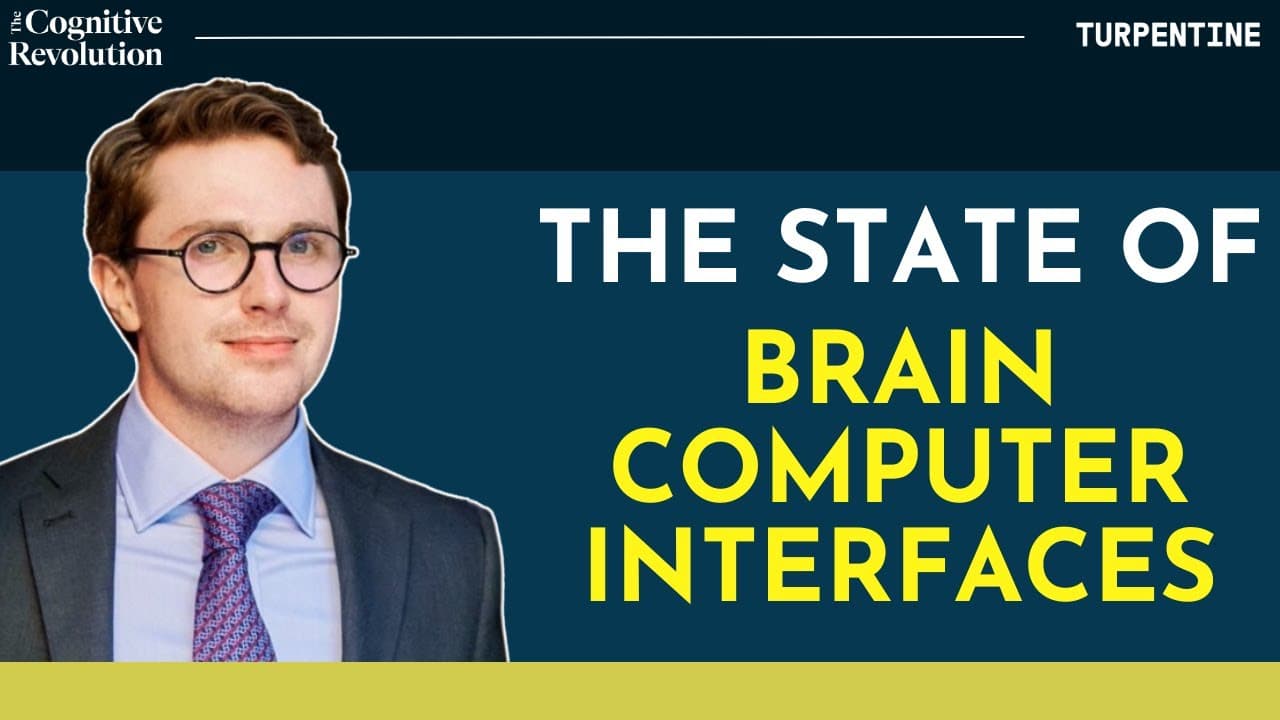
Merging Man and Machine? The Neurotech Frontier with Dean W. Ball
TL;DR
Dean Ball discusses brain-computer interfaces and their societal impact.
Transcript
computers already are neural interfaces you don't control them directly with your brain but they obviously interface with your brain and you are using your brain via touch control to manipulate them throughout the history of Technology one of the things we see is that information Technologies don't just change the way information propagates they ch... Read More
Key Insights
- Brain-computer interfaces have evolved from non-invasive EEG devices to invasive Neuralink implants, offering varying degrees of precision and application.
- Non-invasive technologies like EEG and ultrasound stimulation can predict seizures and enhance cognitive functions like focus and mood regulation.
- Neuralink's invasive approach offers high-density electrode implantation, allowing precise brain activity monitoring and control, demonstrated by a quadriplegic using a computer via brain signals.
- The skull presents a significant barrier to both reading and writing brain signals, but advances in technology are beginning to overcome these challenges.
- Transcranial focused ultrasound shows promise in stimulating brain regions non-invasively, potentially enhancing sensory discrimination and mood.
- The potential for brain-computer interfaces to change societal norms and ethical considerations is significant, raising questions about privacy and cognitive enhancement.
- The development of shared latent spaces for brain signals could allow for more generalized applications across different individuals, similar to advancements in AI models.
- The future of neurotechnology may include consumer devices capable of interpreting and influencing brain states, with applications ranging from medical diagnostics to cognitive enhancements.
Install to Summarize YouTube Videos and Get Transcripts
Explore YouTube Video Summarizer or Get YouTube Transcript Extractor
Questions & Answers
Q: What are the main technologies discussed in the podcast for brain-computer interfaces?
The podcast discusses several technologies for brain-computer interfaces, including non-invasive methods like EEG (Electroencephalography) and transcranial focused ultrasound, as well as invasive methods like Neuralink's high-density electrode implants. EEG devices measure electrical activity on the scalp, while ultrasound can stimulate brain regions non-invasively. Neuralink implants electrodes directly into the brain for precise monitoring and control.
Q: How do non-invasive brain-computer interfaces like EEG work?
Non-invasive brain-computer interfaces like EEG work by placing electrodes on the scalp to measure electrical activity. These devices capture the brain's electrical signals, which are then processed to interpret brain states such as focus, relaxation, or cognitive decline. EEG devices are used in both consumer and medical applications, offering insights into brain function without the need for surgical procedures.
Q: What is the potential impact of Neuralink's invasive technology?
Neuralink's invasive technology, which involves implanting high-density electrodes into the brain, has the potential to revolutionize how we interact with computers and machines. By providing precise monitoring and control of brain activity, it could enable individuals with disabilities to use computers and robotic devices through thought alone. This technology also raises significant ethical and privacy concerns, as it involves direct access to brain signals.
Q: What are the challenges associated with brain-computer interfaces?
Challenges associated with brain-computer interfaces include the difficulty of accurately reading and writing brain signals due to the skull's barrier, the need for extensive data to train models, and the ethical implications of manipulating brain states. Non-invasive methods face issues with signal noise and resolution, while invasive methods involve surgical risks and privacy concerns. Overcoming these challenges requires advances in technology and careful consideration of societal impacts.
Q: How might brain-computer interfaces change societal norms?
Brain-computer interfaces could significantly alter societal norms by enabling cognitive enhancements and new forms of communication. They might lead to increased cognitive inequality, privacy concerns, and ethical dilemmas regarding consent and manipulation of mental states. As these technologies become more widespread, society will need to address these issues to ensure equitable and ethical use, potentially creating new norms around technology adoption and cognitive enhancement.
Q: What are the ethical considerations of brain-computer interfaces?
Ethical considerations of brain-computer interfaces include privacy concerns, as these technologies have the potential to access and manipulate brain signals. There are also questions about consent, especially in medical applications, and the potential for cognitive inequality if enhancements are not accessible to all. Ensuring that these technologies are used ethically and equitably will be crucial as they become more integrated into society.
Q: What role does data play in the development of brain-computer interfaces?
Data plays a crucial role in the development of brain-computer interfaces, as large datasets are needed to train models that can accurately interpret and influence brain states. The collection and analysis of brain data are essential for improving the precision and utility of these technologies. However, the availability and quality of data remain challenges, particularly for non-invasive methods that rely on noisy signals.
Q: What future developments are anticipated for brain-computer interfaces?
Future developments for brain-computer interfaces may include more advanced consumer devices capable of interpreting and influencing brain states with greater precision. These advancements could lead to applications in cognitive enhancement, medical diagnostics, and new forms of human-computer interaction. The trajectory of these technologies suggests a convergence of neuroscience and AI, potentially transforming how we understand and interact with our own cognition.
Summary & Key Takeaways
-
Dean W. Ball explores the current state and future possibilities of brain-computer interfaces, highlighting the technologies that enable brain signal reading and writing, from non-invasive EEG to invasive Neuralink implants. The discussion covers the technical challenges, ethical considerations, and societal impacts of these advancements in neurotechnology.
-
The podcast delves into the concept of merging human cognition with machine capabilities, discussing the potential for brain-computer interfaces to enhance cognitive functions, predict medical conditions, and alter mood and focus. Dean Ball emphasizes the importance of understanding the technical and ethical implications of these technologies.
-
Dean Ball provides insights into the technical advancements and challenges in brain-computer interfaces, focusing on the potential for non-invasive technologies to revolutionize cognitive enhancement and medical diagnostics. The conversation addresses the broader societal implications of these technologies, including privacy concerns and the potential for cognitive inequality.
Read in Other Languages (beta)
Share This Summary 📚
Summarize YouTube Videos and Get Video Transcripts with 1-Click
Try YouTube Summary with ChatGPT & Claude or YouTube Transcript Generator
Explore More Summaries from Cognitive Revolution "How AI Changes Everything" 📚






Summarize YouTube Videos and Get Video Transcripts with 1-Click
Try YouTube Summary with ChatGPT & Claude or YouTube Transcript Generator