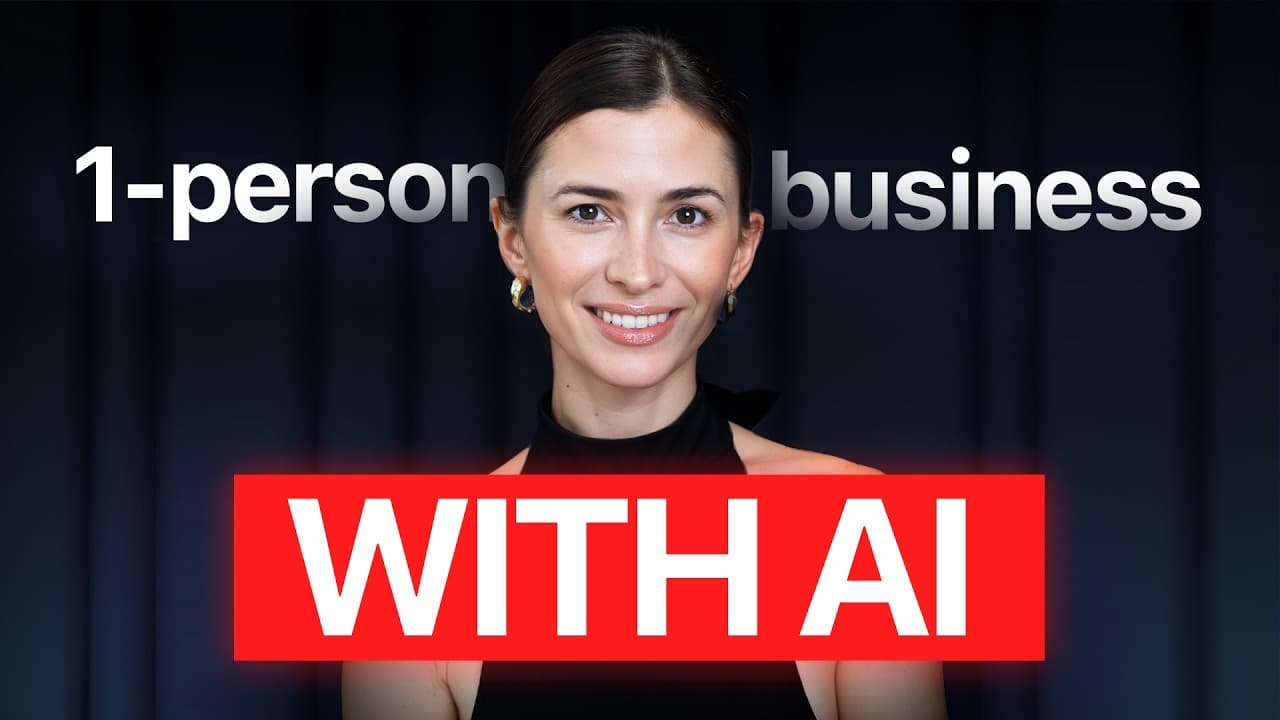
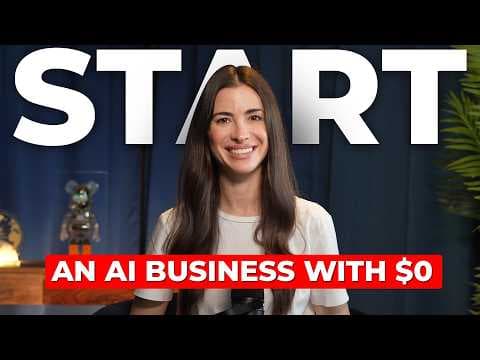
How to Build a Million-Dollar Business With AI
TL;DR
Start by identifying a valuable result you have already produced for a specific type of person, then document the repeatable steps behind it. Use AI as a managed collaborator for building, research, critique, marketing, and content repurposing, but provide precise instructions and retain responsibility for strategy, creative judgment, and quality control.
Transcript
I talked to a lot of entrepreneurs and people who are building AI tools and I asked them one question. Can a solo founder build a hund00 million company and the answer surprised me a lot. The thing is in 2025 AI becomes your co-founder and we already see companies who make millions of dollars every month and they are built by one person but one per... Read More
Key Insights
- AI gives solo founders leverage by expanding what one person can build, manage, and market. The transcript argues that small teams can move quickly and preserve conceptual integrity because fewer people need to align whenever the company changes direction.
- Founder opportunity fit is the overlap between a real market need and work the founder naturally enjoys and understands. A strong opportunity is often rooted in a result the founder has already produced through direct, hands-on experience.
- A practical idea-finding exercise is to take a quiet half-hour walk with pen and paper. The founder should identify whom they helped, what special action they took, what valuable outcome followed, and which steps made that outcome possible.
- Prompting is similar to programming because both require precision, even when AI removes the need to understand syntax. Clear descriptions of the goal, operating context, observed error, and expected behavior help an AI agent diagnose and execute more effectively.
- AI agents require active management because they can be powerful yet easily distracted. A founder acts like a software development manager by defining tasks carefully, reviewing logs and errors, supplying relevant context, and checking whether the resulting work meets the intended objective.
- AI collaboration works best when human thinking remains central. Mike Krieger describes writing his own first draft because writing supports thinking, then asking Claude to identify missing arguments and challenge the document before it is shared with another person.
- Visual AI workspaces can combine videos, transcripts, notes, drafts, references, and competitor examples. Poppy AI is presented as a way to turn those materials into scripts, newsletters, social quotes, and new topics while reducing repetitive creative work.
- A founder's main advantage is clarity rather than capital, headcount, or familiarity with a particular tool. Deep knowledge of a niche, a precise understanding of customer needs, and the ability to communicate requirements allow AI to multiply the founder's existing judgment.
Install to Summarize YouTube Videos and Get Transcripts
Explore YouTube Video Summarizer or Get YouTube Transcript Extractor
Questions & Answers
Q: How can one person build a million-dollar business with AI?
One person can build an AI-powered business by choosing a problem they understand deeply, converting their experience into a repeatable solution, and using AI tools to extend their capacity. AI can assist with product building, debugging, research, writing, marketing, and content repurposing. The founder must still set direction, communicate precise requirements, review outputs, and decide what actually creates value.
Q: How do solo founders find a strong startup idea?
A solo founder can start by recalling the last time they created a remarkable result for a particular type of person. They should document what they did, who received the benefit, what outcome occurred, why it was valuable, and the steps behind it. The most suitable idea is often an experience-based solution the founder enjoyed delivering and can scale to more people.
Q: What is founder opportunity fit?
Founder opportunity fit is the overlap between something the world needs and something the founder naturally enjoys doing. The transcript recommends looking for work grounded in lived, hands-on experience, especially a process that already produced a valuable result. This fit gives the founder intuitive knowledge, makes decisions clearer, and reduces the temptation to build solely around a passing trend.
Q: Why is precise prompting important when building with AI?
Precise prompting matters because an AI agent needs enough context to understand both the desired outcome and the problem preventing it. Instead of reporting only that deployment failed, the founder should provide the error, explain that it appears during deployment but not in preview, and describe the expected behavior. Prompting removes syntax requirements, but it does not remove the need for exact communication.
Q: How should a founder manage an AI coding agent?
A founder should treat an AI coding agent like a capable but easily distracted intern. The founder must define the task, add relevant context, inspect errors and logs, explain where the behavior differs from expectations, and review the proposed solution. Although the agent can build layouts and address technical issues, the founder still performs the managerial work of guiding, correcting, and validating it.
Q: How can AI help repurpose content across platforms?
AI can combine source materials such as videos, interview transcripts, notes, drafts, favorite references, and competitor examples, then transform them into platform-specific assets. The transcript describes generating scripts, newsletters, Instagram quotes, and new topic ideas from connected materials. This reduces repetitive production work and gives the creator more time to consider strategy, creative direction, and higher-return opportunities.
Q: Should AI write the first draft of important content?
AI does not have to write the first draft. Mike Krieger describes drafting substantive writing himself because the act of writing is also a way of thinking and expressing his ideas. Before sharing the document with another person, he asks Claude to challenge it and identify missing points. This preserves the human viewpoint while using AI as a critical collaborator.
Q: Why can a small AI-powered team move faster?
A small team can move faster because fewer people need to understand and approve a change in direction. The transcript calls this preservation of conceptual integrity, meaning the essential ideas behind the company remain concentrated in one or two minds. AI then expands what that small group can accomplish, allowing it to perform more work without immediately adding employees or organizational coordination.
Summary & Key Takeaways
-
A solo founder can use AI to perform work that once required a larger organization, while retaining speed and conceptual integrity. The central advantage is not access to particular tools, but clarity about the problem, the customer, the desired result, and the exact instructions needed to produce reliable work.
-
A promising business idea often comes from a valuable result the founder has already achieved for someone else. By reflecting on who benefited, what outcome occurred, why it mattered, and which steps produced it, a founder can identify an opportunity grounded in practical experience rather than simply chasing trends.
-
AI tools can support product development, debugging, writing, research, marketing, and content repurposing. Effective use still requires management: founders must supply context, describe errors precisely, challenge outputs, and preserve human thinking where it matters. AI multiplies well-directed expertise, but it does not remove the need for judgment.
Read in Other Languages (beta)
Share This Summary 📚
Summarize YouTube Videos and Get Video Transcripts with 1-Click
Try YouTube Summary with ChatGPT & Claude or YouTube Transcript Generator
Explore More Summaries from Silicon Valley Girl 📚


Summarize YouTube Videos and Get Video Transcripts with 1-Click
Try YouTube Summary with ChatGPT & Claude or YouTube Transcript Generator