How to Prepare for AI Job Disruption by 2027
TL;DR
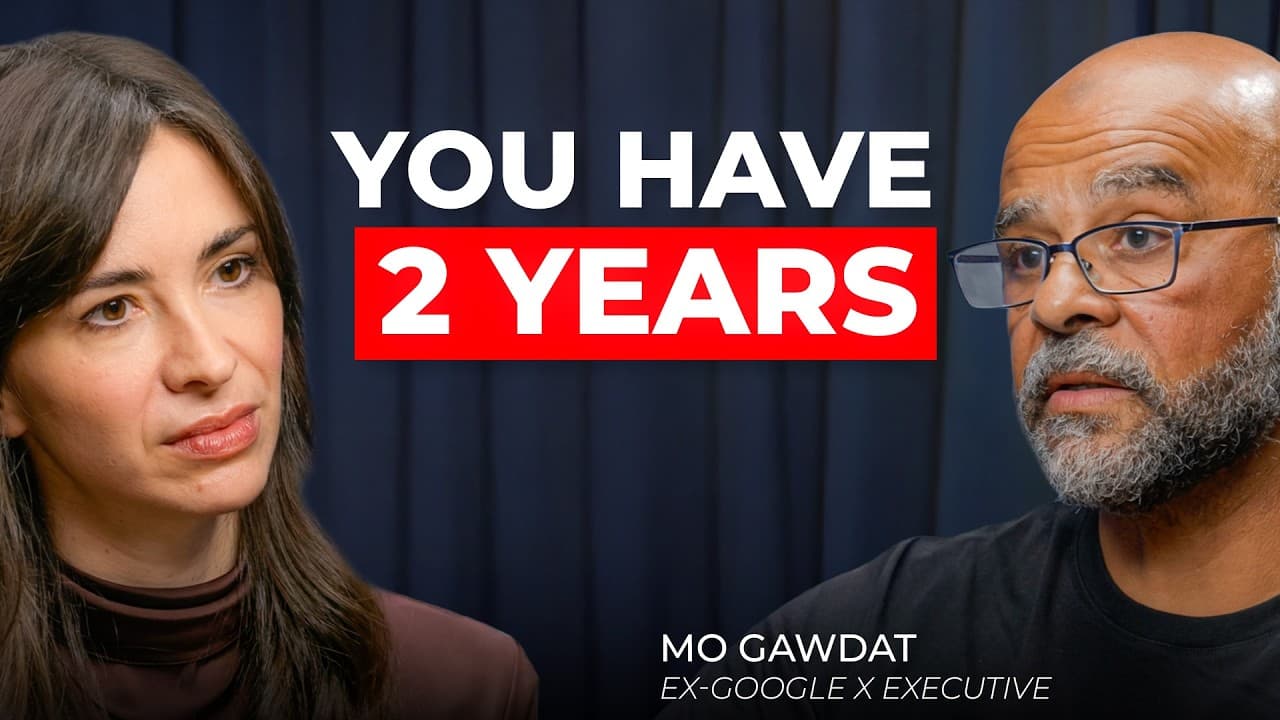
Prepare for AI-driven job disruption by learning to use AI, building adaptable human skills, and planning for rapid changes in employment and entrepreneurship. Mo Gawdat predicts that monotonous and intelligence-based tasks will increasingly move to machines, while concentrated power, synthetic media, weak accountability, and economic instability could make the transition especially difficult.
Transcript
My AI startup took me 6 weeks to build. If I had started in 2022, it would have taken me 4 years. And then when you really think about that, that basically means everyone now has a chance. This is Mo, former Chief Business Officer at Google X, where he spent over a decade running business innovations. He says everyone now has a chance, but only if ... Read More
Key Insights
- AI is dramatically reducing the time required to build companies. Gawdat says his startup took six weeks to create, while he estimates that starting the same project in 2022 would have required four years, giving many more people an opportunity to become entrepreneurs.
- Entrepreneurship is becoming a fast-response discipline rather than a long-range prediction contest. Gawdat compares the old environment to chess and the emerging environment to squash because rapid AI development makes distant forecasts less reliable and rewards constant adaptation to immediate changes.
- Gawdat predicts a massive job-market shift within the next 2–3 years. He argues that every job AI performs better than humans will eventually move to machines, with monotonous roles such as call center work, clerical work, research, accounting, and assistance facing clear pressure.
- AI is becoming a producer of further innovation. Gawdat says AIs are already building other AIs, contributing to scientific discovery, reinventing mathematics, and advancing understanding of biology and material science, making technological innovation increasingly driven by machines rather than humans.
- Automation is likely to force a redefinition of capitalism and income. Gawdat argues that an economy requiring less labor will need new approaches to jobs, earnings, money, and demand, while universal basic income could become a source of conflict between displaced people and taxed platform owners.
- AI power is likely to become highly concentrated. Gawdat connects economic influence with historical productivity, arguing that people controlling powerful AI platforms could receive extraordinary wealth and authority because their systems will affect the world and help redefine humanity's future.
- Synthetic media is weakening confidence in reality and human connection. AI can already generate feeds, films, photographs, voices, videos, influencers, and intimate interactions that may be difficult to distinguish from human-created experiences, creating opportunities for manipulation and machine-mediated relationships.
- Accountability is the central issue behind AI disruption. Gawdat warns that influential figures can pursue personally chosen futures and deploy AI for surveillance, autonomous weapons, automated trading, and other applications without meaningful public consent or clear responsibility for the resulting harm.
Install to Summarize YouTube Videos and Get Transcripts
Explore YouTube Video Summarizer or Get YouTube Transcript Extractor
Questions & Answers
Q: How should people prepare for AI job disruption?
People should learn how to use AI and strengthen the skills needed to adapt as its capabilities change. Gawdat's first recommendation is to learn the skills, while his broader argument emphasizes rapid responsiveness rather than relying on distant forecasts. Workers should expect monotonous and intelligence-based tasks to migrate toward machines and prepare for a major job-market shift within the next 2–3 years.
Q: Which jobs does Mo Gawdat expect AI to replace first?
Gawdat expects monotonous jobs to face the clearest near-term pressure. He specifically names call center agents, clerks, researchers, accountants, and assistants as examples of roles whose work can be handled by AI. His broader claim is that whenever machines become better than humans at a task, organizations will eventually assign that task to the machines instead.
Q: Why does Mo Gawdat compare entrepreneurship to squash?
Gawdat compares modern entrepreneurship to squash because founders must react quickly to developments arriving at high speed. He contrasts this with chess, where entrepreneurs could previously foresee a distant opportunity and prepare several moves ahead. Rapid AI progress makes that forecasting model less dependable, so entrepreneurs increasingly need to respond continuously to changing tools, capabilities, markets, and opportunities.
Q: How does AI make it easier to build a startup?
AI can perform work that previously demanded much more time, labor, and specialized capability. Gawdat says his AI startup took only six weeks to build, whereas he estimates it would have taken four years if he had started in 2022. He presents this compression as evidence that many more people now have a realistic opportunity to create businesses and innovations.
Q: How could AI change capitalism and universal basic income?
Gawdat argues that capitalism has depended on labor and that reducing the need for human workers will force society to reconsider jobs, earnings, money, and economic demand. Universal basic income may initially support displaced workers, but he predicts tension because platform owners would fund it through taxes and could resist paying for people who are no longer economically productive.
Q: Why is accountability the central AI problem?
Accountability matters because individuals and organizations can influence millions of people or deploy consequential technology without being clearly responsible for the outcome. Gawdat points to advice from influencers and decisions by political or technology leaders as examples. He warns that AI expands this problem through surveillance, autonomous weapons, automated trading, and privately chosen futures that the public never approved.
Q: How can AI-generated media affect reality and relationships?
AI-generated media can make it difficult to determine whether online content or interactions come from real humans. Gawdat notes that feeds, films, photographs, voices, videos, social media influencers, and even intimate exchanges can be generated by machines. As people form emotional connections through digital communication, an apparently authentic relationship could be constructed entirely from synthetic content and automated responses.
Q: What timeline does Mo Gawdat give for major AI disruption?
Gawdat says the disruption has already started and predicts a massive shift in the job market within the next 2–3 years. He expects the difficult transition to last roughly 10–12 years, while the description characterizes his broader prediction as 12–15 years of disruption. He believes this turbulent period could eventually lead to an extraordinary, almost biblical-style utopia.
Summary & Key Takeaways
-
Mo Gawdat predicts that AI disruption will intensify and produce a massive shift in the job market within the next 2–3 years. As machines become better at tasks requiring intelligence, employers will transfer more work to AI, beginning with monotonous roles such as call center work, clerical work, research, accounting, and assistance.
-
AI can now accelerate entrepreneurship and innovation dramatically. Gawdat says his AI startup took six weeks to build, compared with an estimated four years if started in 2022. Because future developments are harder to predict, entrepreneurship is changing from a chess-like exercise in long-term forecasting into a faster, reactive game resembling squash.
-
The transition could reshape employment, capitalism, money, education, human connection, freedom, and power. Gawdat identifies accountability as the central problem because influential people and organizations can deploy AI for surveillance, autonomous weapons, automated trading, synthetic relationships, and other purposes without society having agreed on the future they are creating.
Read in Other Languages (beta)
Share This Summary 📚
Summarize YouTube Videos and Get Video Transcripts with 1-Click
Try YouTube Summary with ChatGPT & Claude or YouTube Transcript Generator
Explore More Summaries from Silicon Valley Girl 📚


Summarize YouTube Videos and Get Video Transcripts with 1-Click
Try YouTube Summary with ChatGPT & Claude or YouTube Transcript Generator