How to Build a Self-Running AI Company in 5 Levels (16 Minutes, 75% Faster)
TL;DR
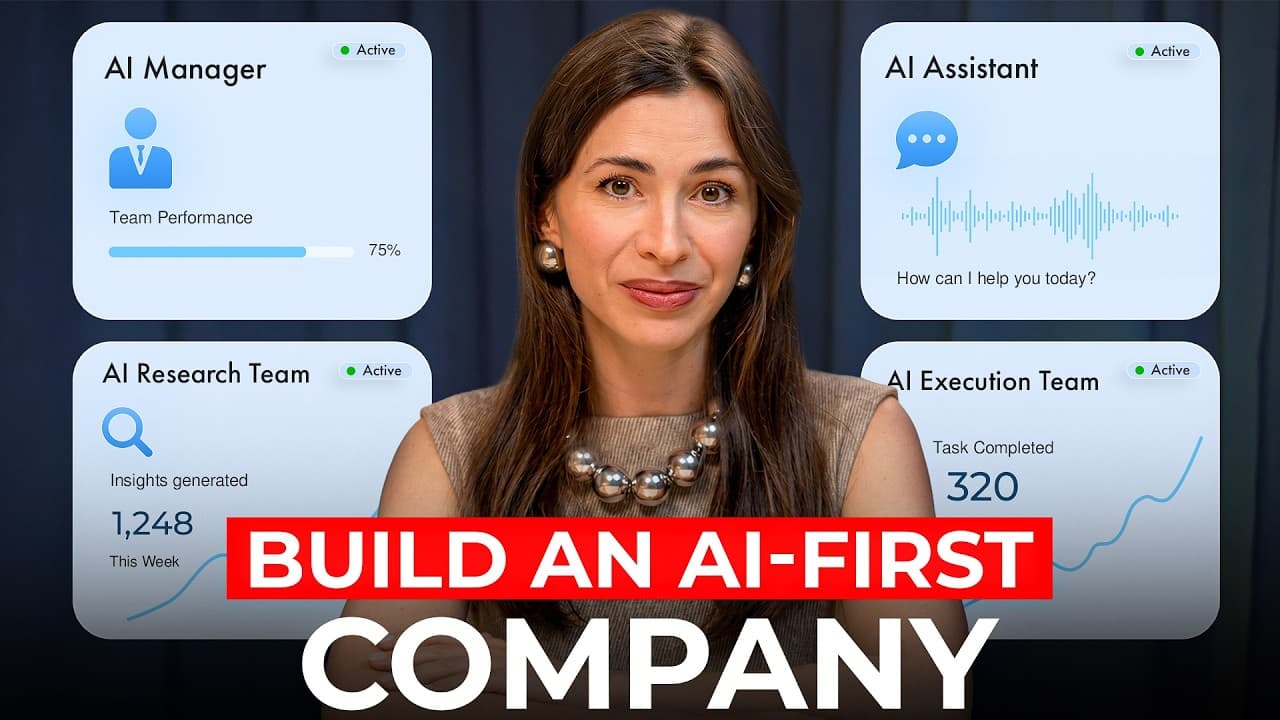
Build a self-running AI company by first organizing business knowledge in a cloud database, then adding AI instructions, scheduled agents, and custom dashboards. The system keeps content, transcripts, performance data, strategy, and tone of voice accessible across tools. One guest-producer agent reduced non-responder work from most of a week to 5%, showing why each level is worth exploring.
Transcript
In 5 years, the most valuable companies in the world will run on AI as a closed information loop. Meaning that all data is inside AI. All calls, emails, meetings, content performance because then AI acts faster on it and iterating and decision-m has just become much faster with AI. As a person who lives in Silicon Valley, interviews the best minds ... Read More
Key Insights
- A closed information loop is the model the most valuable companies will run on in five years, where all data lives inside AI: calls, emails, meetings, and content performance, so AI can act on it and decision-making moves faster.
- Level one is a queryable knowledge layer, and skipping it is what breaks every AI agent setup. Adding more agents on top of disorganized data only adds more chaos, so a structured data layer has to come first.
- Voice input beats typing for prompting because you give the computer 10 times more context than you would ever type. Ali Miller told the host that the best prompting is complaining to your AI about a problem instead of prompting a solution.
- A tool-independent database protects you from migration pain. If all decisions and content live inside one assistant, moving to another means losing that context, so the host's team stores everything in a database organized by social media channel.
- The database automatically pulls views, performance, transcripts, tone of voice, and branding per channel. It can be as simple as Google Drive or Google Sheets, as long as it is on the cloud and accessible from every device and agent.
- Strategy documents matter as much as day-to-day files. The host's team stores tone of voice, this year's business strategy, personal goals, a personal constitution of decisions to make or avoid, and an anti-AI file so content does not sound AI-written.
- Layered instruction files make first-try output more accurate. A master folder holds overall context like voice profile, audience, and business goals, while each subfolder holds task instructions the agent reads after the master file.
- Scheduled agents are prompts that run on a timer, connect to data you choose, and deliver structured output. The host's run Monday 9 a.m. for 10 trending video ideas, 10 a.m. for a 7-day AI and business news summary, and daily mention monitoring.
Install to Summarize YouTube Videos and Get Transcripts
Explore YouTube Video Summarizer or Get YouTube Transcript Extractor
Questions & Answers
Q: How do you build a self-running AI company in five levels?
Start with a queryable knowledge layer, then build AI on top of that organized data. The later levels add scheduled agents and custom vibe-coded tools, working toward production cycles that can run without a human in the middle.
Q: Why do AI agents need a structured data layer first?
Agents cannot work reliably when company information is scattered or disorganized. Adding agents before creating a queryable knowledge layer only adds more chaos, so the first level is a database containing content, performance, transcripts, tone of voice, branding, and strategy.
Q: How can a company avoid locking its data into one AI tool?
Store business information in a separate cloud database instead of keeping every decision and document inside one assistant. The database can be as simple as Google Drive or Google Sheets, allowing the company to connect its existing context whenever it switches AI tools.
Q: Why use voice instead of typing when prompting AI?
Speaking can provide AI with 10 times more context than typing, according to the video. Ali Miller recommends describing or complaining about the problem instead of immediately prompting a solution, and voice makes that detailed explanation easier.
Q: What business information should be stored for AI?
Store day-to-day content, views, performance data, transcripts, tone of voice, and branding for each social media channel. Also include the year's business strategy, personal goals, a personal constitution describing decisions to make or avoid, and an anti-AI file that helps content avoid sounding AI-written.
Q: How do layered instruction files improve AI production work?
Create a master folder containing shared context such as the voice profile, audience, and business goals. Then add subfolders for titles, thumbnails, scripting, distribution, and guest research, each with step-by-step instructions for that specific task.
Q: What are scheduled AI agents, and how are they used?
Scheduled agents are prompts that run on a timer, connect to selected data, and return structured output. Examples include an agent that generates 10 trending video ideas every Monday at 9 a.m., a 7-day AI and business news summary at 10 a.m., and daily mention monitoring.
Q: How did the guest-producer agent save 75% of a workweek?
Every Wednesday, the agent reviews declined guests, searches recent news for a fresh hook, scores candidates against eight criteria, and drafts outreach. It reduced the producer's time spent on non-responders from most of her week to 5%, giving her 75% of the week back.
Summary & Key Takeaways
-
The foundation is level one: get basics organized into a queryable knowledge layer. Switch from typing to voice input, using an app that handles multiple languages if needed, since talking gives the computer far more context. Capture audio during podcasts or conferences and process it later into posts. Then store all business data in a cloud database rather than inside any single AI tool.
-
Level two builds AI on top of the knowledge base so it stops needing re-explanation. The host's team is testing a desktop app that can open files, edit documents, and run scripts, unlike a browser project that can only respond. Producers keep folders for titles, thumbnails, scripting, distribution, and guest research, each with a step-by-step instructions file layered on master context.
-
Level three is scheduled agents, level four is vibe coding your own tools. A guest-producer agent runs every Wednesday, reads declined guests, searches recent news for a fresh hook, scores each on eight criteria, and drafts outreach, cutting her non-responder time from most of her week to 5%. A custom dashboard pulls social data, pushes Telegram alerts, and nudges editors when five shorts are missing.
Read in Other Languages (beta)
Share This Summary 📚
Summarize YouTube Videos and Get Video Transcripts with 1-Click
Try YouTube Summary with ChatGPT & Claude or YouTube Transcript Generator
Explore More Summaries from Silicon Valley Girl 📚






Summarize YouTube Videos and Get Video Transcripts with 1-Click
Try YouTube Summary with ChatGPT & Claude or YouTube Transcript Generator