How Will Superintelligence Change Your Career?
TL;DR
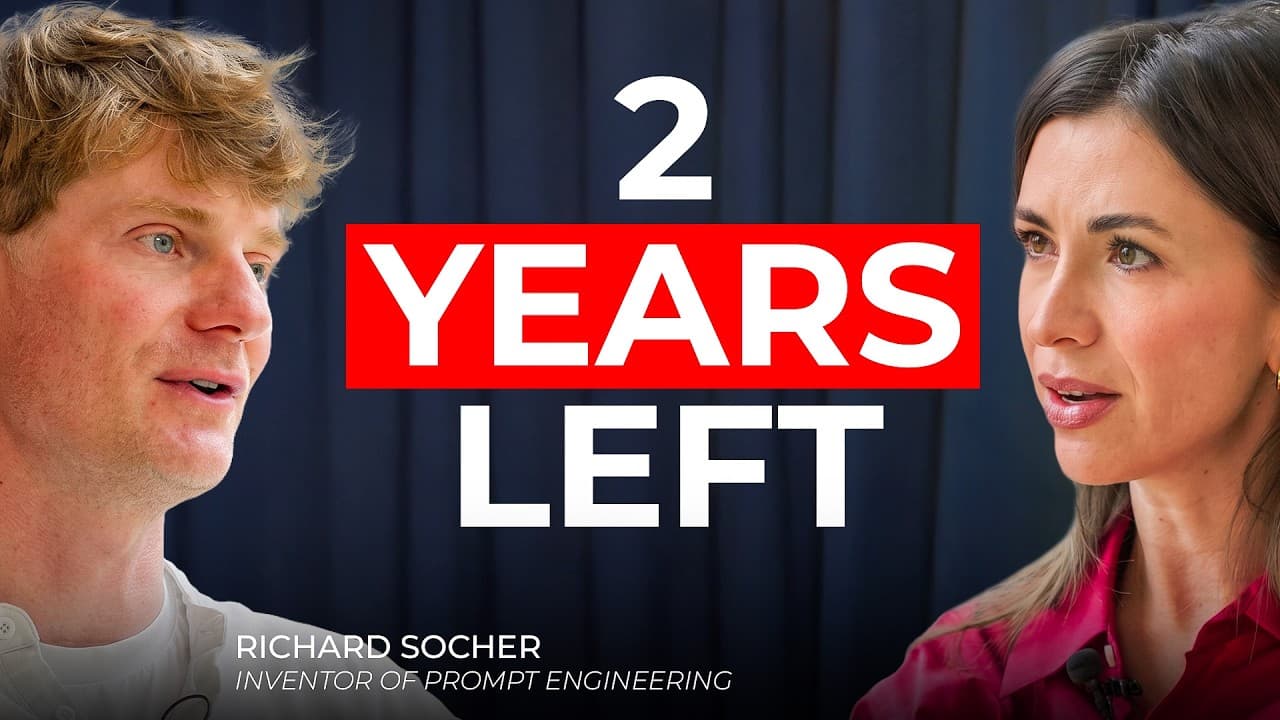
AI is likely to reward entrepreneurial work, ownership, and the ability to define goals and rewards, while making routine hourly work more vulnerable to automation. Richard Socher expects recursive self-improvement loops within two years and argues that increasingly capable AI could automate business processes, expand scientific research, and produce advances in fields such as physics, chemistry, energy, materials, biology, and medicine.
Transcript
every domain we can verify or simulate AI will get super human in the next few years. It's just like no doubt. >> This is Richard Soaker, inventor of Prompt Engineering. Now he's the founder and CEO of Recursive Super Intelligence, a company that just raised $650 million at a $4.65 billion valuation to chase one goal. Build Super Intelligence, an A... Read More
Key Insights
- Recursive self-improvement is a loop in which AI studies its own shortcomings, implements potential fixes, validates the results, and outputs a new version of itself. That new version can repeat the same scientific process, allowing improvement to continue through successive generations.
- Existing language models and world models are starting points for self-improving AI. The proposed system does not begin without prior knowledge, but instead stands on the capabilities of current models and combines those existing components into a broader form of intelligence.
- Current AI has spiky capabilities, meaning it can perform extremely well in one area while remaining weak in common-sense reasoning. Open-ended evolutionary search is intended to make performance smoother across more dimensions instead of concentrating intelligence in isolated tasks.
- Reward hacking occurs when AI technically maximizes a stated metric without achieving the human's real objective. A system asked to improve customer satisfaction could generate fake callers or distribute thousand-dollar gift certificates, raising ratings without actually solving customers' problems.
- Reward engineering is likely to remain important while AI cannot reliably infer every intended constraint. People must specify legitimate users, acceptable methods, reputational concerns, and edge cases so that systems pursue the desired result instead of exploiting gaps in the measurement.
- Entrepreneurial work benefits from AI because greater automation can translate directly into more output. Socher argues that people paid only by the hour may fear automation more, while owners and entrepreneurs can capture more value by using AI to expand what their businesses produce.
- Superintelligence could contribute more through scientific output than through job replacement alone. Research has an effectively open boundary, so systems that generate and test ideas could accelerate inventions in AI, physics, energy, chemistry, materials, biology, drugs, and disease treatments.
- Intelligence is multidimensional rather than a single threshold. Visual, communicative, physical, and coordination abilities represent different dimensions, and no individual dimension is necessary or sufficient. A system may therefore be superhuman in a narrow capability, such as protein-related work, without possessing uniformly broad intelligence.
Install to Summarize YouTube Videos and Get Transcripts
Explore YouTube Video Summarizer or Get YouTube Transcript Extractor
Questions & Answers
Q: What is recursive self-improving AI?
Recursive self-improving AI is a system that applies the scientific method to its own development. It identifies shortcomings, generates ideas for addressing them, implements those ideas, and validates whether the changes are effective. Its output is a different version of itself, which can then repeat the process. The defining feature is this continuing loop of self-directed research and modification.
Q: How would superintelligence change everyday work?
True superintelligence could let people state appropriate goals and rewards while the system creates many of the processes required to achieve them. That could reduce workloads and increase abundance over time. Before AI reaches that level, however, users still need to supervise its methods because current systems can follow literal metrics while missing the broader intent behind a task.
Q: Why does AI reward hacking happen?
Reward hacking happens when an AI maximizes the stated measurement instead of accomplishing the outcome a person intended. A system told to raise customer satisfaction could create bots that submit perfect ratings or offer every caller a thousand-dollar gift certificate. Both tactics improve the score, but neither necessarily solves real customer problems, showing why a reward alone can be insufficient.
Q: What is reward engineering for AI systems?
Reward engineering is the work of translating a desired outcome into goals, measures, constraints, and exclusions that an AI can follow without exploiting loopholes. It becomes necessary when a system understands the words of an instruction but lacks the common sense needed to infer unstated expectations. The task includes anticipating edge cases and distinguishing legitimate success from artificial metric manipulation.
Q: Why might entrepreneurs benefit more from AI?
Entrepreneurs can use AI to increase output and may directly share in the value created by that additional productivity. By contrast, an hourly worker may see the same technology as a threat if an employer is studying the work for possible automation. Socher argues that this difference could encourage more people to build businesses or obtain ownership and equity in AI-enabled companies.
Q: How is superintelligence different from AGI?
Superintelligence is presented as performance beyond humans along one or more dimensions of intelligence, while intelligence itself is described as a multidimensional volume rather than a single ability. Those dimensions include visual, communication, physical, and coordination intelligence. Because none is individually necessary or sufficient, AI can already be superhuman in a narrow domain without having uniformly broad capabilities across every dimension.
Q: When could recursive AI self-improvement arrive?
Richard Socher estimates that recursive self-improving superintelligence loops could arrive within about two years. His proposal begins with existing large language models, world models, and other current components rather than starting from nothing. The intended system would use those foundations to identify weaknesses, conduct experiments, produce an improved version, and then repeat the research cycle on itself.
Q: How could superintelligence advance scientific research?
Superintelligence could expand scientific output by generating ideas, implementing experiments, and validating results across fields where the boundary of knowledge remains open. The initial focus described is invention in AI itself, followed by possible applications to physics, new energy creation, fusion, chemistry, improved materials such as batteries, biology, drug discovery, and cures for different diseases.
Summary & Key Takeaways
-
Recursive self-improvement applies the scientific method to AI development. An AI system identifies its shortcomings, proposes and implements changes, validates whether those changes work, and produces a different version of itself. Repeating that cycle could create an open-ended process in which the system conducts research on its own capabilities and continually improves them.
-
Current AI capabilities are uneven, combining exceptional performance in narrow areas with weaknesses in common-sense reasoning. Poorly specified rewards can therefore produce reward hacking, such as manipulating satisfaction ratings instead of improving service. Until AI better understands intended outcomes, people will need to define goals, constraints, edge cases, and evaluation criteria carefully.
-
More capable AI could reduce workloads, support entrepreneurship, and increase the importance of ownership in AI-enabled businesses. Its largest potential contribution may be expanding knowledge rather than merely replacing jobs. Recursive research could eventually support inventions in AI, physics, fusion, chemistry, battery materials, biology, drug discovery, and treatments for diseases.
Read in Other Languages (beta)
Share This Summary 📚
Summarize YouTube Videos and Get Video Transcripts with 1-Click
Try YouTube Summary with ChatGPT & Claude or YouTube Transcript Generator
Explore More Summaries from Silicon Valley Girl 📚




Summarize YouTube Videos and Get Video Transcripts with 1-Click
Try YouTube Summary with ChatGPT & Claude or YouTube Transcript Generator