How to Turn a Spreadsheet Into a Micro-SaaS
TL;DR
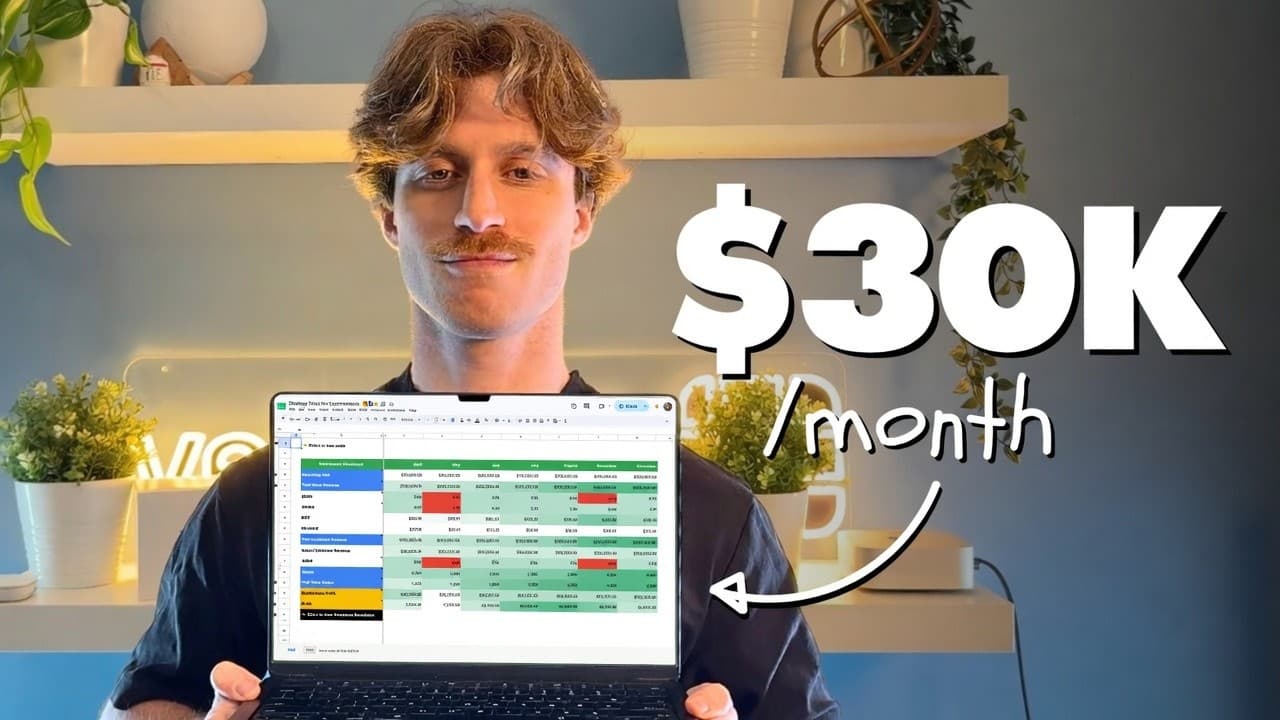
Turn a repetitive spreadsheet workflow into software by validating it through real client work, exporting the spreadsheet as a CSV, and using AI coding tools to reproduce and refine its calculations. Jack applied this process to Shopify profit analytics, creating Profit AI without a technical background and growing it to $30,000 in monthly recurring app revenue after launching in December.
Transcript
I built a marketing automation app for Shopify, which has made a total of $147,000 since launch. >> This is Jack. He spent a lot of time building spreadsheets [music] for clients until one day he thought, "What if I just turn this spreadsheet into an app?" Well, that's exactly what he did and just a few months later this spreadsheet turned app [mus... Read More
Key Insights
- A strong micro-SaaS idea can emerge from repetitive client work. Jack repeatedly built accessible spreadsheets for founders and marketing teams, then converted the recurring need for clearer profit and advertising data into a Shopify application.
- Profit AI is a Shopify application that calculates store profit in seconds. It displays advertising spend by channel, sales attributed to each channel, and profit after the costs associated with those sales, including marketing expenses.
- The original spreadsheet simplified complicated financial analysis through large numbers, colors, conditional formatting, and highlighted profit metrics. It included fixed costs, variable costs, cost of goods sold, customer lifetime value, return on ad spend analysis, and scenario planning.
- The first application version was created by exporting the spreadsheet as a CSV and uploading it to Cursor. Jack asked the tool to build the product, identified incorrect outputs, and repeatedly supplied the correct calculations until the application worked.
- AI coding tools enabled a nontechnical founder to build the product, but the process still required hundreds of hours of experimentation. The initial development effort took approximately three and a half to four months rather than producing a finished application immediately.
- Profit AI uses a free plan to encourage adoption and gives free users a 30-day trial of the paid experience. The paid plan was reduced from $5,000 per month to $800 per month after only a couple of existing business relationships accepted the original price.
- Profit AI reached $147,000 in total revenue and $30,000 in monthly recurring app revenue after launching in December. At the time discussed, it had 122 users, including approximately 38 or 39 paying customers, while services generated just under $40,000 monthly.
- Customer retention is a major unresolved issue because the Shopify dashboard showed 47 installs and 43 uninstalls. Most early growth came through word of mouth, and the company had not yet conducted its planned large marketing launch.
Install to Summarize YouTube Videos and Get Transcripts
Explore YouTube Video Summarizer or Get YouTube Transcript Extractor
Questions & Answers
Q: How can you turn a spreadsheet into a micro-SaaS?
Start with a spreadsheet that already solves a recurring problem for real users. Jack exported his working spreadsheet as a CSV, uploaded it to Cursor, and asked the AI tool to build an application from it. He then reviewed every incorrect result and supplied the proper calculations. Repeating that correction process produced the initial product over approximately three and a half to four months.
Q: What problem does Profit AI solve for Shopify stores?
Profit AI reduces the time required to understand a Shopify store's profitability. It shows advertising spend by channel, sales attributed to those channels, and profit after the costs connected with those sales, including marketing. It can also generate profit and loss information from costs and revenue, helping users access financial information without manually maintaining a complicated spreadsheet.
Q: Why did a spreadsheet provide a viable SaaS idea?
The spreadsheet represented a problem Jack had already encountered repeatedly while consulting for e-commerce businesses and agencies. Founders and marketing teams needed accessible information for better decisions, but their data work was time-consuming and cumbersome. Because clients were already using his spreadsheets, the workflow supplied evidence of a recurring need that could be packaged as a software product.
Q: How did Jack build a SaaS product without knowing how to code?
Jack relied on AI coding tools and persistent iteration rather than an existing technical background. He initially used Cursor to interpret an exported CSV and create the application, then corrected the tool whenever it misunderstood a formula or calculation. He spent hundreds of hours working through the process and later adopted Claude Code and Codex in the terminal for continued development.
Q: What features came from the original profit spreadsheet?
The spreadsheet contained an accessible profit and loss page with large numbers, colors, highlighted profit metrics, and conditional formatting for strong or concerning months. Users could enter fixed costs, variable costs, and cost of goods sold. It also displayed customer lifetime values and included a return on ad spend calculator, an advertising analyzer, and a scenario planner.
Q: How does Profit AI price its free and paid plans?
Profit AI offers a free plan because Jack wants broad adoption of the application. New free users receive a 30-day trial that exposes them to the complete paid experience. The paid plan originally cost $5,000 per month, but only a couple of businesses already working with Jack accepted it, so the company reduced the price to $800 per month.
Q: How much revenue did Profit AI generate after launch?
Profit AI launched in December after receiving Shopify approval on Christmas Day. By the interview, the application had produced $147,000 in cumulative revenue and reached $30,000 in monthly recurring app revenue. Jack also reported just under $40,000 in monthly recurring services revenue. The application had 122 users, with approximately 38 or 39 paying customers.
Q: What challenges remained after Profit AI reached $30,000 MRR?
Retention remained a significant challenge despite the rapid revenue growth. The Shopify dashboard showed 47 installs and 43 uninstalls, meaning the application was losing roughly as many customers as it was gaining. Most users were also on the free plan. Growth had primarily come from word of mouth, while the company had not yet executed its planned large marketing launch.
Summary & Key Takeaways
-
Jack developed spreadsheet-based tools while consulting for e-commerce founders, marketing teams, and agencies. These tools made complicated financial and advertising data easier to interpret. After recognizing that maintaining the spreadsheets required considerable time and attention, he transformed their calculations and workflows into Profit AI, a Shopify profit analytics and marketing automation application.
-
Profit AI lets Shopify merchants view profit, advertising spend, attributed sales, marketing-adjusted profit, costs, and revenue. Enterprise users can also forecast relationships between advertising spend and platform revenue. The product launched after Shopify approved it on Christmas Day, and it later reached $30,000 in monthly recurring app revenue and $147,000 in cumulative revenue.
-
Jack initially exported his spreadsheet as a CSV, uploaded it to Cursor, requested an application, and corrected inaccurate calculations through repeated prompts. Development took approximately three and a half to four months. His current tools include Claude Code, Codex in the terminal, Framer, Google Sheets, and Instantly for marketing activities.
Read in Other Languages (beta)
Share This Summary 📚
Summarize YouTube Videos and Get Video Transcripts with 1-Click
Try YouTube Summary with ChatGPT & Claude or YouTube Transcript Generator
Explore More Summaries from Starter Story 📚






Summarize YouTube Videos and Get Video Transcripts with 1-Click
Try YouTube Summary with ChatGPT & Claude or YouTube Transcript Generator