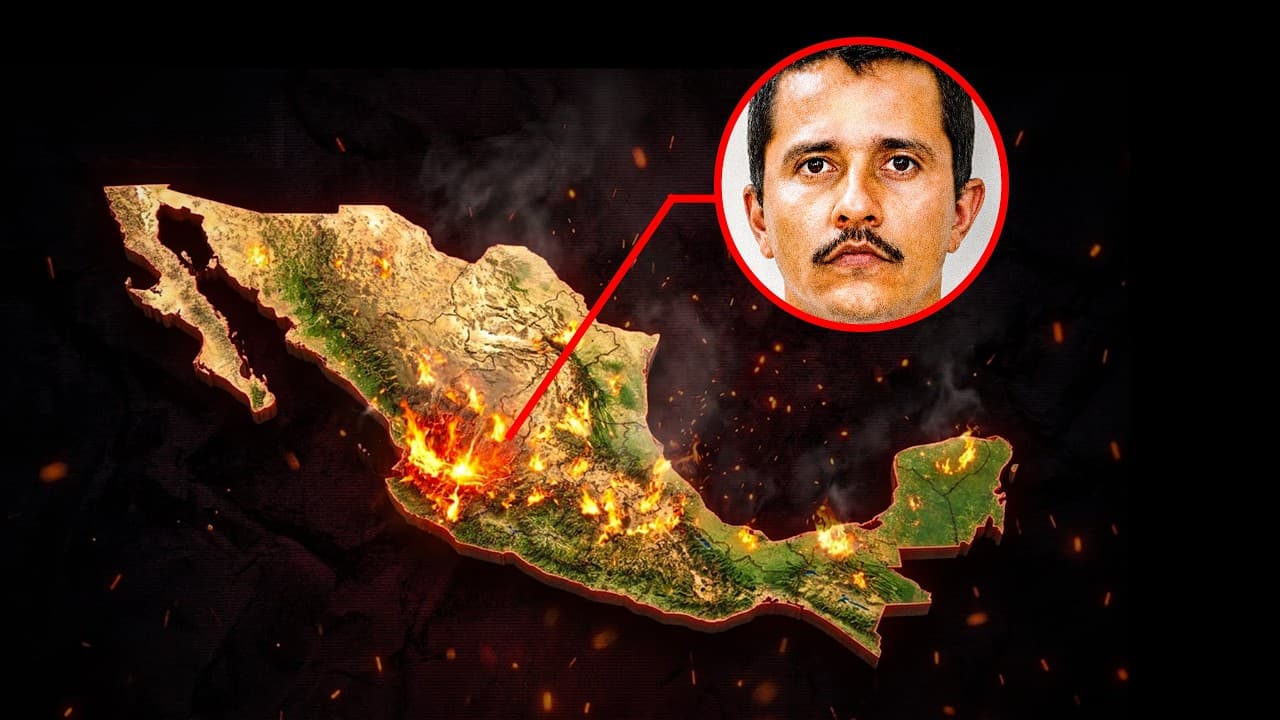
How did El Mencho build CJNG's global cartel power
TL;DR
El Mencho expanded CJNG by using a franchising model to absorb local groups, prioritizing meth production and distribution, and diversifying into other illegal activities. He pursued internationalization and money laundering to create a resilient, global criminal empire that could outpace rivals and adapt to changing markets.
Transcript
This drone is hovering over a compound in Kaliscoco, Mexico. Suddenly, its infrared camera captures a man. He hugs two children and then a woman in what looks like a long and intimate goodbye. The man's name is Nessia Rubin Oera Cantes, but he's better known by his street name, El Meno. He may be the world's most wanted drug lord. He's the leader o... Read More
Key Insights
- El Mencho runs CJNG as a franchise, absorbing local groups and channeling profits to the top.
- Meth is a cornerstone product for CJNG, enabling high profits and scale.
- Diversification spreads risk across multiple illegal sectors to weather losses in any single line of business.
- Internationalization extends CJNG’s footprint and creates cross-border money laundering networks.
- Strategic betrayals and alliances shift power dynamics, removing obstacles within rival factions.
- The CEO-centric model concentrates decision making at the top while local cells operate with branding independence.
- The Calderon era kingpin strategy inadvertently created openings CJNG exploited to rise to power.
- CJNG emphasizes rapid expansion and high productivity labs to dominate in the meth trade.
Install to Summarize YouTube Videos and Get Transcripts
Explore YouTube Video Summarizer or Get YouTube Transcript Extractor
Questions & Answers
Q: What is the core growth strategy that enabled CJNG to expand quickly?
CJNG expanded quickly by using a franchise-like model where the top leadership sets strategic directions and local cells operate under the brand, sending a share of profits to the center. This structure allows rapid territorial absorption, consistent branding, and scalable governance that can outpace slower, traditional cartel organizations.
Q: Why is meth a central part of CJNG's business plan?
Meth provides high profits with scalable production. El Mencho replicated efficient meth lab concepts from California, investing in large scale production that yields high purity product for the US market. This focus strengthens CJNG’s financial power and competitive positioning against rivals who depend more on other drugs.
Q: How does diversification help CJNG survive market shocks?
Diversification creates multiple income streams beyond drugs, including oil theft, extortion, avocado farming related activities, migrant smuggling, and other ventures. If one line declines, others can compensate, reducing exposure to enforcement, supply chain disruptions, or price shocks in any single market.
Q: What role does internationalization play in CJNG’s strategy?
Internationalization broadens CJNG’s customer base and enables cross border money flows. By selling to South America and Asia and building a money laundering network spanning multiple countries, the cartel can move profits more efficiently while reducing dependence on a single market or route.
Q: How did internal power dynamics affect CJNG’s rise?
Internal rivalries and perceived betrayals within the organization created opportunities for El Mencho to consolidate power. By navigating factions, aligning with or eliminating rivals, and leveraging loyalty networks, he positioned himself as the central decision maker and unified the cartel under his leadership.
Q: What impact did Calderon’s kingpin strategy have on CJNG?
Calderon’s push to capture or kill top bosses disrupted many organizations, creating power vacuums. CJNG capitalized on these gaps by expanding into newly unstable territories, absorbing weaker groups, and strengthening its own command structure to control strategic plazas and production hubs.
Q: What makes the CJNG organizational model resilient against law enforcement?
The combination of centralized leadership, autonomous local cells under a branded umbrella, diversified revenue streams, and a global network for money laundering makes CJNG harder to dismantle. Even if some cells are captured, the brand, profits, and governance framework sustain the broader operation.
Q: How does El Mencho’s background influence CJNG’s operations?
El Mencho’s experiences in Mexico and the United States, including time spent in California’s meth scene, shaped a preference for large scale production, cross border logistics, and a business like approach to expansion. This background informs CJNG’s emphasis on efficiency, scale, and international reach.
Summary & Key Takeaways
-
El Mencho engineered rapid CJNG growth by absorbing local cells into a franchise-like network, enabling fast expansion across multiple territories.
-
Meth production and trafficking became a core focus, increasing revenue and centralized control, modeled after high efficiency labs seen during his time in California.
-
Diversification into fuel theft, extortion, migrant smuggling, and other ventures broadened risk channels and resilience against disruptions.
-
Internationalization expanded CJNG reach beyond Mexico, targeting South America and Asia while building a global money laundering network.
-
CJNG leveraged strategic betrayals and alliances to topple rivals, consolidating leadership and eliminating centralized threats within the organization.
-
The leadership style placed the CEO at the top of strategic decisions, with local cells maintaining autonomy under branded control.
-
The kingpin strategy under Calderon era accelerated turf wars, creating opportunities for CJNG to rise through weakened rivals and seize power.
-
Ultimately CJNG’s growth hinged on business-like operations, aggressive expansion, and exploiting systemic weaknesses in state enforcement.
Read in Other Languages (beta)
Share This Summary 📚
Summarize YouTube Videos and Get Video Transcripts with 1-Click
Try YouTube Summary with ChatGPT & Claude or YouTube Transcript Generator
Explore More Summaries from fern 📚






Summarize YouTube Videos and Get Video Transcripts with 1-Click
Try YouTube Summary with ChatGPT & Claude or YouTube Transcript Generator