How to understand number systems and bases
TL;DR
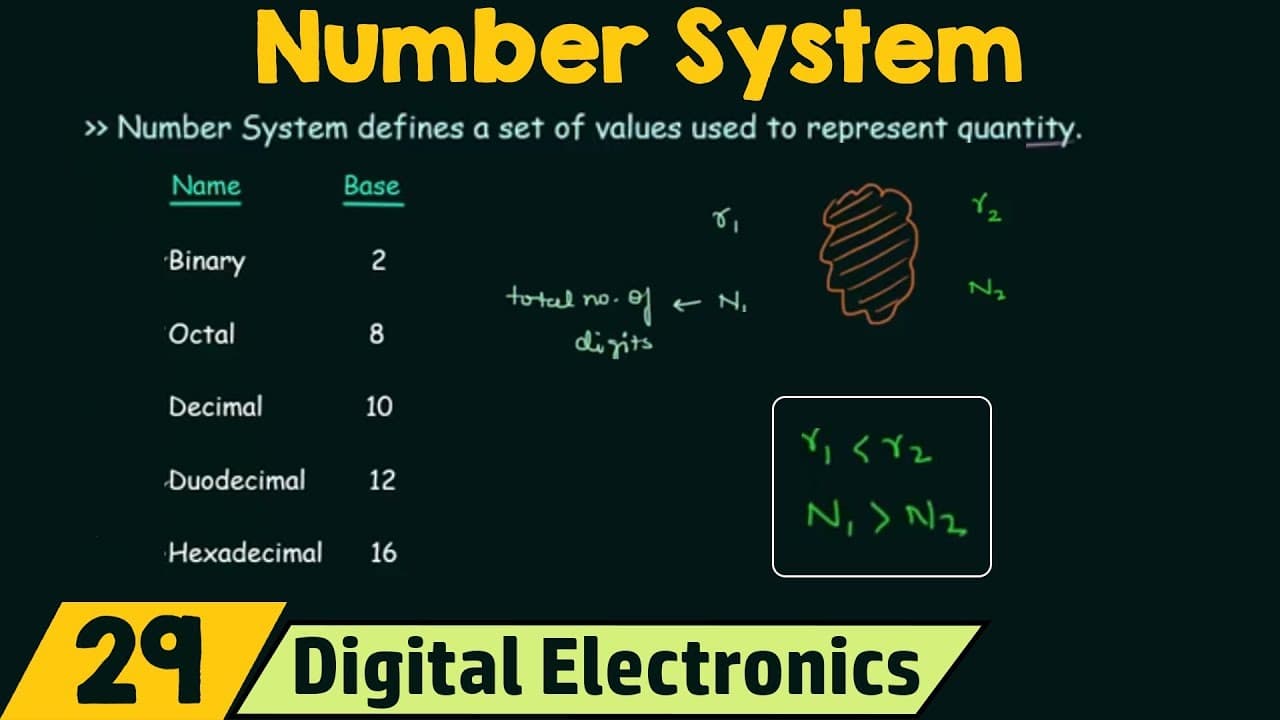
Bases define how many digits a system uses and how values are weighted. Decimal uses ten digits 0 through 9, binary uses two digits 0 and 1, octal uses eight digits 0 through 7, and hexadecimal uses sixteen digits 0-9 and A-F. Numbers are represented by weighted positions and their base determines digit count.
Transcript
from this lecture we will start number systems number system defines a set of values used to represent quantity let us consider any quantity and this quantity is represented by decimal number 7392 this is in decimal we can also represent the same quantity in any other number system like binary octal Duo decimal hex decimal the decimal number system... Read More
Key Insights
- Number systems are defined by a base, or radix, which determines the available digits and the weighting scheme.
- Decimal uses base 10 with digits 0 through 9, binary uses base 2 with digits 0 and 1, octal uses base 8 with digits 0 through 7, and hexadecimal uses base 16 with digits 0-9 and A-F.
- The base dictates how many digits exist and how many digits are required to represent a quantity, with higher bases generally yielding fewer digits.
- Digits range from 0 to base minus 1 in any base, and number representation relies on weighted positions such as powers of the base.
- Binary is weighted by powers of 2, decimal by powers of 10, and the concept generalizes to any base R.
- The term radix is another name for base, and it is denoted by R in the material.
- Weighted number systems assign a weight to each position, whereas unweighted systems do not rely on positional weights.
- The material contrasts weighted systems like decimal and binary with unweighted codes such as gray code and XS3 code.
Install to Summarize YouTube Videos and Get Transcripts
Explore YouTube Video Summarizer or Get YouTube Transcript Extractor
Questions & Answers
Q: A real search query about the video: How is a decimal number like 7392 represented in different bases?
A decimal number such as 7392 can be represented in other bases by expressing the quantity using powers of the target base. For binary, 7392 expands into a long sequence of bits, while in octal and hexadecimal the number of digits is reduced due to the larger base. The general rule is that higher bases require fewer digits to express the same quantity.
Q: What is a base (radix) in a number system and how is it denoted?
The base, or radix, of a number system is the number of distinct digits it uses and the base determines the weighting of each position. It is denoted by R, and the digits range from 0 to R-1. For decimal, R equals 10, so digits are 0 through 9; for binary, R equals 2, so digits are 0 and 1.
Q: Why does increasing the base reduce the number of digits needed to represent a quantity?
Increasing the base gives more digits per position, allowing larger values per place. Since each position can represent up to base minus one, a larger base packs more value into each digit, which reduces the total number of digits required to express the same quantity. This is demonstrated when comparing decimal, binary, octal, and hexadecimal representations of 7392.
Q: What are the digits used in binary, and how are they different from decimal digits?
Binary uses two digits, 0 and 1, to represent values, whereas decimal uses ten digits, 0 through 9. The binary digits are called bits and the base is 2, which limits the available symbols to 0 and 1. This fundamental difference leads to longer representations in binary for the same quantity compared to decimal.
Q: What is the significance of the term weighted number system?
A weighted number system assigns a weight to each position, typically a power of the base, so the value of a number is the sum of coefficients times the corresponding powers. Decimal shows weights of 10^0, 10^1, 10^2, and so on, whereas unweighted systems do not rely on positional weights.
Q: What examples are given of unweighted number systems in the material?
Unweighted number systems mentioned include gray code and XS3 code. These systems do not use the traditional positional weighting of digits based on powers of the base. They are contrasted with weighted systems like decimal and binary to illustrate different coding methods.
Q: How are digits defined for hexadecimal representation in the lecture?
In hexadecimal, the digits range from 0 to 15, where values 10 through 15 are represented by A through F. Thus the digits are 0-9 and A-F, giving a total of 16 distinct digits. The lecture notes emphasize writing 10 as A, 11 as B, up to 15 as F.
Q: What happens when comparing representation lengths across bases in the example with 7392?
When comparing the representation lengths of 7392 across bases, binary requires more digits than decimal because its base is smaller (2 versus 10). Octal reduces digits further than binary but still may have more digits than decimal, while hexadecimal can match decimal in some cases, reflecting how higher bases can lead to shorter representations.
Summary & Key Takeaways
-
A foundation of number systems is the base or radix which determines how many distinct digits exist and how numbers are formed. Decimal uses 10 digits, binary uses 2, octal uses 8, and hexadecimal uses 16. The base also dictates how many digits are needed to express a quantity.
-
The lecture distinguishes weighted and unweighted number systems, showing that decimal is weighted with powers of 10 while some codes like gray code are unweighted. It also demonstrates how a decimal number like 7392 is decomposed into powers of 10.
-
It is shown that increasing the base reduces the number of digits needed to represent a quantity, as illustrated by converting 7392 from decimal to binary, octal, and hexadecimal and comparing the digit counts across bases.
Read in Other Languages (beta)
Share This Summary 📚
Summarize YouTube Videos and Get Video Transcripts with 1-Click
Try YouTube Summary with ChatGPT & Claude or YouTube Transcript Generator
Explore More Summaries from Neso Academy 📚





Summarize YouTube Videos and Get Video Transcripts with 1-Click
Try YouTube Summary with ChatGPT & Claude or YouTube Transcript Generator