What Is Framing in Networking and Its Types?
TL;DR
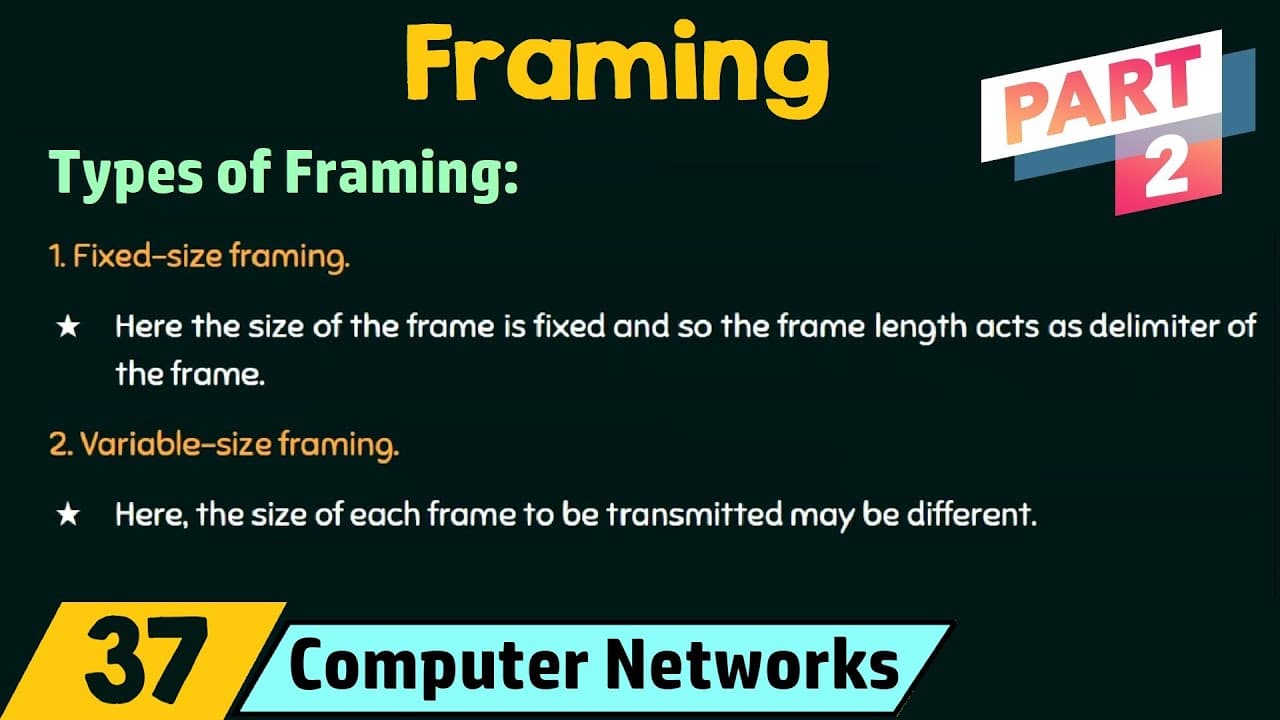
Framing in networking distinguishes between frames to facilitate data exchange between nodes. There are two primary types: fixed-size framing, which uses a consistent size as a delimiter, and variable-size framing, which necessitates additional markers for frame boundaries to ensure error-free transmission.
Transcript
in the previous lecture we had a very basic understanding about framing and in today's session we will formally see what is framing we will start the session with the outcomes in today's session we have three outcomes we will see what are they one by one upon the completion of the session the learner will be able to outcome number one understand th... Read More
Key Insights
- 🖼️ Framing in networking allows for the exchange of data between nodes by separating frames.
- 🖼️ Fixed-size framing uses a set frame size as a delimiter, while variable size framing requires additional mechanisms to mark frame boundaries.
Install to Summarize YouTube Videos and Get Transcripts
Explore YouTube Video Summarizer or Get YouTube Transcript Extractor
Questions & Answers
Q: What is the role of framing in the data link layer?
Framing in the data link layer separates frames, allowing for the exchange of data between nodes in a network. It ensures that frames are distinguishable from one another and adds a header and trailer to the network layer PDU.
Q: How do nodes transmit frames in a packet-switched network?
When a node wants to send data to another node in a packet-switched network, it tells its adapter to transmit a frame from its memory. The sequence of bits representing the frame is then sent over the link to the receiver's adapter.
Q: What is the difference between fixed-size framing and variable size framing?
In fixed-size framing, both the sender and receiver know the size of the frame, which acts as a delimiter. In variable size framing, the size of each frame may be different, requiring additional mechanisms to mark the start and end of frames.
Q: What are the two approaches to framing?
The two approaches to framing are the bit-oriented approach and the byte-oriented (or character-oriented) approach. The bit-oriented approach focuses on individual bits, while the byte-oriented approach considers groups of bits as characters.
Key Insights:
- Framing in networking allows for the exchange of data between nodes by separating frames.
- Fixed-size framing uses a set frame size as a delimiter, while variable size framing requires additional mechanisms to mark frame boundaries.
- Two approaches to framing are the bit-oriented approach and the byte-oriented (or character-oriented) approach.
Summary & Key Takeaways
-
Framing in the data link layer separates frames from one another, allowing for the exchange of data between nodes in a network.
-
Frames are created by the sender and received by the receiver, with the size of the frame acting as a delimiter in fixed-size framing.
-
Variable size framing requires additional mechanisms to mark the start and end of frames, ensuring correct construction without errors.
Read in Other Languages (beta)
Share This Summary 📚
Summarize YouTube Videos and Get Video Transcripts with 1-Click
Try YouTube Summary with ChatGPT & Claude or YouTube Transcript Generator
Explore More Summaries from Neso Academy 📚






Summarize YouTube Videos and Get Video Transcripts with 1-Click
Try YouTube Summary with ChatGPT & Claude or YouTube Transcript Generator