What Are the Eight Parts of Speech in English?
TL;DR
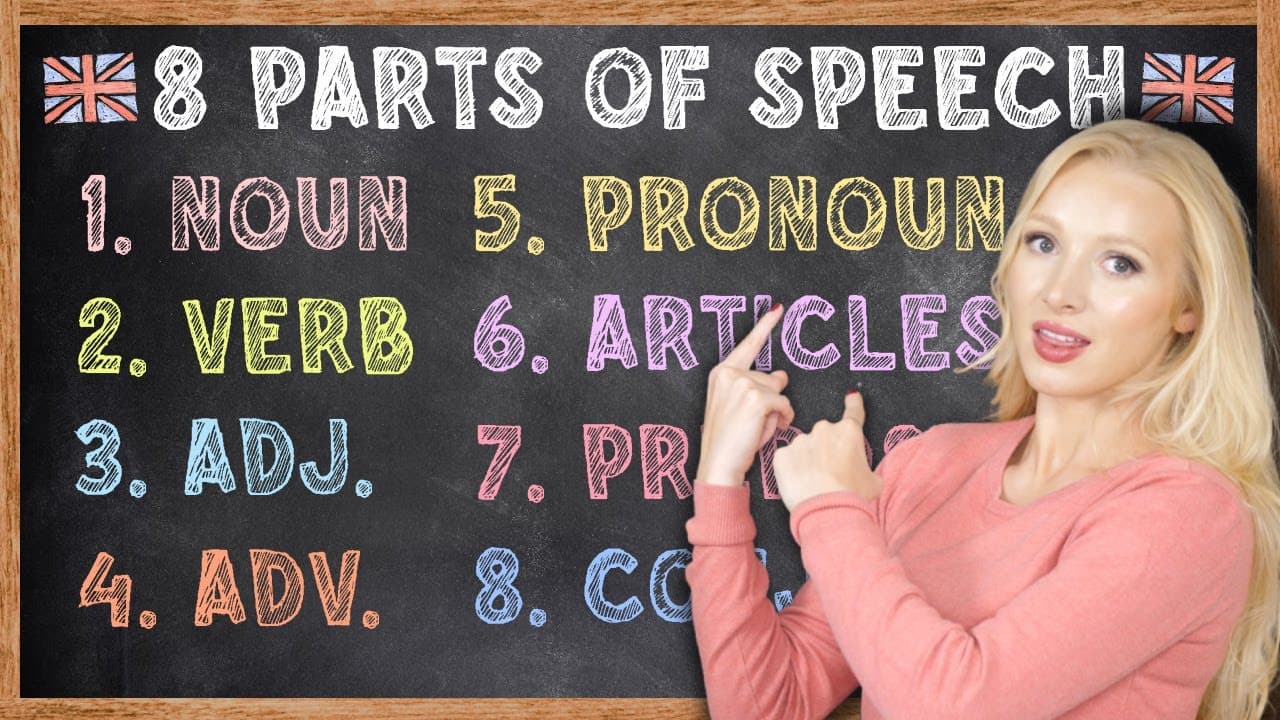
English words can be classified as nouns, pronouns, adjectives, verbs, adverbs, prepositions, conjunctions, or articles according to their roles in sentences. Understanding these categories helps you identify how words name things, replace nouns, add descriptions, express actions or states, show relationships, connect ideas, and distinguish between specific and general references.
Transcript
(upbeat music) - Hello everyone. And welcome back to English with Lucy. Today we are going back to basics. We are looking at the building blocks of spoken English. I'm going to be talking to you about the eight parts of speech. Every single word you say has a role within a sentence. Every single word is a part of speech. Today we're going to be bre... Read More
Key Insights
- A noun is a word that names a person, place, thing, activity, concept, process, or idea. Examples include girl, Spain, kitchen, love, rugby, shorts, and knowledge, and nouns can perform several grammatical roles within a sentence.
- A pronoun is used instead of a noun or noun phrase when the listener or reader already understands the reference. Replacing repeated names with forms such as he or she makes speech less repetitive and more natural.
- An adjective is a word that describes a noun and may appear directly before it or later in the sentence. English speakers naturally order multiple adjectives by opinion, size, physical quality, shape, age, colour, origin, material, type, and purpose.
- A verb is a word that describes an action, feeling, or state. Dynamic verbs express actions such as walking or singing, stative verbs refer to states such as loving or thinking, and auxiliary verbs help alter another verb's mood, voice, or tense.
- An adverb is a word that can describe a verb, an adjective, another adverb, or an entire sentence. In the examples, gently modifies lifted, more modifies interesting, unusually modifies tall, and unfortunately comments on the whole statement.
- A preposition is a word that expresses when or where something stands in relation to something else. Sentences such as "Where do you come from?" demonstrate that ending an ordinary English sentence with a preposition can sound natural and be grammatically acceptable.
- A conjunction is a word that connects words, phrases, clauses, or sentences. Coordinating conjunctions join elements of equal rank, correlative conjunctions work in pairs, and subordinating conjunctions connect a dependent clause with an independent clause.
- An article is a word that indicates whether a noun refers to something specific or general. The identifies a particular item known to both speakers, while a or an introduces a general item, with the choice determined by the following consonant or vowel sound.
Install to Summarize YouTube Videos and Get Transcripts
Explore YouTube Video Summarizer or Get YouTube Transcript Extractor
Questions & Answers
Q: What are the eight parts of speech in English?
The eight parts of speech presented are nouns, pronouns, adjectives, verbs, adverbs, prepositions, conjunctions, and articles. Every word has a role within a sentence and belongs to a part of speech. Together, these categories account for nearly everything people say in English and provide the basic building blocks needed to understand sentence structure.
Q: What is a noun in English grammar?
A noun is a word that names something, including a person, place, thing, activity, concept, process, or idea. Examples include girl, Taylor Swift, mountain, Spain, kitchen, love, rugby, shorts, and knowledge. Within sentences, nouns can serve as subjects, direct objects, indirect objects, subject complements, object complements, and other grammatical roles.
Q: Why are pronouns used instead of nouns?
Pronouns replace nouns or noun phrases when a reader or listener already knows the intended reference. Their main practical benefit is preventing tedious repetition. Instead of repeatedly saying William in several connected sentences, a speaker can introduce William once and then use he or him, producing language that sounds less repetitive, less awkward, and more natural.
Q: How should multiple adjectives be ordered in English?
Multiple adjectives naturally follow a sequence of opinion, size, physical quality, shape, age, colour, origin, material, type, and purpose. This ordering produces phrases such as a beautiful brown leather suitcase or a big black Indian cooking pot. Native speakers commonly follow the pattern automatically, even if they were not explicitly taught it at school.
Q: What types of verbs are described in the lesson?
Dynamic or action verbs describe literal actions such as walking, running, and singing, while stative verbs refer to feelings or states such as loving, thinking, and feeling. Auxiliary verbs, especially be, have, and do, help change another verb's mood, voice, or tense. Modal verbs express meanings including capability, possibility, and necessity.
Q: What can an adverb modify in a sentence?
An adverb can modify a verb, an adjective, another adverb, or an entire sentence. In "I gently lifted him out of bed," gently describes the action lifted. In examples involving more interesting and unusually tall, the adverbs modify adjectives. In "Unfortunately, we had already left," unfortunately comments on the complete sentence.
Q: Can an English sentence end with a preposition?
An English sentence can naturally end with a preposition in many situations. "Where do you come from?" sounds more natural in ordinary speech than "From where do you come?" Likewise, "I don't know who I'm going with" is less formal than "I don't know with whom I'm going." Some formal contexts may still favor another construction.
Q: What is the difference between coordinating, correlative, and subordinating conjunctions?
Coordinating conjunctions join words, phrases, or clauses of equal rank and can be remembered as for, and, nor, but, or, yet, and so. Correlative conjunctions operate in pairs, such as either with or and neither with nor. Subordinating conjunctions, including because, although, while, and whereas, connect dependent and independent clauses.
Q: When should you use the articles a, an, and the?
Use the when referring to one particular noun understood by both people, as in "the ticket." Use a or an when the noun represents a general item rather than a specific one. A precedes a consonant sound, while an precedes a vowel sound, as illustrated by "a bottle of wine" and "an apple."
Summary & Key Takeaways
-
Nouns name people, places, things, activities, concepts, processes, and ideas, while pronouns replace nouns or noun phrases when the intended reference is already understood. Pronouns reduce awkward repetition, as shown by replacing repeated uses of William with he, and include personal, demonstrative, indefinite, interrogative, reflexive, intensive, and relative forms.
-
Adjectives describe nouns and may appear before a noun or after a linking construction, while adverbs can modify verbs, adjectives, other adverbs, or entire sentences. Verbs express actions, feelings, or states, and auxiliary or modal verbs help communicate tense, voice, mood, capability, possibility, and necessity.
-
Prepositions express relationships involving place or time, and they can naturally end sentences in ordinary English. Conjunctions connect words, phrases, clauses, or sentences, while articles distinguish specific nouns from general ones. The definite article is the, whereas a and an are indefinite articles chosen according to the following sound.
Read in Other Languages (beta)
Share This Summary 📚
Summarize YouTube Videos and Get Video Transcripts with 1-Click
Try YouTube Summary with ChatGPT & Claude or YouTube Transcript Generator
Explore More Summaries from English with Lucy 📚




Summarize YouTube Videos and Get Video Transcripts with 1-Click
Try YouTube Summary with ChatGPT & Claude or YouTube Transcript Generator