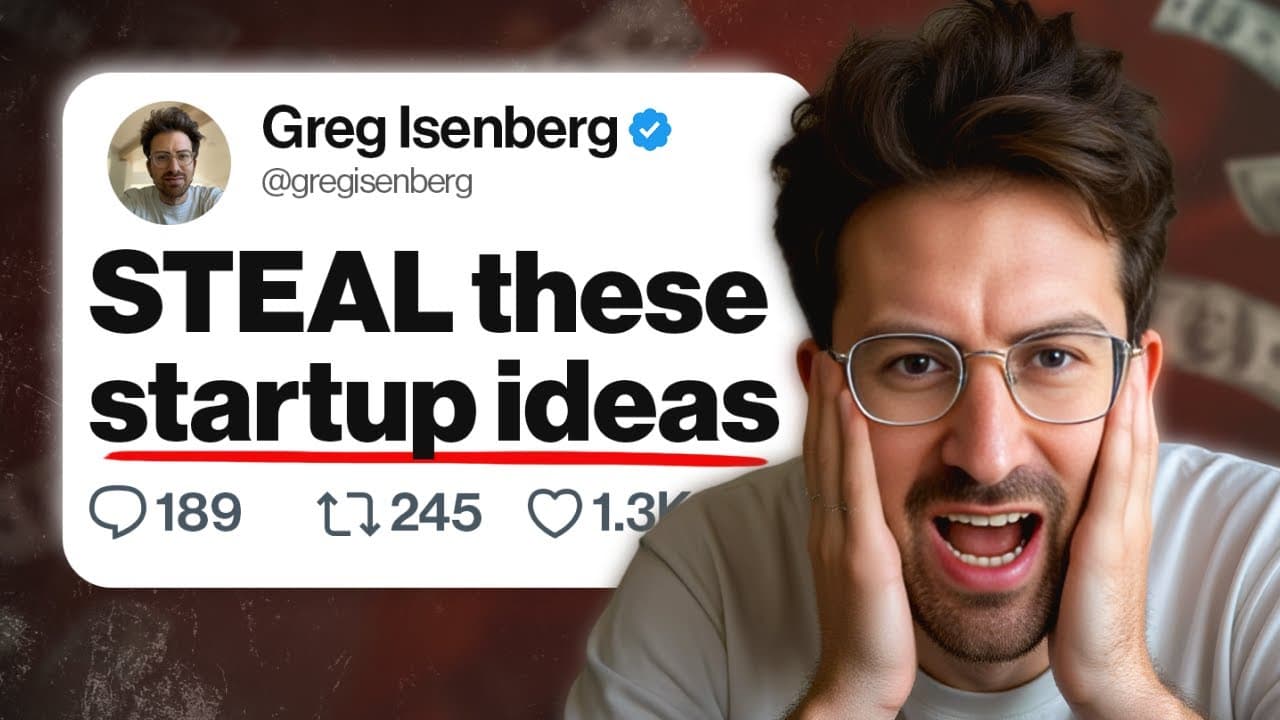
What Are Greg Isenberg's 5 Startup Ideas to Start at 22 for Under $500 and Grow to $100k/Month?
TL;DR
Greg Isenberg's startup ideas are a first-job rejection tracker, digital detox community, creator-in-residence agency, $2K vibe coding agency, and TikTok hook generator. Each can start for under $500 by using existing tools, direct outreach, and a narrowly defined customer problem rather than custom technology. Read on for practical launch and monetization steps for all five ideas.
Transcript
Today we're going to talk about five startups I would build if I were in my 20s today for under $500. Now I built and sold three venturebacked startups in my 20s. It absolutely changed my life. So, you know, hopefully someone listens to some of these ideas. It gets their creative juices flowing. I think this is particularly valuable for people in t... Read More
Key Insights
- A first-job rejection tracker is a transparency platform for college students and recent graduates to record applications, compare response rates by company and role, and connect with applicants rejected by the same employer. It can begin with crowdsourced data covering only one company.
- A digital detox community is a paid membership concept for people who feel controlled by phones, screens, or headphones. Its proposed benefits include daily offline text reminders, weekly in-person meetups, accountability partners, and structured digital detox challenges delivered through existing community and event platforms.
- A creator-in-residence agency is a matchmaking service that connects brands needing stronger social content with micro-creators seeking steady pay. The agency can maintain creator and brand lists, arrange introductions through Zoom, and earn 20% of each contract without building an application or writing code.
- A $2K vibe coding agency is a productized service that builds micro-SaaS products during two-week sprints using tools such as ChatGPT, Bolt, Lovable, Replit, and Cursor. Client work provides revenue while helping the operator improve product development and prompting skills through repeated practice.
- Hookline Studio is a focused AI product that converts a submitted video idea into 10 TikTok hook lines within 30 seconds. Its simple flow can send one text input to a GPT prompt, display the results, offer free hooks initially, and upsell unlimited access for $9 monthly.
- Existing platforms are sufficient for testing these startup ideas before investing in custom technology. The suggested starting tools include Notion, Zapier, Discord, Circle, School, Twilio, Eventbrite, Airtable, Zoom, Cursor, and Typedream, depending on the business being tested.
- Narrow positioning is central to the proposed launch strategy. The job tracker can start with applicants to one employer, the agency can focus specifically on creators placed on brand payrolls, and the hook generator can solve only the problem of producing TikTok opening lines.
- A college campus prediction market is presented only as a bonus idea with unresolved legal concerns. The proposed markets include dean's list outcomes, relationship breakups, Greek life removals, and class curves, but the speaker explicitly says the concept may operate in a legal gray area.
Install to Summarize YouTube Videos and Get Transcripts
Explore YouTube Video Summarizer or Get YouTube Transcript Extractor
Questions & Answers
Q: What are Greg Isenberg's five startup ideas?
The five startup ideas are a first-job rejection tracker, a digital detox community, a creator-in-residence agency, a $2K vibe coding agency, and Hookline Studio, a TikTok hook generator. Each is designed to start for under $500 by using existing platforms, direct outreach, or a productized service.
Q: How can I start a first-job rejection tracker?
Begin by crowdsourcing application data for one employer, then expand after validating demand. Users could log applications, compare response rates by company and role, identify effective approaches, and connect with applicants rejected by the same employer using Notion, Zapier, and a community platform.
Q: How can a digital detox community make money?
The community could charge $9, $12, or $19 per month for support in reducing dependence on phones, screens, and headphones. Benefits could include daily offline text reminders, weekly in-person meetups, accountability partners, and structured detox challenges.
Q: What is a creator-in-residence agency?
It is a matchmaking service that connects brands needing better social content with micro-creators seeking steady pay. The agency can organize both groups in Airtable, arrange introductions through Zoom, and take 20% of each resulting contract without building an app.
Q: How can I find clients and creators for a creator-in-residence agency?
Post on LinkedIn to find brands that want a creator on payroll, then source creators through X and Instagram. Direct messages can recruit creators, Airtable can organize prospects, and Zoom can support introductions between suitable matches.
Q: How does a $2K vibe coding agency work?
The agency sells two-week development sprints that build micro-SaaS products for $2,000. Projects can use ChatGPT, Bolt, Lovable, Replit, and Cursor, allowing the operator to earn revenue while repeatedly improving product development and prompting skills.
Q: How can Hookline Studio generate and monetize TikTok hooks?
A user submits one video idea and receives 10 TikTok hook lines within 30 seconds through a focused GPT prompt and simple interface. The service can offer free hooks initially, then upsell unlimited generation for $9 per month.
Q: Why should these businesses start with a narrow niche?
A narrow niche makes initial testing and outreach more manageable. The rejection tracker can cover one employer first, the agency can focus specifically on placing creators on brand payrolls, and the hook generator can solve one defined problem before expanding.
Summary & Key Takeaways
-
The first idea is a job rejection tracker for college students and recent graduates. Users could log applications, compare company and role response rates, identify effective approaches, and connect with other rejected applicants. The founder recommends crowdsourcing data for one employer first, using Notion and Zapier, then promoting the service through short-form videos.
-
The next three ideas emphasize communities and services that require little custom technology. A digital detox community could combine text reminders, accountability partners, challenges, and local meetups. A creator-in-residence agency could place micro-creators with brands for 20% of contracts, while a vibe coding agency could sell two-week micro-SaaS development sprints.
-
The fifth idea is Hookline Studio, a focused tool that turns one video idea into 10 TikTok hooks within 30 seconds and offers unlimited use for $9 monthly. A bonus campus prediction market is also discussed, but its legality is described as uncertain and operating in a gray area, requiring caution before execution.
Read in Other Languages (beta)
Share This Summary 📚
Summarize YouTube Videos and Get Video Transcripts with 1-Click
Try YouTube Summary with ChatGPT & Claude or YouTube Transcript Generator
Explore More Summaries from Greg Isenberg 📚




Summarize YouTube Videos and Get Video Transcripts with 1-Click
Try YouTube Summary with ChatGPT & Claude or YouTube Transcript Generator