What Is ARDS? Berlin Criteria and Pathophysiology
TL;DR
ARDS is diagnosed using the Berlin criteria: acute hypoxemia developing in under a week since a trigger, a PF ratio under 300, diffuse bilateral infiltrates on imaging, and no cardiogenic pulmonary edema. It stems from diffuse alveolar damage to type 1 and type 2 cells, which floods and collapses alveoli, creating a pulmonary shunt and severe hypoxemia.
Transcript
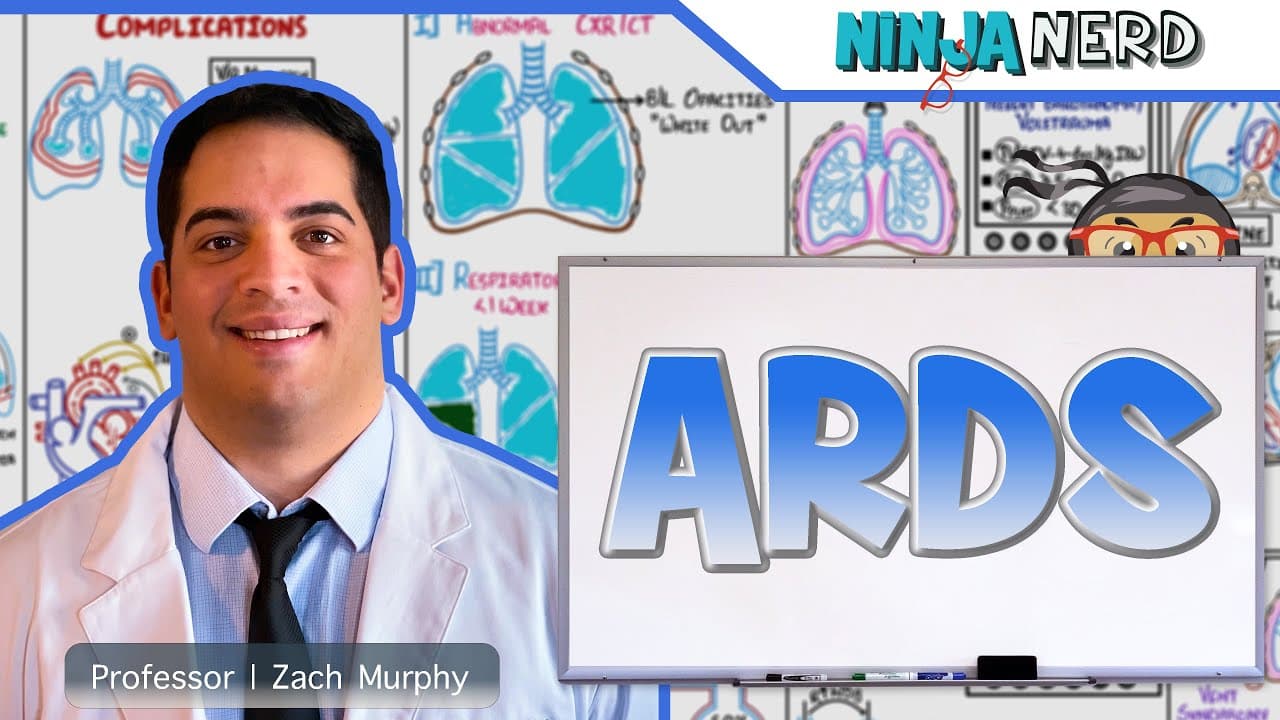
foreign what's up Ninja nerds in this video today we're going to be talking about acute respiratory distress syndrome also known as ards this is part of our clinical medicine section and if you guys like it please support us and you can do that by hitting that like button commenting down the comment section please subscribe also if you guys get a c... Read More
Key Insights
- ARDS is defined by acute hypoxemia, shown as an SpO2 usually less than 90 in patients with acute respiratory failure or a PaO2 less than 60 mmHg measured off an arterial blood gas (ABG).
- The Berlin criteria diagnose ARDS through four findings: acute hypoxemia within less than one week of the trigger, a PF ratio under 300, diffuse bilateral infiltrates on imaging, and no cardiogenic pulmonary edema.
- The PF ratio determines the severity of a patient's hypoxemia, and a value less than 300 is required to consider the patient to have ARDS under the Berlin criteria.
- Cardiogenic pulmonary edema is most definitively ruled out with a Swan-Ganz catheter showing a pulmonary capillary wedge pressure less than 18, though an echocardiogram is the more likely first test.
- Diffuse alveolar damage (DAD) drives ARDS by injuring type 1 cells, type 2 cells, and the pulmonary capillaries throughout the lungs, producing the diffuse bilateral infiltrates seen on imaging.
- Type 1 cell injury destroys the barrier for gas exchange, so fluid, proteins, and immune cells leak into the alveoli during the exudative phase, filling them so they cannot be ventilated.
- Type 2 cell injury decreases surfactant production, which raises surface tension and causes alveolar collapse, and both this collapse and alveolar filling create a pulmonary shunt.
- A pulmonary shunt is the most extreme low VQ mismatch, where alveoli receive almost no ventilation but relatively normal perfusion, so blood leaves without gas exchange and oxygen drops, causing profound hypoxemia.
Install to Summarize YouTube Videos and Get Transcripts
Explore YouTube Video Summarizer or Get YouTube Transcript Extractor
Questions & Answers
Q: What is acute respiratory distress syndrome (ARDS)?
ARDS, or acute respiratory distress syndrome, is a disorder in which patients develop acute hypoxemia along with specific findings. The hypoxemia usually presents as an SpO2 below 90 in patients with acute respiratory failure or a PaO2 below 60 mmHg on an arterial blood gas. It develops within less than one week of the triggering event and includes a PF ratio under 300 and diffuse bilateral lung infiltrates.
Q: What are the Berlin criteria for diagnosing ARDS?
The Berlin criteria require four findings to diagnose ARDS. First, acute hypoxemia that developed within less than one week of the trigger. Second, a PF ratio less than 300, which determines the severity of the hypoxemia. Third, diffuse bilateral infiltrates seen as white opacities on chest x-ray or CT. Fourth, no cardiogenic pulmonary edema causing those infiltrates. All four must be present to confirm ARDS.
Q: How do you rule out cardiogenic pulmonary edema in ARDS?
The most definitive way to rule out cardiogenic pulmonary edema is a Swan-Ganz catheter placed into the pulmonary capillaries to obtain a wedge pressure; a pulmonary capillary wedge pressure less than 18 confirms there is no cardiogenic pulmonary edema. However, other tests should be done first, and an echocardiogram is the more likely initial choice before proceeding to a Swan-Ganz catheter.
Q: What is the PF ratio and why does it matter in ARDS?
The PF ratio is a measurement that determines the degree or severity of a patient's hypoxemia, calculated from arterial blood gas values. To consider a patient to have ARDS under the Berlin criteria, the PF ratio must be less than 300. It works alongside the other findings, including acute hypoxemia developing within a week and diffuse bilateral infiltrates, to establish the diagnosis and grade how severe the hypoxemia is.
Q: How does diffuse alveolar damage cause hypoxemia in ARDS?
Diffuse alveolar damage (DAD) injures the type 1 cells, type 2 cells, and pulmonary capillaries. Type 1 cell injury breaks the gas-exchange barrier so fluid, proteins, and immune cells leak into and fill the alveoli during the exudative phase. Type 2 cell injury lowers surfactant, raising surface tension and collapsing alveoli. Both filling and collapse stop ventilation while perfusion stays normal, creating a shunt that drops oxygen and causes profound hypoxemia.
Q: What is a pulmonary shunt and how does it develop in ARDS?
A pulmonary shunt is the most extreme form of low VQ mismatch, where an alveolus receives almost no ventilation but has relatively normal perfusion. In ARDS it develops two ways: alveolar filling from the exudative phase, where fluid and cells fill the alveolus, and alveolar collapse from decreased surfactant. Blood flowing through these units leaves without gas exchange, so the PaO2 drops and the patient develops profound hypoxemia.
Q: Why do type 2 alveolar cells matter in ARDS?
Type 2 alveolar cells are cuboidal cells that make surfactant, which coats the inner alveoli and keeps them from collapsing. When diffuse alveolar damage injures type 2 cells, surfactant production decreases, causing surface tension to rise. Combined with fluid accumulation from type 1 cell damage, the alveoli collapse. This alveolar collapse prevents ventilation while perfusion continues, producing a pulmonary shunt and contributing to the severe hypoxemia seen in ARDS.
Q: What are the direct lung injury causes of ARDS?
Direct lung injury in ARDS comes from something inhaled or aspirated that reaches and injures the alveoli and capillary beds. The major causes highlighted are pneumonia, which is a very big one, SARS-CoV-2, aspiration, and inhaled toxins. An example of inhaled toxins is smoke inhaled during a house fire. Enough of these cells must be damaged to produce the diffuse alveolar damage that drives the syndrome.
Summary & Key Takeaways
-
ARDS is characterized by acute hypoxemia, defined as an SpO2 usually below 90 in acute respiratory failure or a PaO2 below 60 mmHg on an ABG, developing in less than one week since the triggering event that started the process.
-
The Berlin criteria require four findings to diagnose ARDS: acute hypoxemia within under a week, a PF ratio less than 300 that grades severity, diffuse bilateral infiltrates appearing as white opacities on chest x-ray or CT, and no cardiogenic pulmonary edema.
-
Diffuse alveolar damage injures type 1 cells, causing fluid to leak and fill alveoli in an exudative phase, and type 2 cells, decreasing surfactant so alveoli collapse; both produce a pulmonary shunt with poor ventilation, normal perfusion, and severe hypoxemia.
Read in Other Languages (beta)
Share This Summary 📚
Summarize YouTube Videos and Get Video Transcripts with 1-Click
Try YouTube Summary with ChatGPT & Claude or YouTube Transcript Generator
Explore More Summaries from Ninja Nerd 📚






Summarize YouTube Videos and Get Video Transcripts with 1-Click
Try YouTube Summary with ChatGPT & Claude or YouTube Transcript Generator