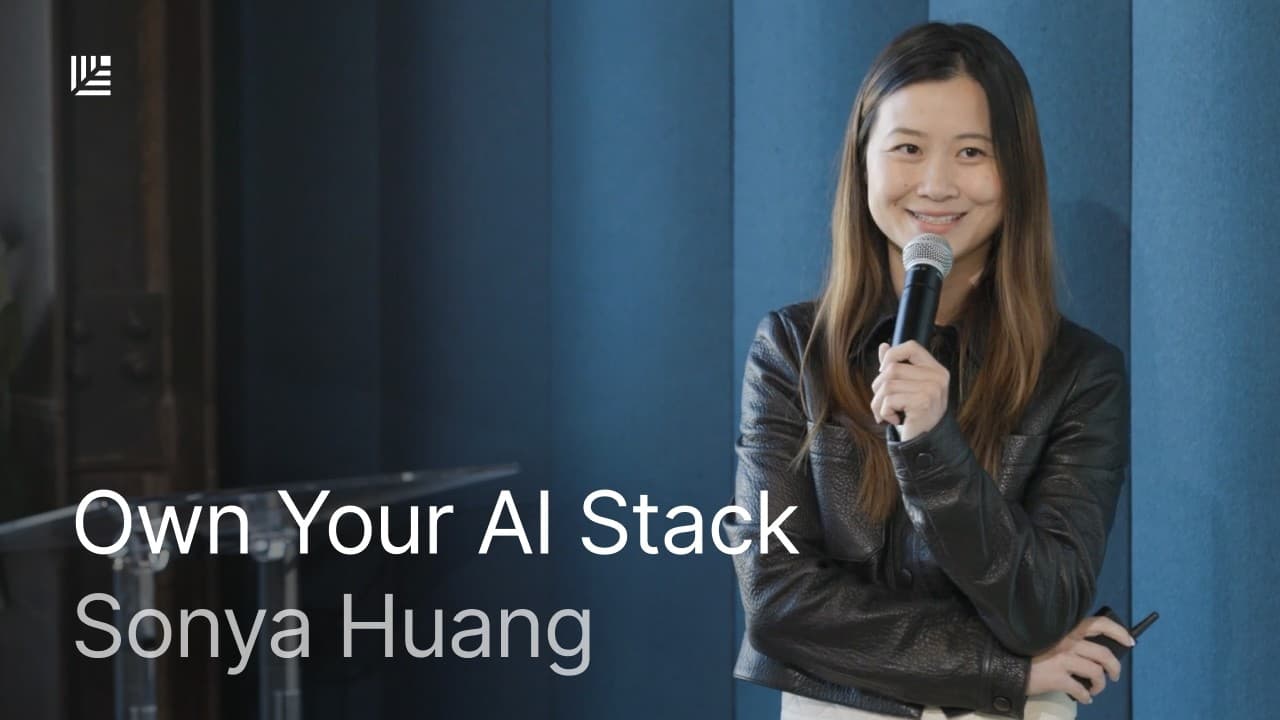
Why Should Companies Own Their AI Model Weights?
TL;DR
Companies should own selected AI capabilities when cost, latency, domain performance, proprietary data, or strategic independence make external dependence undesirable. Sovereign AI is not an all-or-nothing choice: businesses can keep renting frontier APIs for some workloads while building custom, open-weight models for high-volume, speed-sensitive, or specialized product features.
Transcript
Okay, good morning everyone. Thank you all so much for being here. We have about 80 portfolio company founders and AI leaders uh in the room to explore a very timely topic, owning your intelligence or sovereign AI. Uh today's event is meant to be half a rallying call and half technical how-to. And so we have stacked the agenda with I think high hig... Read More
Key Insights
- Sovereign AI is a company’s ability to own and control its intelligence without external dependencies, including custody of the underlying model weights. The concept supports selective ownership rather than requiring a complete departure from closed models or frontier-level APIs.
- The strongest reasons to own AI capabilities are cost, speed, performance, and control over strategic direction. These considerations become especially important when inference is frequent, latency directly affects the experience, proprietary data creates differentiation, or reliance on another provider creates business risk.
- AI costs can rise as a product becomes more successful because greater usage produces greater AI cost of goods sold. For companies with low, zero, or negative margins, owning models can therefore become a requirement rather than an optional technical investment.
- Small, distilled custom models can outperform larger general models in domains where response speed is especially important. Coding and security are cited as areas where a focused model’s latency and specialized post-training can matter more than the broad capabilities of a larger system.
- Open-weight models can produce better domain performance when companies tune them using their own data and requirements. Owning intelligence is consequently no longer framed only as accepting weaker performance in exchange for control, but as a potential source of specialized product advantage.
- Sovereign AI is not a binary state because companies can own some capabilities and rent others. Coding agents may use rented models for strong out-of-the-box results, while autocomplete can use owned models because calls are frequent, speed is critical, and costs accumulate quickly.
- The intelligence layer is becoming a competitive battleground alongside the application layer. Application companies are increasingly conducting applied research in evaluations, benchmarks, harness engineering, fine-tuning techniques, and other methods that shape the intelligence embedded directly within their products.
- A dedicated research team should operate differently from a conventional hub-and-spoke AI platform group. The proposed organization starts with a small, purpose-built team that can explore frontier problems proactively instead of functioning mainly as a service provider for separate product teams.
- More videos from this channel:
- More from this channel: Sequoia Capital
Install to Summarize YouTube Videos and Get Transcripts
Explore YouTube Video Summarizer or Get YouTube Transcript Extractor
Questions & Answers
Q: What is sovereign AI for a company?
Sovereign AI is the practice of owning and controlling the intelligence embedded in a company’s products without depending entirely on external providers, including having custody of model weights. It does not mean eliminating all rented models. A company can use closed frontier APIs for some tasks while owning custom models for capabilities where control, economics, speed, or specialization matters more.
Q: Why should companies own their AI model weights?
Companies may want to own model weights for four main reasons: cost, speed, domain-specific performance, and control over their future. Ownership can reduce exposure to growing inference expenses, support lower-latency experiences, enable bespoke post-training with proprietary data, and provide an independent foundation if external model providers change their products, terms, or strategic direction.
Q: How should a company decide which AI capabilities to own?
A company should evaluate each capability according to its contribution to overall costs, the importance of speed and latency, the performance obtainable through customization, and the sensitivity or strategic value of its proprietary data. The decision should be made capability by capability because sovereign AI is a spectrum, not a choice between complete ownership and complete outsourcing.
Q: When should a company rent an AI model instead of owning one?
Renting is appropriate when strong out-of-the-box performance is more important than complete control, latency is not a top priority, and the economics of API use remain acceptable. Coding agents are presented as an example that is still mostly rented. Closed model APIs also remain useful for desktop work, coding tasks, and access to frontier-level capabilities.
Q: Why are autocomplete models more suitable for owned AI?
Autocomplete models are strong candidates for company-owned intelligence because they receive frequent API calls, making external usage costs accumulate rapidly. Speed is also especially important to the user experience. A smaller custom model can address both concerns by responding quickly and operating under the company’s control, while being optimized for its narrow and recurring task.
Q: Can open-weight models outperform closed models?
Open-weight models can outperform closed models within a company’s specific domain when they are tuned using relevant proprietary data and adapted to specialized requirements. The argument is not that open models are universally superior. Rather, domain customization can create better performance for selected capabilities, making ownership a possible performance advantage instead of merely a compromise for lower cost or greater control.
Q: How should a company organize a sovereign AI research team?
A company should consider forming a small, dedicated research team instead of assigning sovereign AI work to an existing hub-and-spoke platform group. The required work is described as a distinct capability that demands people who can think on the frontier, pursue research proactively, and develop intelligence, rather than primarily servicing requests from multiple application product teams.
Q: Why is the intelligence layer becoming strategically important?
The intelligence layer is becoming strategically important because competition is expanding beyond product interfaces, distribution, and application wrappers. Foundation model labs approach users from the model side, while application companies work backward from user needs. Companies that shape their own models, evaluations, harnesses, and post-training methods can embed differentiated intelligence directly into the product rather than relying entirely on rented foundations.
Summary & Key Takeaways
-
Sovereign AI means controlling company intelligence without external dependencies, down to model weights. It does not require abandoning closed frontier APIs. Companies can continue renting models for coding agents, desktop work, and other demanding tasks while selectively owning capabilities where customization, operating economics, responsiveness, or independence creates greater product value.
-
The decision to own or rent an AI capability should consider four factors: cost, speed and latency, performance, and proprietary data. Coding agents often remain rented because strong out-of-the-box performance matters, while autocomplete is commonly owned because requests are frequent, latency is critical, and accumulated API costs can become substantial.
-
Building proprietary intelligence requires deliberate strategy, a suitable team, visible and understandable research, and a technical roadmap. The research group should not simply be added to a conventional platform-services team. A small, dedicated unit can instead pursue applied research, evaluations, benchmarks, harness engineering, post-training techniques, and other product-specific improvements.
-
Key Insights lessons, summary, podcast notes, recap, review
-
Q&A questions answered, important topics, key points
-
Key Insights breakdown, analysis, explained, video takeaways
-
Q&A FAQ, common questions, definitions, examples
-
Summary chapters, timestamps, main ideas, outline
-
transcript summary, video summary, highlights
Read in Other Languages (beta)
Share This Summary 📚
Summarize YouTube Videos and Get Video Transcripts with 1-Click
Try YouTube Summary with ChatGPT & Claude or YouTube Transcript Generator
Explore More Summaries from Sequoia Capital 📚




Summarize YouTube Videos and Get Video Transcripts with 1-Click
Try YouTube Summary with ChatGPT & Claude or YouTube Transcript Generator