How Do Voltage, Area, and Separation Affect Capacitors?
TL;DR
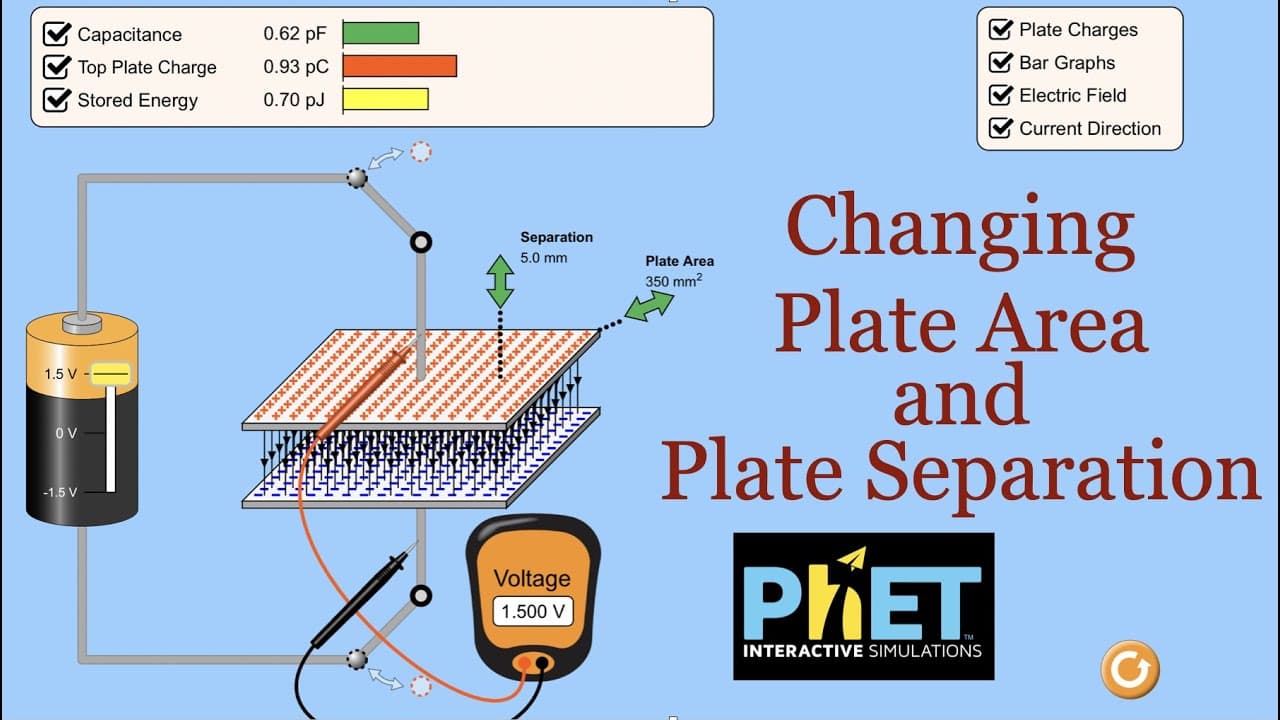
Changing the voltage across a capacitor increases the charge stored and voltage across plates, while increasing plate separation decreases capacitance and charge stored. Increasing plate area raises capacitance and charge, but the voltage and electric field strength will generally remain constant. Simulations demonstrate these relationships and their practical implications, such as discharging capacitors through light bulbs.
Transcript
in today's video we're going to be going over a detailed look at capacitors and we are going to look at if we change the voltage across the plate to the capacitor the plate separation and the plate area how does that affect the following four things that would be the capacitance of the capacitor the amount of charge that's stored in the capacitor t... Read More
Key Insights
- ⚡ Voltage directly impacts charge stored, voltage across plates, and electric field strength in capacitors.
- 🍽️ Plate separation inversely affects capacitance, charge stored, and electric field strength.
- 🍽️ Plate area directly influences capacitance and charge stored while voltage and electric field strength remain constant.
- 💡 Discharging a capacitor through a light bulb demonstrates energy transfer and the gradual decrease in energy stored in the electric field.
- ❓ Captivating exploration of capacitor properties through simulations and practical demonstrations.
- 🍽️ Understanding the interplay between voltage, plate area, and separation in manipulating capacitor behavior.
- ❓ Importance of following scientific procedures and equations to explain observations in capacitor experiments.
Install to Summarize YouTube Videos and Get Transcripts
Explore YouTube Video Summarizer or Get YouTube Transcript Extractor
Questions & Answers
Q: How does increasing the voltage across a capacitor impact its properties?
Increasing voltage leads to more charge stored, higher voltage across plates, and increased electric field strength due to direct relationships between voltage and these properties.
Q: Why does increasing plate separation decrease capacitance?
Plate separation is inversely proportional to capacitance, meaning as the distance increases, capacitance decreases affecting the amount of charge stored and electric field strength.
Q: What happens when plate area is increased while keeping plate separation constant?
Increasing plate area increases capacitance and charge stored, but voltage and electric field strength remain constant since they are only dependent on plate separation.
Q: How does discharging a capacitor through a light bulb illustrate energy transfer?
Discharging a capacitor through a light bulb shows the conversion of stored energy into light as the charge returns to its source, gradually diminishing the electric field and brightness of the bulb.
Summary & Key Takeaways
-
Detailed examination of how changing voltage, plate area, and separation affects capacitance, charge stored, voltage, and electric field strength.
-
Demonstrations using simulations and equations to illustrate the impact of various factors on capacitor properties.
-
Emphasis on practical applications like discharging capacitors through light bulbs for energy transfer.
Read in Other Languages (beta)
Share This Summary 📚
Summarize YouTube Videos and Get Video Transcripts with 1-Click
Try YouTube Summary with ChatGPT & Claude or YouTube Transcript Generator
Explore More Summaries from Step by Step Science 📚

Summarize YouTube Videos and Get Video Transcripts with 1-Click
Try YouTube Summary with ChatGPT & Claude or YouTube Transcript Generator