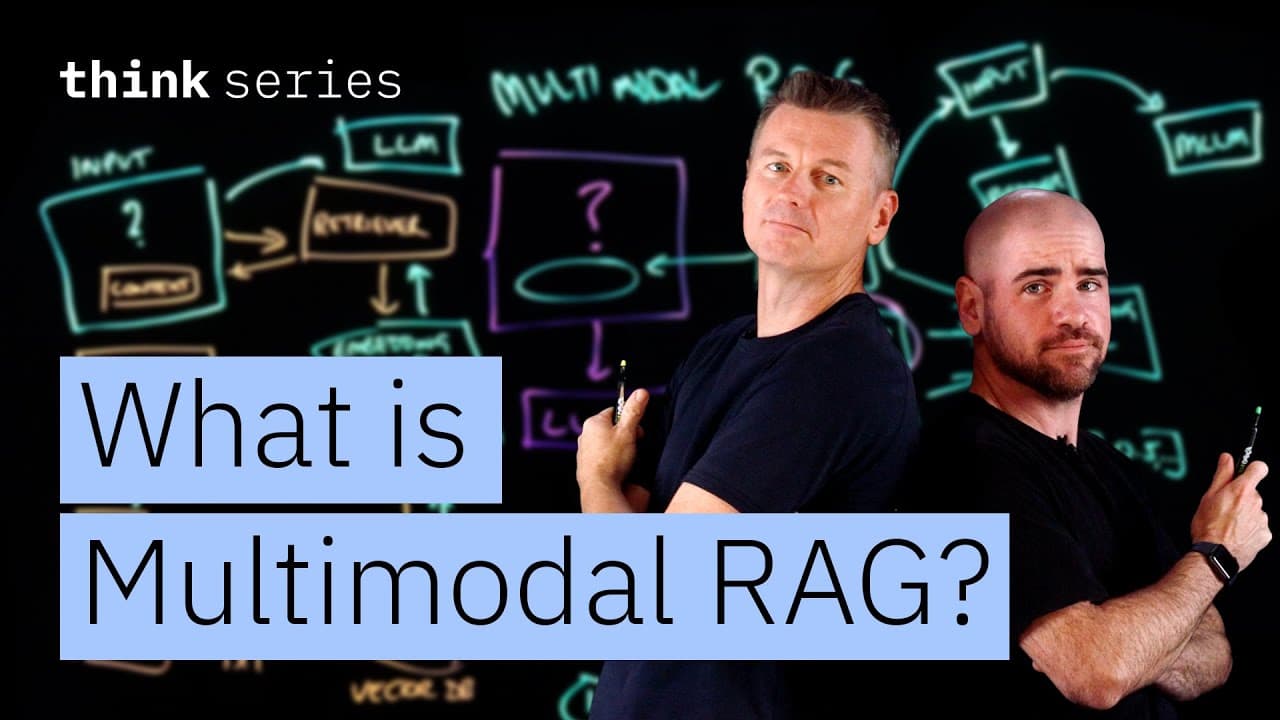
What Is Multimodal RAG, and How Does It Use Vector Databases to Ground LLMs?
TL;DR
Multimodal RAG retrieves relevant text, images, audio, or video and gives that context to an LLM for a grounded answer. Its three approaches are to convert all media into text, retain links from searchable text to original media, or embed multiple modalities in a shared vector space. Each balances retrieval simplicity, preserved detail, compute, and context management. Read on to compare how they work.
Transcript
If we want to retrieve external information like up-to-date documents or search results, and then send them as part of a query to a large language model, there's a technique we can use for that. Right. That is RAG or retrieval augmented generation. Yeah. So say I'm building an internal help chatbot with RAG. When somebody asks the LLM a question, l... Read More
Key Insights
- Retrieval augmented generation is a technique for finding external information, adding the relevant material to an input prompt, and giving a language model grounded context from which to answer questions about current documents, policies, search results, or other available sources.
- Classic RAG works by converting document chunks into vectors offline, storing those vectors in a vector database, embedding a user query with the same model, and retrieving the closest vectors as the most semantically relevant pieces of the original documents.
- A grounded RAG prompt is formed by placing retrieved context beside the original user query. The combined prompt is sent to the language model, which uses the supplied document material rather than relying only on information already available to the model.
- The text-ify everything approach converts images and screenshots into captions and converts audio or video into transcripts. These textual representations can enter a standard RAG pipeline, making the approach simple while preserving basic semantic information from different media types.
- Caption-based retrieval can lose visual nuance and spatial relationships. A caption might identify a network diagram and its major components but omit meaningful details, such as which colored path represents a primary connection and which one represents failover.
- Hybrid multimodal RAG searches paragraphs, captions, and transcripts as text while retaining pointers to the original media. When a caption is retrieved, the corresponding image can be passed to a multimodal language model together with the textual context and user query.
- Hybrid retrieval is limited by the quality of its textual proxies. If a caption or transcript fails to describe the important signal, the retriever may never surface the correct image, recording, or video clip, even though the generation model could reason over it.
- Full multimodal RAG uses aligned encoders that map text, images, audio, and other modalities into a shared vector space. This enables a single query vector to retrieve different artifact types directly, although the approach requires more compute, capable encoders, and context summarization.
Install to Summarize YouTube Videos and Get Transcripts
Explore YouTube Video Summarizer or Get YouTube Transcript Extractor
Questions & Answers
Q: What is multimodal retrieval augmented generation?
Multimodal RAG retrieves relevant information from text, images, audio, video, and other media, then supplies it to a language model as grounded context. It can convert media into text, preserve original artifacts behind textual proxies, or retrieve different media types directly from a shared vector space.
Q: How does a classic RAG pipeline use a vector database?
During an offline step, documents are divided into chunks, converted into vectors by an embedding model, and stored in a vector database. The same model embeds the user's query, allowing a retriever to find the closest vectors and return the associated text chunks as context for the LLM.
Q: How does the text-ify everything RAG approach work?
This approach converts each non-text medium into text before retrieval. A captioning model describes images and screenshots, while a speech-to-text service converts audio or video into transcripts; those outputs then follow the ordinary embedding, vector-storage, and retrieval pipeline.
Q: Why can image captions reduce multimodal RAG quality?
A caption may preserve an image's general subject while omitting visual nuance and spatial relationships. For example, it might describe a network diagram with a VPN gateway and redundant links without recording that a red path is primary and a blue path is for failover.
Q: How does hybrid multimodal RAG preserve original media?
Hybrid multimodal RAG searches paragraphs, captions, and transcripts as text while retaining pointers to the original images, audio, or video. When a textual proxy is retrieved, the corresponding media can also be supplied to a multimodal LLM for richer reasoning.
Q: What is the main limitation of hybrid multimodal RAG?
Discovery still depends on the quality of captions and transcripts. If a textual proxy omits the decisive visual, spatial, or audio signal, the retriever may never select the original artifact for the multimodal LLM to inspect.
Q: How does full multimodal RAG enable cross-modal retrieval?
Full multimodal RAG uses aligned encoders to map text, images, audio, and other media into a shared vector space. A single query vector can therefore retrieve relevant artifacts across modalities directly instead of relying entirely on captions or transcripts.
Q: How do the three multimodal RAG approaches compare?
Text-ify everything is simplest but can discard important details, while hybrid RAG preserves original media for reasoning but still retrieves through textual proxies. Full multimodal RAG supports direct cross-modal search and richer grounding, but it requires stronger encoders, additional compute, and careful context management.
Summary & Key Takeaways
-
Classic RAG converts document chunks and a user query into vectors using the same embedding model. A retriever searches a vector database for the closest matches, returns relevant text chunks, and places them beside the original query as context. The language model then generates an answer grounded in the retrieved information.
-
The text-ify approach converts images into captions and audio or video into transcripts before applying ordinary text-based RAG. Hybrid multimodal RAG uses the same text retrieval process but retains pointers to original media, allowing a multimodal language model to inspect retrieved images, audio, or video alongside textual context.
-
Full multimodal RAG uses aligned encoders to represent text, images, audio, and other media in a shared vector space. A query vector can therefore retrieve relevant artifacts across modalities directly. This provides richer grounding without relying entirely on captions or transcripts, but it requires stronger encoders, additional compute, and careful context management.
Read in Other Languages (beta)
Share This Summary 📚
Summarize YouTube Videos and Get Video Transcripts with 1-Click
Try YouTube Summary with ChatGPT & Claude or YouTube Transcript Generator
Explore More Summaries from IBM Technology 📚

Summarize YouTube Videos and Get Video Transcripts with 1-Click
Try YouTube Summary with ChatGPT & Claude or YouTube Transcript Generator