How to Flip High-Ticket Items for Profit in 2026
TL;DR
To flip high-ticket items profitably, prioritize finding an unusually strong deal, stay flexible about how inventory is resold, and use confidence and relationships to uncover opportunities. Shannon Jean describes sourcing products through auctions and a growing network, then choosing among wholesale, eBay, parts, and repair channels. Read on for his approach to financing, resale strategy, confidence, and avoiding businesses that become pure maintenance.
Transcript
if you could take like all of your knowledge today you're 21 years old you've got ,000 doll to your name but you know everything that you know right now and you wanted to just flip stuff or just make deals but you only have a thousand bucks what do you think is the biggest like most asymmetric opportunity today to do stuff like that I created these... Read More
Key Insights
- Finding the deal matters more than having the capital, because Shannon Jean argues that if a deal is good enough you will find the money, which is how he committed to buying an entire Sprint auction facility he could not initially afford.
- Auctions with few bidders create asymmetric flips, as Shannon flew to a Kansas Sprint auction on short notice with only six other buyers present, bought the whole facility for roughly $300,000-$400,000, and flipped it for four or five million.
- Splitting inventory across multiple sales channels maximizes profit, since Shannon ran a wholesale division for dealers, an eBay division, a parts division that stripped components, and a repair division that consumed those same parts.
- Components are often worth more than the whole unit, because Shannon's parts division tore products down and sold individual pieces, which took longer to sell but returned more than selling the intact machine.
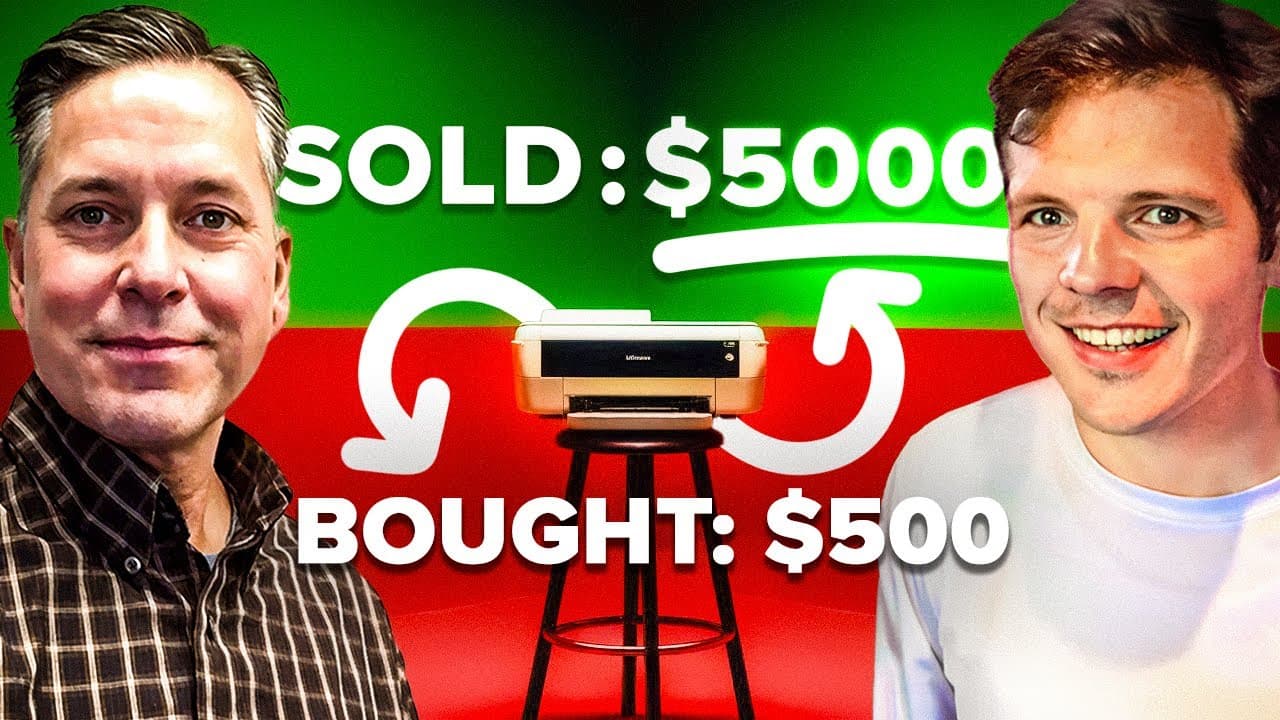
- Refurbishing distressed inventory creates huge margins, as Shannon bought returned Apple color laser printers for $500 each, had interns clean the contaminated oil trays and rebuild them, then resold them for $5,000 against a $10,000 new price.
- Confidence directly increases what you can charge, since Shannon says his Mac expertise made him look more credible in his landscaping business, letting him charge 20 to 40 percent more because confidence shapes how you present yourself.
- Entrepreneurs build a widening net of contacts over time, which Shannon describes as constantly catching opportunities through phone calls from people who heard he buys auction lots or has specific inventory to move.
- Being unbothered by others' opinions unlocks more deals, because Shannon says the older he gets the less he cares what people think, so he would sell porta potties door to door if the opportunity were good.
Install to Summarize YouTube Videos and Get Transcripts
Explore YouTube Video Summarizer or Get YouTube Transcript Extractor
Questions & Answers
Q: How can you start flipping high-ticket items with little money?
Shannon Jean argues that finding a strong deal matters more than already having all the money. His approach is to secure an attractive opportunity and then use methods such as wholesaling inventory or selling components to generate cash.
Q: How does Shannon Jean find products and deals to flip?
He built relationships with sellers and auctioneers while traveling around the country to attend auctions. Over time, his network began producing calls from people who had inventory, knew someone with products to sell, or needed help moving a deal.
Q: What was Shannon Jean's standout auction flip?
His standout example was an auction at a Sprint facility in Kansas. He bought the facility's inventory and later resold it through several channels, including wholesale, eBay, parts, and repair operations.
Q: How does Shannon Jean maximize profit from auction inventory?
He stays flexible instead of relying on a single resale method. Inventory can be wholesaled to dealers, sold on eBay, dismantled for components, or directed to a repair division, depending on which route fits the products.
Q: Why can selling components be better than selling a complete product?
Shannon explains that individual components can sometimes be worth more than the intact unit. Selling them may take longer, but the parts can serve outside buyers as well as an internal repair operation.
Q: How did Mac Rescue shape Shannon Jean's business experience?
Shannon started Mac Rescue after falling in love with the Mac while operating a landscape construction business. The company later merged with a Midwest firm and became Rescue Systems, which pursued large deals and benefited from inefficiencies during Apple's difficult periods.
Q: Why does Shannon Jean move on from businesses instead of preparing them for sale?
He says that starting and figuring out a business gives him energy, while an established operation eventually becomes maintenance. Preparing some companies for sale would have required substantial time, and he often sees greater opportunity in starting his next idea.
Q: How does confidence affect pricing and dealmaking?
Shannon says confidence is crucial to how someone presents themselves. His Mac expertise made him feel more capable and appear more credible while running his landscaping business, allowing him to charge 20, 30, or 40% more.
Summary & Key Takeaways
-
Shannon Jean describes himself as patently unemployable since college, starting a successful landscape construction business, then Mac Rescue after falling in love with the Mac. That company merged with a midwest firm to become Rescue Systems, riding the Apple wave up and down and profiting from market inefficiencies.
-
As a self-described product guy and hustler, Shannon chased auctions across the country before online bidding matured. His standout flip was a Sprint facility bought in Kansas for roughly $300,000-$400,000 with only six other bidders, then resold for four or five million dollars through multiple channels.
-
Shannon maximizes returns through flexibility: wholesaling to dealers, selling via eBay, stripping units for parts, and running a repair division. He now holds real estate, a Tahoe house, an eight million dollar high-end watch side hustle, and a four million dollar business started on his phone.
Read in Other Languages (beta)
Share This Summary 📚
Summarize YouTube Videos and Get Video Transcripts with 1-Click
Try YouTube Summary with ChatGPT & Claude or YouTube Transcript Generator
Explore More Summaries from Chris Koerner on The Koerner Office Podcast 📚






Summarize YouTube Videos and Get Video Transcripts with 1-Click
Try YouTube Summary with ChatGPT & Claude or YouTube Transcript Generator