How to Micro-Scalp NASDAQ Futures Without Bias
TL;DR
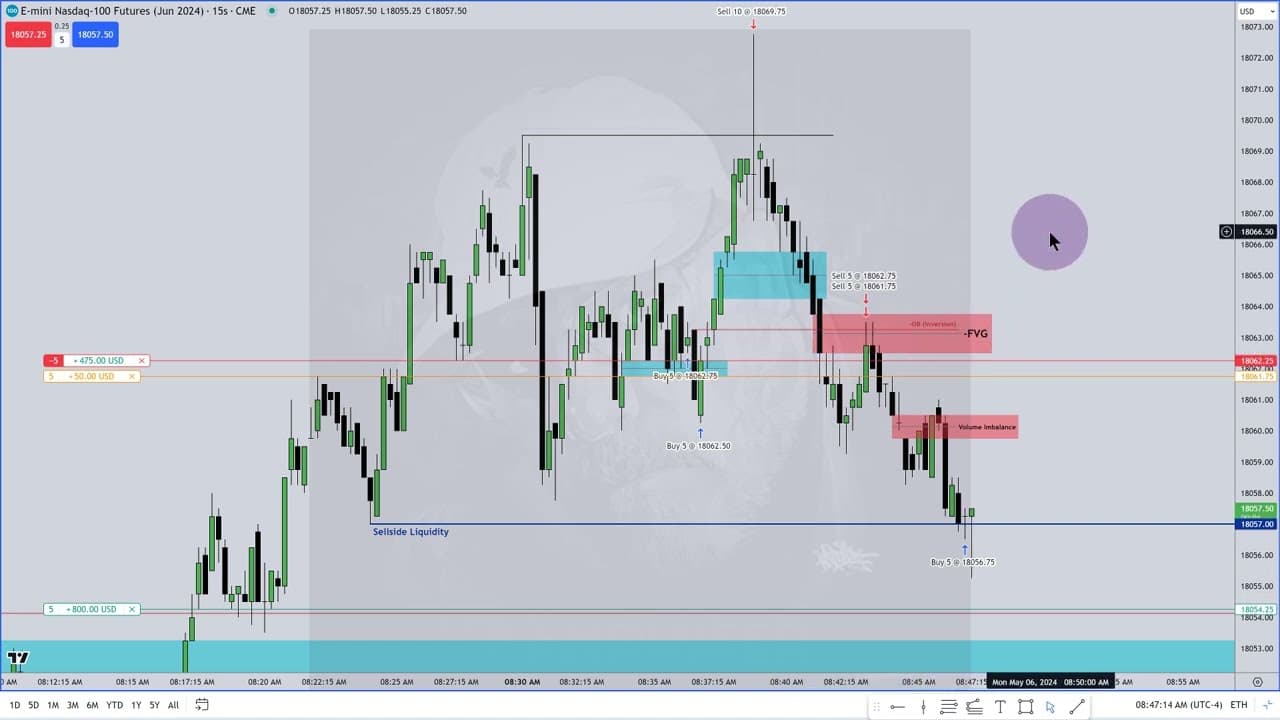
Trading without bias means entering at logical liquidity levels and expecting a logical draw on liquidity rather than guessing direction. On a 15-second NASDAQ chart, place stops below down-close candles, add near fair value gaps and volume imbalances, and take partials to cover the roughly $10 per-contract commission cost while reducing risk.
Transcript
hello folks so we're looking at the uh NASDAQ here I believe if we look at the one chart here so we have a little bit of a premium relative to our previous day's settlement we're inside this little fair value Gap here think we can go a little bit higher from where we are so we're going to go beneath this down close candle with our stop loss and we'... Read More
Key Insights
- Trading without bias means taking the liquidity available and letting logical levels draw price, rather than forcing a directional prediction; you enter where a logical draw on liquidity should make sense in the grand scheme of things.
- Micro-scalping works on very small time frames like a 15-second chart, where a trader carves income out of tiny ranges by reading price action around fair value gaps, order blocks, and volume imbalances.
- Volume imbalances are described as flexible PD arrays, meaning price can trade back and forth over them and still keep the underlying narrative active, so you should not expect them to turn the market on a dime.
- Order blocks can become inversion levels, where a level that previously acted as support or a draw flips its role, and the speaker points this out as part of the ICT framework as it 'pans out like it's designed to do.'
- Taking partials reduces risk and covers costs, with commission around $10 per contract including fees, so a trader takes five off inside an inefficiency between a candle's high and low to lock in profit.
- Stops are placed below the bodies of candles or beneath down-close candles, and a new higher high can create a problematic stop that may get hit, which is acceptable because partials have already covered costs.
- A surgical hit-and-run scalper takes no partials and exits at the first logical level of liquidity, then waits for the next setup, versus holding to see if there is more 'juice in the lemon' toward a target.
- The daily fair value gap serves as a target draw on liquidity, and a limit order is placed just below candle bodies because price may not touch the daily fair value gap high again.
Install to Summarize YouTube Videos and Get Transcripts
Explore YouTube Video Summarizer or Get YouTube Transcript Extractor
Questions & Answers
Q: What is micro-scalping in trading?
Micro-scalping is trading on very small time frames, such as a 15-second chart, to capture profit from tiny price ranges. In the video, the trader works within small ranges on NASDAQ futures, entering at logical levels like fair value gaps and volume imbalances. The speaker frames it as carving out a consistent income by reading price action, and jokes that funded account companies do not want traders doing it because it is unprofitable for them.
Q: How do you trade without bias?
Trading without bias means trading the liquidity that is available rather than forcing a directional prediction. You drop down into a very small time frame, work with a small range, and enter at logical levels while expecting a logical draw on liquidity. The trader stresses that entries should make sense in the grand scheme of things, and that this discipline of getting in at logical levels and expecting logical draws comes with experience over time.
Q: What is a fair value gap in ICT trading?
A fair value gap is an inefficiency in price that can act as a draw or an area to add to a position. In the video the trader is inside a small fair value gap expecting price to move higher, labels one as an ICT bearish fair value gap, and targets a daily fair value gap as an objective. Price reaching up into a fair value gap is used as a signal to add more to the position.
Q: Why should you take partial profits when scalping?
Taking partials reduces risk and covers costs. The trader explains commission costs are around $10 per contract with fees and everything included, so partials are taken to cover those costs and lock in profit. It also means that when a problematic higher high forms and threatens to hit the stop, it is completely okay because costs are already covered. A surgical hit-and-run scalper instead takes no partials and exits at the first logical liquidity level.
Q: What is a volume imbalance and how does it behave?
A volume imbalance, also called volume in balance in the transcript, is described as a flexible PD array. This means price can trade back and forth over the top of it and still keep the underlying narrative active. The trader warns not to expect them to turn the market on a dime; instead you judge where the order flow is in and around them. Many times they can cause the market to turn, but you must be more flexible with them.
Q: What is an inversion level in ICT concepts?
An inversion level is created when an order block flips its role, and the trader points out how an order block mentioned earlier becomes an inversion level right where price reacts. He credits this to ICT design, saying 'clever ICT,' and treats it as evidence the framework is panning out as intended. The order block is relabeled to reflect its new function as price interacts with that level.
Q: What time frame does the trader use for this scalping?
The trader uses a 15-second chart, noting it explicitly for viewers who were wondering. He looks at the one-minute chart initially to assess a premium relative to the previous day's settlement, then works within a very small range on the lower time frame. The point he emphasizes is that you can drop down into a very small time frame, work with a very small range, and still do very well.
Q: Why place a limit order just below the candle bodies?
The trader places a limit order just below the bodies of the candles because price may not even touch the daily fair value gap high again. He reasons that order flow did not come back and touch the daily fair value gap high, so he positions the limit order to capture another run into the inefficiency. He also notes there is liquidity and inefficiency in that area, giving reason for price to trade into it.
Summary & Key Takeaways
-
The video is a live micro-scalping session on NASDAQ futures using a 15-second chart. The trader identifies a premium relative to the previous day's settlement and works inside a fair value gap, adding to positions at volume imbalances and order blocks while placing stops below down-close candles.
-
Core ICT concepts are demonstrated in real time: fair value gaps, volume imbalances treated as flexible PD arrays, order blocks that become inversion levels, and short-term sell-side liquidity pools. The trader targets the daily fair value gap and uses limit orders placed just below candle bodies to capture additional runs.
-
Risk management centers on taking partials to cover roughly $10 per-contract commission costs and reduce exposure. The trader emphasizes trading without bias by entering at logical levels and expecting a logical draw on liquidity, and notes all of this is taught for free on the ICT YouTube channel.
Read in Other Languages (beta)
Share This Summary 📚
Summarize YouTube Videos and Get Video Transcripts with 1-Click
Try YouTube Summary with ChatGPT & Claude or YouTube Transcript Generator
Explore More Summaries from The Inner Circle Trader 📚



Summarize YouTube Videos and Get Video Transcripts with 1-Click
Try YouTube Summary with ChatGPT & Claude or YouTube Transcript Generator