What Are the 2025 Lecture Series NY Lunch Macro Rules for the PM Session and Final RTH Hour of Trading on 02/24/2025?
TL;DR
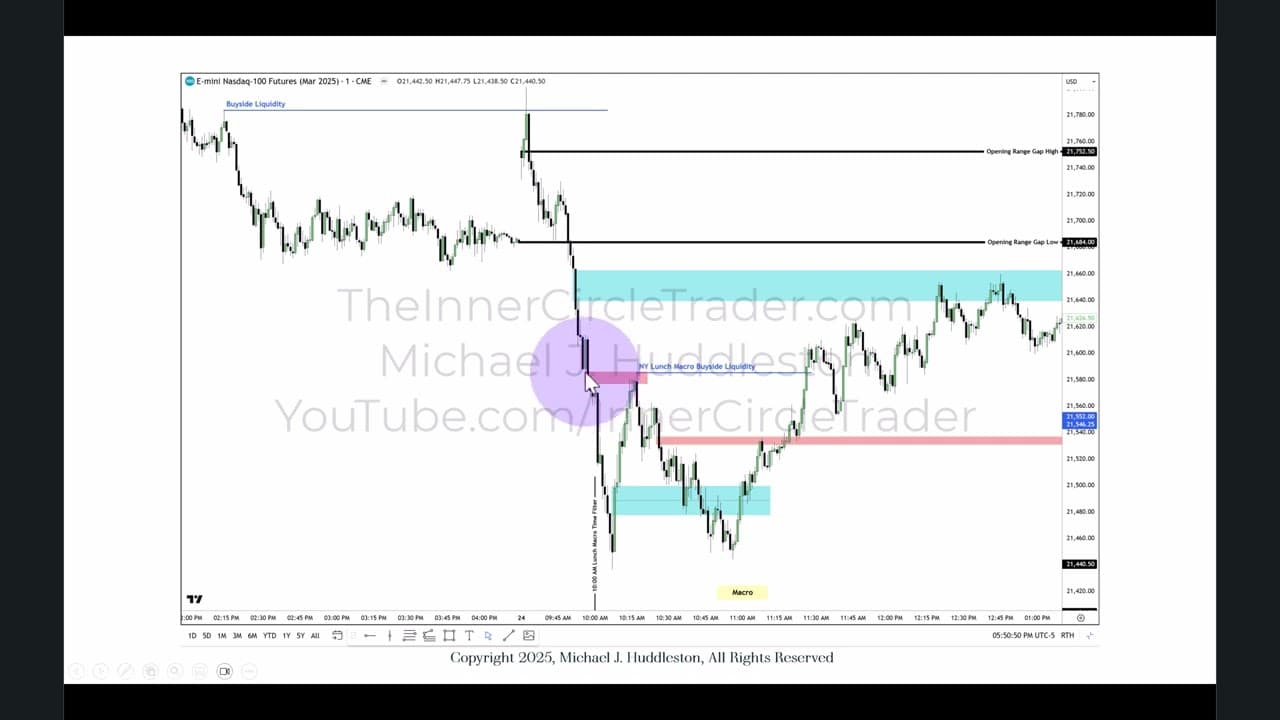
The New York lunch macro targets the first swing high formed after 10:00 a.m. following a strong decline, or the first subsequent swing low after a strong rise. After a large-range day, the rule is to avoid trading from 9:30 to 10:30 a.m. Eastern time. Read on for the time filter, confirmation criteria, opening-range gap context, and alternatives when the expected setup fails.
Transcript
e welcome back folks so we're going to be looking at the New York launch macro and the PM session so one of the things I wanted to cover this year in the 2025 lecture series is I wanted to show how using the intraday profiles of how the high the low where the open and close nest in that daily range and the effects of that and this morning following... Read More
Key Insights
- • The morning-session rule is to take no trades from 9:30 to 10:30 a.m. Eastern time after a large-range day. The restriction is intended to avoid difficult opening action and reduce the temptation to chase a sharp directional move.
- • The New York lunch macro is a retracement within the daily range. On a strongly declining morning, the expected retracement seeks buy-side liquidity, while the inverse procedure on a strongly rising morning looks toward a subsequent swing low.
- • The 10:00 a.m. time filter is significant because it marks the close of the 9:30 to 10:00 opening range. At that point, the opening range and its liquidity, gaps, and other price-delivery arrays provide a frame of reference.
- • The bearish-morning target is the first swing high formed after 10:00 a.m. Starting at the time filter and moving right across the chart produces a fixed, rule-based objective rather than a target chosen through discretion alone.
- • The bullish-morning target is the first swing low formed after 10:00 a.m. This is the mirrored application of the lunch macro for a market that rises precipitously near the opening bell and later retraces downward.
- • A one-directional opening decline without taking any short-term high supports the expectation of a retracement. The absence of a run on minor buy-side liquidity leaves a potential objective above the market after the opening range has ended.
- • A failed attempt to break the post-10:00 swing low strengthens the case for a return toward the first post-10:00 high. If price takes that low instead, the stated alternatives are to use another strategy, do nothing, or wait for the afternoon.
- • The opening-range gap midpoint has a stated 70% likelihood of being reached. In the example, price trades into the gap, reaches its 50% midpoint, visits the gap low, returns to the midpoint, and subsequently breaks aggressively lower.
- "so from 9:30 to 10:30 you can't take any trades" (4:31)
- "now the New York lunch macro is just a retracement inside of the entire daily range up to on a down day the low and the high" (5:18)
- "your time filter is 10:00 a.m." (7:31)
- "that is not a signal service it's not meant for you to try to copy me it's not meant for you to try to take live trades" (3:31)
Install to Summarize YouTube Videos and Get Transcripts
Explore YouTube Video Summarizer or Get YouTube Transcript Extractor
Questions & Answers
Q: What are the New York lunch macro rules?
Set a time filter at 10:00 a.m. and examine the price action that forms afterward. Following a one-directional decline, target the first swing high after 10:00. Following a strong rise, apply the inverse rule and target the first subsequent swing low.
Q: How do you identify the New York lunch macro target after a decline?
Mark 10:00 a.m. with a vertical line and move right across the chart. The first high encountered becomes the retracement objective. This rule applies when the opening move is one-directional and does not take a minor buy-side liquidity pool or short-term high.
Q: Why does the lunch macro use 10:00 a.m. as its time filter?
The first 30 minutes of trading form the opening range, running from 9:30 to 10:00 a.m. After 10:00, the completed opening range and the price action left by the initial move provide the framework for identifying the lunch-macro target.
Q: When should index futures traders avoid the morning session?
After a large-range day, the mentorship rule is to take no trades during the following morning's first hour. For index futures, that restriction runs from 9:30 to 10:30 a.m. The opening action may be stagnant, difficult to navigate, or forceful enough to encourage chasing price.
Q: What supports a retracement after a strongly declining open?
The setup begins with a one-directional decline from the opening bell that leaves minor buy-side liquidity untouched. If no short-term high is taken during the drop, price is expected to retrace into the daily range and seek buy-side liquidity.
Q: What confirms the lunch-macro retracement toward the first post-10:00 high?
In the demonstrated decline, price retraces into a premium array, moves lower, and fails to break the relevant post-10:00 swing low. That failure supports a return toward the first high formed after 10:00. Gaps, inversion fair value gaps, and rejection blocks provide additional context.
Q: What should a trader do if price breaks the relevant post-10:00 swing low?
If price takes the relevant swing low, the demonstrated lunch-macro expectation is no longer supported in the same way. The stated alternatives are to use another strategy, do nothing, or wait for the afternoon session.
Q: What role does the opening-range gap play in the setup?
The gap is measured from its high to its low, and its midpoint represents a 50% retracement. The transcript states a 70% likelihood of price reaching that midpoint. In the example, price reaches the midpoint, trades to the gap low, returns to the midpoint, and then breaks aggressively lower.
Summary & Key Takeaways
-
The framework begins with risk control after a large-range day. Students are instructed to avoid the following morning’s first hour, from 9:30 to 10:30 a.m. Eastern time, because the opening action may be stagnant, difficult to navigate, or capable of encouraging traders to chase a forceful move.
-
The lunch macro uses 10:00 a.m. as its time filter because that moment closes the 9:30 to 10:00 opening range. After a one-directional decline that leaves minor buy-side liquidity untouched, the method identifies the first swing high formed after 10:00 as the retracement objective.
-
Confirmation depends on how price behaves after the target is identified. In the demonstrated decline, price retraces into a premium array, moves lower, and fails to break a relevant swing low. That failure supports a return toward the first post-10:00 high, with gaps, inversion fair value gaps, and rejection blocks providing context.
Read in Other Languages (beta)
Share This Summary 📚
Summarize YouTube Videos and Get Video Transcripts with 1-Click
Try YouTube Summary with ChatGPT & Claude or YouTube Transcript Generator
Explore More Summaries from The Inner Circle Trader 📚


Summarize YouTube Videos and Get Video Transcripts with 1-Click
Try YouTube Summary with ChatGPT & Claude or YouTube Transcript Generator