How Do You Trade the ICT Charter Price Action Model 12 for 20-Pip Scalps?
TL;DR
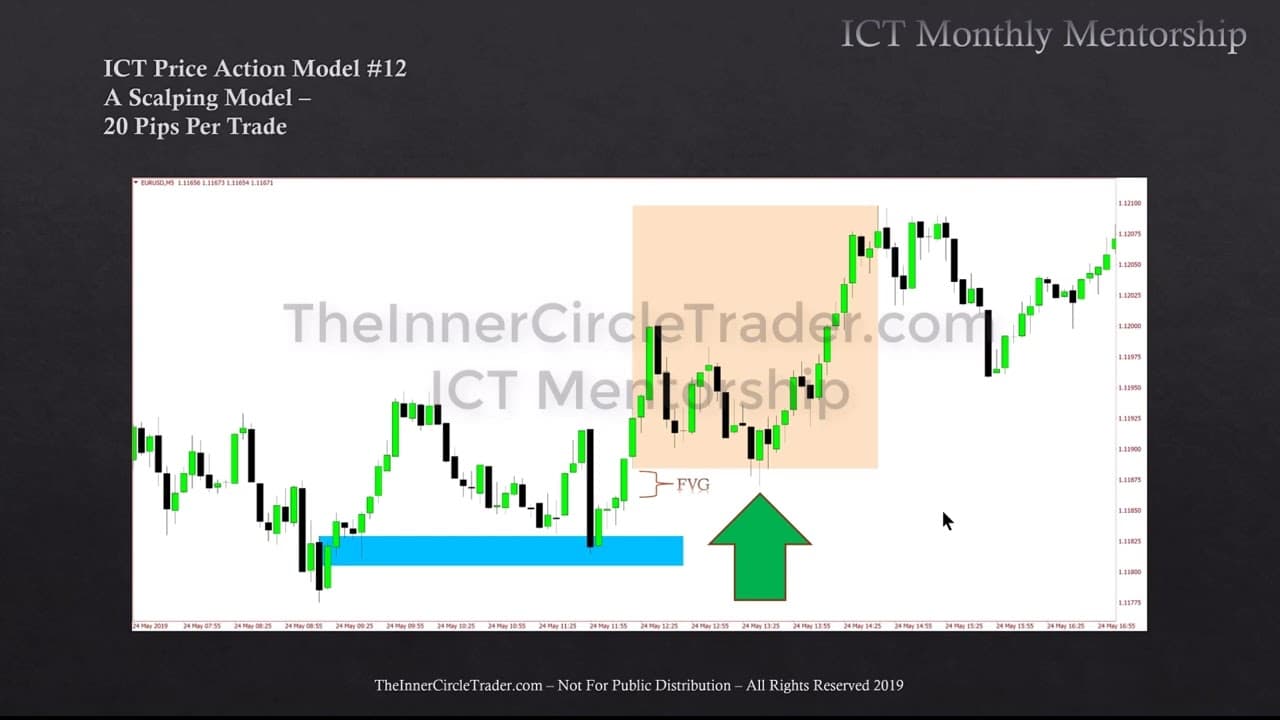
Trade ICT Charter Price Action Model 12 by identifying the daily bias, waiting for an order block retest and expansion swing, then entering at the fair value gap inside that swing for a 20-pip run. The scalping model is presented on 5-minute charts, and the order block need not have a gap linked directly to its candle. Read on to understand the exact sequence and entry zone.
Transcript
okay folks welcome back this is the ICT mentorship price action model number 12 it's a scalping model and its focus is 20 Pips per trade okay see I price action model number 12 a scalping model 20 Pips per trade the stage used for this model is a daily range expansion order blocks and fair value Gap is the setup internal range to 20 pip price runs ... Read More
Key Insights
- Model 12 uses daily range expansion as the stage, order blocks with a fair value gap as the setup, and internal range to 20 pip price runs as the pattern. It is built on 5 minute charts for scalping but scales to larger time frames for larger pip hauls.
- The sequence matters more than any single element: an order block forms, price retests it, an expansion swing unfolds out of that retest, and only then is the fair value gap inside that expansion swing used as the entry. Trading the gap without the prior steps is not the model.
- A high probability order block by the speaker's own definition has a fair value gap linked directly to the candle. Model 12 explicitly does not require that. It filters instead on any down closed candle at the beginning of an initial expansion price swing that later gets retested.
- The answer to the recurring question of which fair value gap to trade is the one found inside the expansion price swing that followed the order block retest. This filter exists because trying to trade every potential fair value gap produces a conundrum.
- Buying at the order block retest itself is avoided. The trader does not want to be a buyer at that moment because the order block has not yet proved there is expansion. The proof is the expansion swing, which reveals that smart money accumulated orders at that level.
- Only the upper portion of a bullish order block candle is used, from the high down to the midpoint or mean threshold, because that is where the most sensitivity sits. Full order block theory would use the entire candle instead.
- A fair value gap is framed by one single pass through: the previous candle's high, the next candle's low, and the low of the candle in between marks the gap's high. Price needs to trade to that price or lower, plus spread, for the entry to fill.
- Small ranges bring large ranges, and displacement on both sides of a compressed range signals the volatility a scalper wants. The example shows price kept in a relatively small range with displacement before and after, preceding the directional impulse.
Install to Summarize YouTube Videos and Get Transcripts
Explore YouTube Video Summarizer or Get YouTube Transcript Extractor
Questions & Answers
Q: What is ICT Charter Price Action Model 12?
ICT Price Action Model 12 is a scalping model focused on 20 pips per trade. It uses daily range expansion as the stage, order blocks and a fair value gap as the setup, and internal range liquidity to facilitate an entry toward a 20-pip price run.
Q: What is the entry sequence for the 20-pip scalping model?
First identify the likely direction of the current daily candle, then wait for an order block to form and be retested. After an expansion swing unfolds from that retest, find the fair value gap inside the swing and use it to enter in the direction of the daily bias.
Q: Which fair value gap should you trade in Model 12?
Trade the fair value gap inside the expansion price swing that occurs after the order block retest. The model does not require a gap linked directly to the original order block candle, and it does not treat every potential fair value gap as an entry.
Q: Why wait instead of buying immediately at the order block retest?
At the retest, the order block has not yet proved that price will expand. The trader waits for an expansion swing because that reaction supports the narrative that smart money bought and accumulated orders at the order block; only then is the gap inside the swing used for entry.
Q: Can Model 12 use an order block without a directly linked fair value gap?
Yes. The model can use a down-closed candle at the beginning of an initial expansion price swing even when no fair value gap is linked directly above that candle, provided the order block is later retested and produces another expansion swing.
Q: Which part of a bullish order block is used for the retest zone?
The model highlights the upper portion of the down-closed candle, from its high to its midpoint or mean threshold. Although full order block theory would use the entire candle, the speaker prefers the upper portion because he says it has the most sensitivity.
Q: How is the bullish fair value gap entry framed?
The gap is identified from a single pass through involving the previous candle’s high and the next candle’s low. The middle candle’s low frames the high of the fair value gap, and price must trade to that level or lower, with the spread added, for the buy entry.
Q: Is ICT Price Action Model 12 limited to 5-minute charts and 20-pip targets?
No. The model is presented for scalping on 5-minute charts with a focus on 20 pips per trade, but the speaker says it is not limited to scalping or 20 pips. Scaling it to larger time frames can produce larger pip hauls.
Q: How do you take profits on an ICT Model 12 scalp?
Bank the 20-pip move and take 80% off. The remaining position can target additional liquidity objectives using Target Theory and other models from the core content.
Q: Why are small ranges useful for ICT Model 12 scalps?
Small ranges can lead to large ranges, providing the volatility and directional impulse an intraday scalper wants. The model looks to combine an order block, an expansion swing, and a fair value gap before pursuing the price run.
Q: Does ICT Model 12 try to catch the exact high or low?
No, the model is not trying to capture the absolute low or absolute high. Its specific objective is a straightforward 20-pip run, although price may continue farther.
Summary & Key Takeaways
-
Price action model number 12 is a scalping model targeting 20 pips per trade, presented on 5 minute charts. The stage is daily range expansion, the setup is order blocks coupled with a fair value gap, and the pattern is internal range liquidity driving a 20 pip price run in the direction of the daily bias.
-
The model deliberately accepts order blocks that would fail the high probability definition. A down closed candle at the start of an expansion swing may have no fair value gap above it because price closes any likelihood of a gap. Rather than discard it, the model waits for the retest and the expansion swing that follows to prove the order block.
-
Once the expansion swing unfolds, the trader looks inside that swing for the fair value gap and uses its upper boundary, the low of the candle forming the gap, as the entry with spread added. Drawdown in the examples is described as one or two pips, and the shaded 20 pip run is only an illustration since price often extends further.
Read in Other Languages (beta)
Share This Summary 📚
Summarize YouTube Videos and Get Video Transcripts with 1-Click
Try YouTube Summary with ChatGPT & Claude or YouTube Transcript Generator
Explore More Summaries from The Inner Circle Trader 📚

Summarize YouTube Videos and Get Video Transcripts with 1-Click
Try YouTube Summary with ChatGPT & Claude or YouTube Transcript Generator