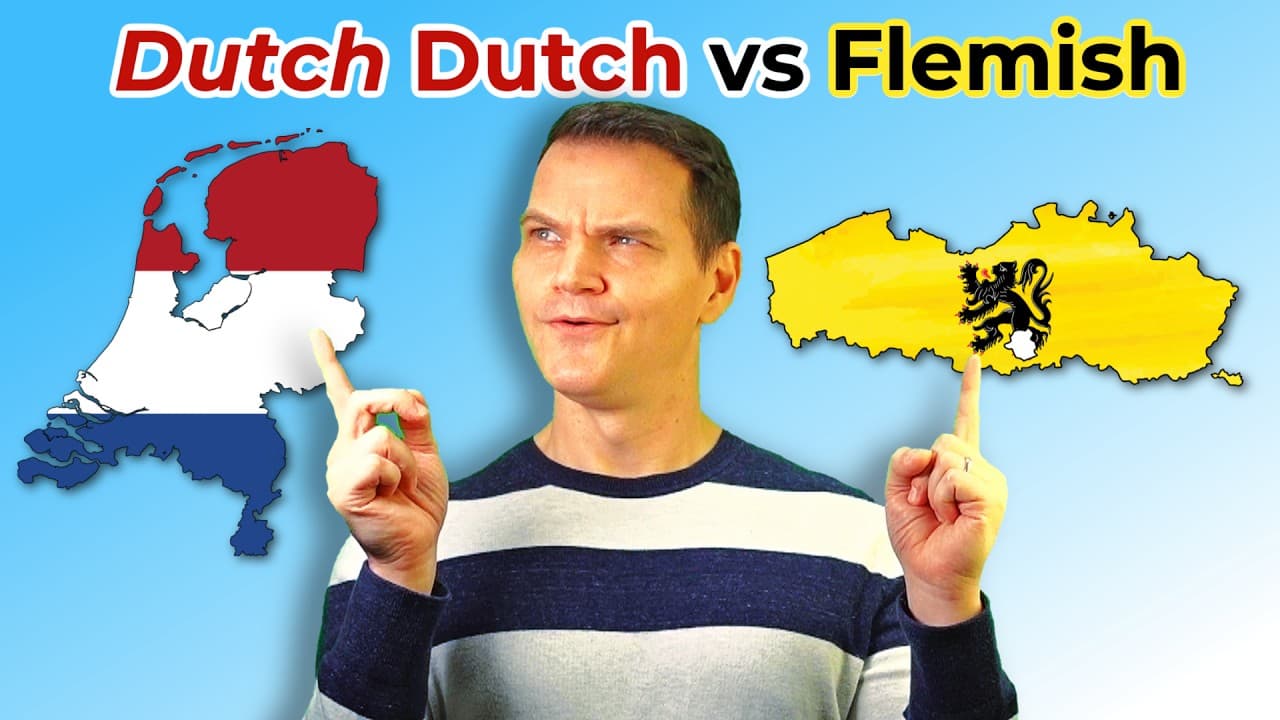
How Different Are DUTCH Dutch and *Flemish*?
TL;DR
Explores the differences between Dutch and Flemish language variations.
Transcript
the Dutch language is the third most widely spoken Germanic language after English and German it's the official language of the Netherlands and one of the official languages of Belgium where it's the native language of around 60% of the population mainly in the northern region of Flanders no not this Flanders this Flanders in Dutch flandre the hist... Read More
Key Insights
- Dutch is the third most widely spoken Germanic language, official in both the Netherlands and Belgium, with distinct variations.
- Flemish, spoken in Belgium's Flanders region, differs from Dutch Dutch in pronunciation, grammar, and vocabulary.
- Tussentaal, a semi-standardized Flemish, combines elements of standard Dutch and local dialects, differing from dialects in the Netherlands.
- Pronunciation differences include the 'hard G' in Dutch Dutch versus the 'soft G' in Flemish.
- Flemish often drops final 'T' sounds and uses singular pronouns differently compared to standard Dutch.
- Vocabulary variations include different words for everyday items, with some Flemish words influenced by French due to Belgium's bilingual nature.
- Flemish dialects retain three gender distinctions, unlike Dutch Dutch, which has merged masculine and feminine into a common gender.
- Dialectal and vocabulary differences can cause confusion or amusement between Dutch and Flemish speakers.
Install to Summarize YouTube Videos and Get Transcripts
Explore YouTube Video Summarizer or Get YouTube Transcript Extractor
Questions & Answers
Q: What is the main focus of the video?
The video focuses on the differences between Dutch as spoken in the Netherlands and Flemish in Belgium. It explores variations in pronunciation, grammar, and vocabulary, particularly highlighting Tussentaal, a semi-standardized form of Flemish that incorporates elements of standard Dutch and local dialects.
Q: How does pronunciation differ between Dutch Dutch and Flemish?
One major pronunciation difference is the 'hard G' in Dutch Dutch, which is a voiceless uvular fricative, compared to the 'soft G' in Flemish, which is either a voiced or voiceless fricative. Additionally, Flemish often drops final 'T' sounds, which is less common in Dutch Dutch.
Q: What is Tussentaal and how is it used?
Tussentaal, literally meaning 'between language,' is a semi-standardized form of Flemish spoken in Belgium. It combines elements of standard Dutch and local dialects, serving as an informal way of speaking in everyday situations, similar to the role of standard Dutch in the Netherlands.
Q: How does vocabulary differ between Dutch Dutch and Flemish?
Vocabulary differences include different words for common items, influenced by French in Flemish due to Belgium's bilingual nature. For example, the word 'poepen' means 'to defecate' in Dutch Dutch but 'to have sex' in Flemish, illustrating potential for confusion between speakers.
Q: What grammatical differences exist between Dutch Dutch and Flemish?
Flemish retains three gender distinctions, unlike Dutch Dutch, which merges masculine and feminine into a common gender. Additionally, Flemish often uses singular pronouns differently, such as using 'gij' informally, and sometimes includes an extra 'do' in subordinate clauses.
Q: How do dialects in the Netherlands compare to those in Flanders?
While both regions have numerous dialects, in the Netherlands, standard Dutch is increasingly used in daily life, unlike in Flanders where Tussentaal serves as a bridge between dialects and standard Dutch. Dialects in southern Netherlands are often similar to Flemish dialects.
Q: What role does French play in Flemish vocabulary?
French significantly influences Flemish vocabulary due to Belgium's bilingual nature. Many Flemish words are borrowed from French, such as 'velo' for 'bicycle' and 'chauffage' for 'heating,' reflecting the linguistic interplay between French and Flemish in Belgium.
Q: Are Dutch Dutch and Flemish mutually intelligible?
Yes, Dutch Dutch and Flemish are generally mutually intelligible, but differences in vocabulary, grammar, and pronunciation can cause temporary confusion or amusement. Despite these variations, speakers in both regions can communicate effectively, understanding the nuances of each variety.
Summary & Key Takeaways
-
The video discusses the differences between Dutch as spoken in the Netherlands and Flemish in Belgium, focusing on pronunciation, grammar, and vocabulary. It highlights the semi-standardized Tussentaal used in Flanders, which combines elements of standard Dutch and local dialects.
-
Pronunciation differences include the 'hard G' in Dutch Dutch versus the 'soft G' in Flemish. Flemish also often drops final 'T' sounds and uses singular pronouns differently compared to standard Dutch, with vocabulary variations influenced by French.
-
While both Dutch and Flemish are mutually intelligible, differences in vocabulary, grammar, and pronunciation can lead to confusion or amusement. The video emphasizes the unique linguistic landscape in Belgium, where French also plays a significant role.
Read in Other Languages (beta)
Share This Summary 📚
Summarize YouTube Videos and Get Video Transcripts with 1-Click
Try YouTube Summary with ChatGPT & Claude or YouTube Transcript Generator
Explore More Summaries from Langfocus 📚



Summarize YouTube Videos and Get Video Transcripts with 1-Click
Try YouTube Summary with ChatGPT & Claude or YouTube Transcript Generator