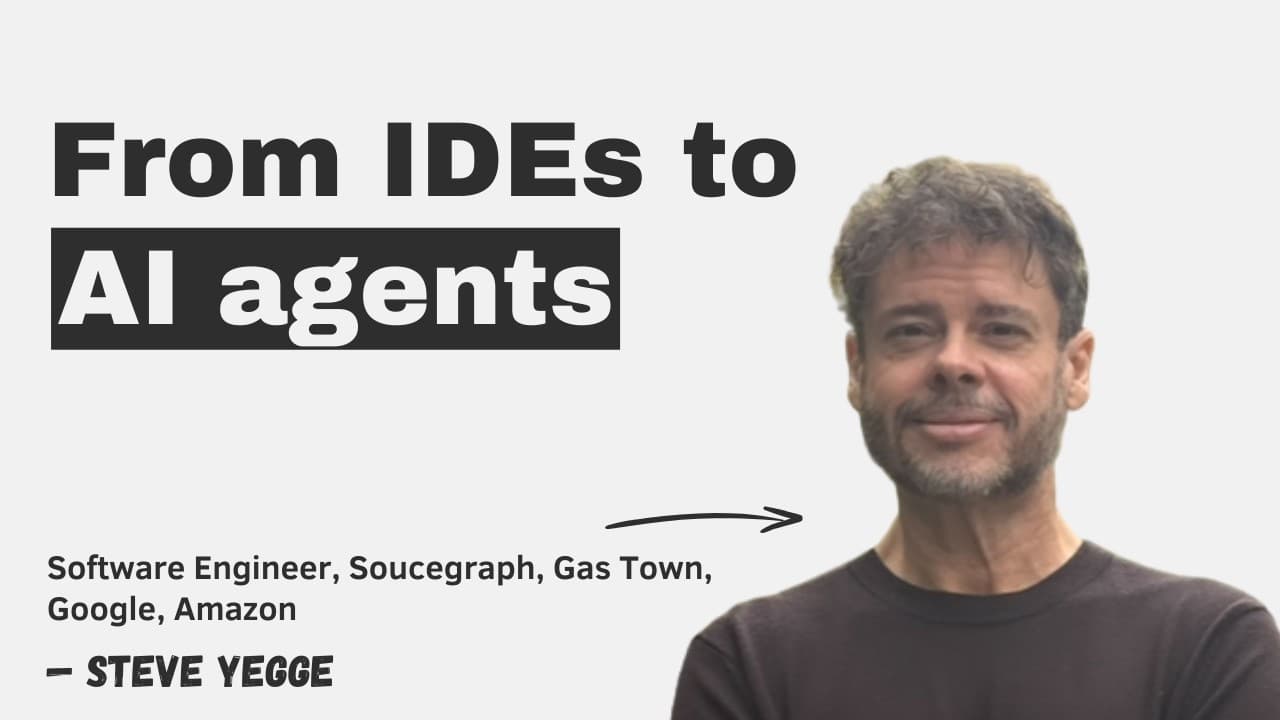
How to use AI agents to boost engineering productivity
TL;DR
AI agents can multiply engineering output by orchestrating multiple tasks, but true gains require moving through defined levels of adoption rather than chasing the latest tool. Early stages focus on avoiding AI and basic automation, while later stages enable parallel agent execution that scales impact and changes how teams operate.
Transcript
Tell me about your levels. >> Level one, no AI. Level two, it's the yes or no. Can I do this thing in your IDE? At level six, you're bored because your agent's busy. >> What is Gas Town? >> If chat is complet, well, then we're going to put agents in a loop and that'll be an orchestrator. That's all it is. It's agents running agents. There's a vampi... Read More
Key Insights
- AI adoption has eight levels, from no AI to orchestrating multiple agents, defining a path for engineers to increase productivity without overwhelming complexity.
- The vampiric burnout effect is described as AI hype causing temporary enthusiasm followed by fatigue, underscoring the importance of sustainable workflows and realistic productivity metrics.
- Gas Town is an open source AI agent orchestrator illustrating the concept of agents running agents as a framework for scalable automation in engineering.
- The conversation posits that big tech output may decline while small teams could rival larger companies, emphasizing shifts in organizational scale and collaboration.
- Industry maturity moves up ladders such as raw graphics to game engines and bare metal to cloud, suggesting engineers must continually ascend abstraction layers.
- Understanding how compilers influence programming efficiency is linked to deeper knowledge of systems, signaling that foundational knowledge remains valuable even as tools evolve.
- The role of AI is framed as amplifier rather than replacer, with a focus on augmenting human capabilities and enabling higher leverage when integrated thoughtfully.
- The need for evolving education and curricula is highlighted, as what is taught and necessary skills keep changing with technology and architectural shifts.
Install to Summarize YouTube Videos and Get Transcripts
Explore YouTube Video Summarizer or Get YouTube Transcript Extractor
Questions & Answers
Q: A real search query question about the video (e.g. 'How to...', 'What is...', 'Why does...', 'When should...'). Question 1
What are the eight levels of AI adoption for engineers and how do they differ in terms of tool usage, orchestration, and expected productivity gains? The levels range from no AI to using a single tool, to yes or no checks, to running multiple agents in parallel, each step increasing complexity and potential output while also raising management and cognitive load concerns. Understanding these levels helps teams plan gradual, sustainable improvements without burnout.
Q: Question 2
How does Steve Yegge describe the vampire burnout effect related to AI and what strategies does he suggest to mitigate it? He explains that initial excitement over AI can lead to heavy work and fatigue if productivity does not scale. Mitigation involves designing workflows that deliver verifiable efficiency, avoiding overreliance on hype, and ensuring that tooling aligns with real business value and team capacity.
Q: Question 3
What is Gas Town and why is it significant in the discussion about AI agents? Gas Town is an open source AI agent orchestrator that demonstrates the concept of agents running agents. It serves as a concrete example of how orchestration can enable scalable automation in software development, while also underscoring potential cautions about relying on complex multi-agent systems without clear governance.
Q: Question 4
What did Steve say about the evolution of software engineer skills and how this affects education and hiring? He argues that knowing how systems work, including compiler concepts, remains relevant even as tools evolve. The pace of change in what is taught is rapid, and universities and companies should teach adaptable problem solving and system thinking rather than only current toolchains.
Q: Question 5
According to the discussion, what is the expected impact of AI on large tech companies versus small teams? The conversation suggests big tech output may dwindle while small teams of 2 to 20 people could rival larger organizations in impact. This implies a shift toward lean, highly capable teams leveraging AI to amplify productivity and innovate rapidly.
Q: Question 6
How do the levels of AI adoption relate to the day-to-day work of engineers, and what practical steps can teams take to progress? Levels correlate with the increasing complexity of tool usage and automation, culminating in parallel agent execution. Practically, teams should start with understanding current bottlenecks, implement low-friction automation, measure impact, and gradually introduce orchestrated AI while managing cognitive load.
Q: Question 7
What role does understanding the history of software engineering play in preparing for AI driven changes? The discussion traces shifts from bare metal and compilers to cloud and AI, illustrating that history informs how teams adapt to new architectures and processes. It argues that learning to navigate abstraction layers and evolving job roles is essential for resilience.
Q: Question 8
What is the core takeaway about AI's role in engineering according to the episode, and how should developers approach adoption? The core takeaway is that AI amplifies human capability rather than replaces engineers. Developers should approach adoption with deliberate strategy, sustainable workflows, and a focus on delivering real business value, while being mindful of new technical debt and the need for governance in multi-agent setups.
Summary & Key Takeaways
-
Steve argues engineers must navigate eight levels of AI adoption, from no AI to running multiple agents in parallel, to avoid burnout and stagnant output.
-
The discussion highlights a vampire burnout effect where enthusiasm for AI can lead to fatigue if productivity does not scale, and stresses the need for disciplined workflow design.
-
Gas Town is presented as an open source AI agent orchestrator that embodies the concept of agents running agents, illustrating how orchestration can shape future engineering practices.
Read in Other Languages (beta)
Share This Summary 📚
Summarize YouTube Videos and Get Video Transcripts with 1-Click
Try YouTube Summary with ChatGPT & Claude or YouTube Transcript Generator
Explore More Summaries from The Pragmatic Engineer 📚

Summarize YouTube Videos and Get Video Transcripts with 1-Click
Try YouTube Summary with ChatGPT & Claude or YouTube Transcript Generator