What Are Cognitive Distortions and How Do They Work?
TL;DR
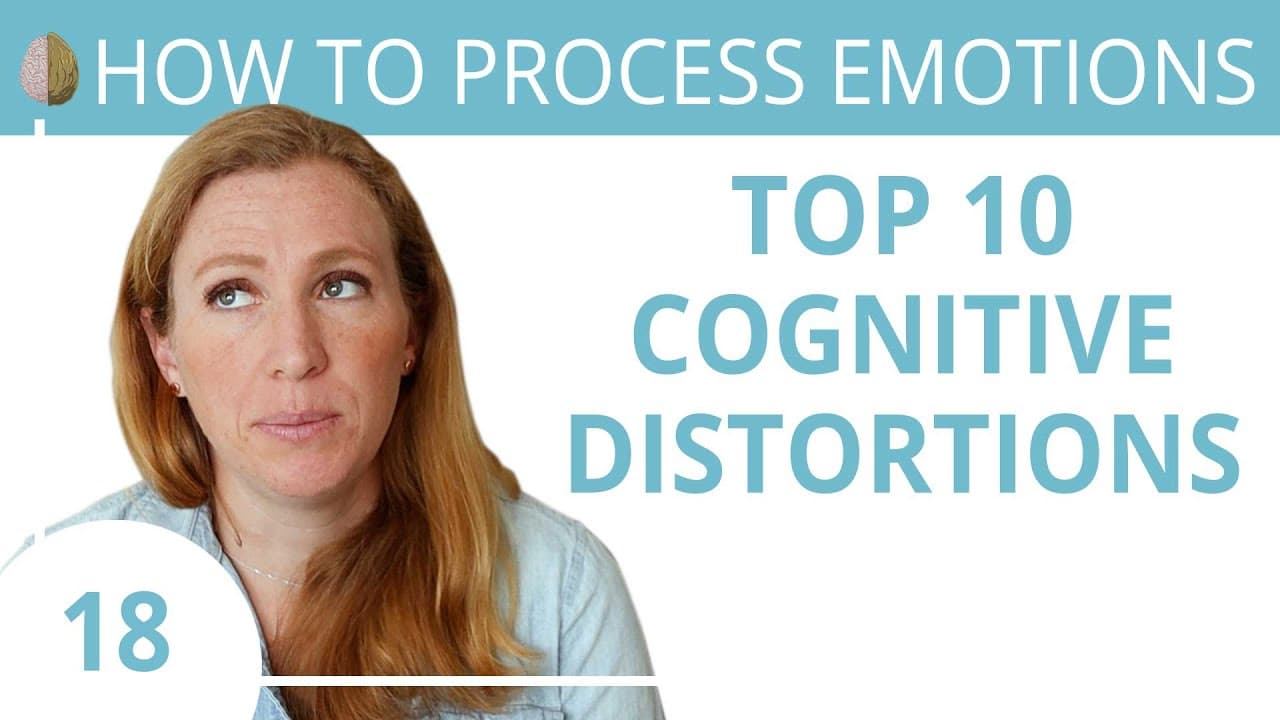
Circumstances do not cause emotions; interpretations do. Cognitive distortions are habitual thought patterns that twist reality so you feel bad, broken, or threatened while sounding rational to yourself. The ten covered include all-or-nothing thinking, over generalizing, black and white thinking, mind reading, catastrophizing, emotional reasoning, labeling, and mental filtering. Identifying them is the foundation of cognitive behavioral therapy.
Transcript
you know what's funny about our mind it lies to us all the time our mind loves to convince us that circumstances are the cause of our emotions so for example you may think i'm sad because i didn't get the job but here's the thing it's not the outside circumstances that make us sad or anxious it's how we interpret them it's how we think about th... Read More
Key Insights
- Emotions come from interpretation, not circumstance. Not getting a job does not cause sadness by itself; the sadness comes from thoughts like "I'm such a failure" instead of "I don't have the qualifications" or "I need to change my approach in the next interview."
- Cognitive distortions are ways the mind convinces you of something that is not actually true but feels true. Thoughts twist reality until you feel bad, broken, or deficient, or you start seeing the world as dangerous, threatening, or cruel.
- The defining trait of a distortion is that you do not realize you are doing it. Talking through the lens of a distortion sounds rational and accurate to yourself, and because you have thought that way for years, it feels normal and natural.
- All or nothing thinking says that if you cannot do it all perfectly or fix it all at once, you might as well not bother. Eating one cookie means the diet already failed, so you eat the whole box. It produces hopelessness and justified giving up.
- Over generalizing takes one bad event and assumes everything afterward will be awful, using words like always and never: "I'm never going to get a good job," or after one rejection, "there aren't any girls who could love me, I'm always going to be alone."
- Mind reading is assuming you know how others feel about you, as in "nobody likes me," "everyone is judging me," or "my boss must think I'm incompetent." It produces insecurity, anxiety, fear, and sometimes anger, without being based on reason.
- Catastrophizing treats fears and worries as facts, believing the worst case scenario in your head is the most likely outcome. It is what-if thinking: she is late and it is raining, so she must have crashed her car and be upside down in a ditch.
- Labeling turns a behavior into an identity, converting "he made a mistake" into "he's a complete idiot" or a few mistakes into "I'm a complete loser." Labels create hopelessness because an identity feels permanent and unchangeable.
Install to Summarize YouTube Videos and Get Transcripts
Explore YouTube Video Summarizer or Get YouTube Transcript Extractor
Questions & Answers
Q: What is a cognitive distortion?
A cognitive distortion is a way your mind convinces you of something that is not actually true but feels true. Your thoughts twist reality, so you start to feel like you are bad, broken, or deficient, or you begin to see the world as dangerous, threatening, or cruel. The key feature is that you do not realize you are doing it. You think the way you see things is reality, you sound rational and accurate to yourself, and the pattern is habitual because you have been thinking that way for so long that it feels normal and natural.
Q: Why do cognitive distortions cause depression and anxiety?
Getting stuck in thought patterns that are distorted, untrue, or unhelpful contributes to depression, anxiety, and other mental illness, and distorted thinking also makes people less successful in both professional and personal life. The reason is that circumstances themselves do not create emotions; how you interpret them does. Not getting a job produces sadness through interpretations like "I'm such a failure" or "this career will never work out" rather than through the event itself. Distortions also create a reality in which change seems impossible, leaving you feeling trapped and hopeless.
Q: How does all or nothing thinking work?
All or nothing thinking is the belief that if you cannot do something perfectly, or cannot fix it all at once, you might as well not bother at all. You see yourself as either perfect or a failure, which is common with performance: saying "I'm failing math" while getting a C, or eating one cookie, deciding the diet is already ruined, and eating the entire box. In the example used, James knows he should save money but is so deep in debt that trying feels pointless, so he buys a fancy watch or the next big video game instead. It usually leaves you feeling hopeless, depressed, and justified in giving up.
Q: What is the difference between over generalizing and black and white thinking?
Over generalizing takes one bad thing and assumes everything afterward will be awful, producing thoughts like "I'm never going to get a good job," "people will always take advantage of me," or "I have the worst luck in the entire world." After one rejection, James concluded "there aren't any girls who could love me, I'm always going to be alone." Black and white thinking means thinking in extremes and seeing only the negative in a situation or in yourself, as in "I'm a complete failure" or "my parents are such idiots." Both are flagged by extreme wording such as always, never, completely, and terrible.
Q: What is mind reading in cognitive behavioral therapy?
Mind reading is assuming that people do not like you, or assuming that you already know how they feel about you. It sounds like "nobody likes me," "everyone is judging me," or "my boss must think I'm incompetent." In session, James would sometimes tell the therapist "you must think I'm a terrible person." Mind reading makes you feel insecure, anxious, and fearful, and sometimes angry, vindictive, or upset, but it is not really based on reason, since you are treating an assumption about someone else's private thoughts as established fact.
Q: How do you recognize catastrophizing?
Catastrophizing is assuming your fears and worries must be true and believing the worst case scenario in your head is the most likely outcome. It is what-if thinking, imagining catastrophes: "this is never going to work, I'm going to fail and make a complete fool of myself," or noticing someone is late in the rain and concluding she crashed her car and is upside down in a ditch. James said things like "I'm never going to be successful, I'm going to be stuck working fast food for the rest of my life," even though in his early 20s a couple of years of training could change his entire future. It makes you feel fearful, anxious, and hopeless, and it prevents real helpful action.
Q: What is emotional reasoning and why is it misleading?
Emotional reasoning is thinking that your feelings accurately reflect reality. Feeling stressed about school becomes "the teacher must be giving us too much homework." Feeling hurt becomes "the other person must be a jerk." Feeling anxious in social situations becomes "I must be an awkward person," though there is a real difference between feeling anxious and actually acting awkward, just as feeling stupid is not the same as being stupid. James felt discouraged and hopeless about his future ability to succeed, so he decided to believe it truly was hopeless. Emotional reasoning takes any emotion and makes it bigger.
Q: Why is labeling yourself harmful?
Labeling takes a behavior and turns it into an identity. Instead of "he made a mistake," you label a neighbor a complete idiot; instead of noting your own mistakes, you conclude "I'm a complete loser, I'm broken, I'm a failure." When James could not find a new job right away, he called himself a loser who would never be successful, even though in his mid-20s he had his entire life to learn the skills he needed. Labeling creates hopelessness, because if something is your identity there is nothing you can do about it. The truth is that we are not what we feel or do, and everyone has an immense capacity to learn, grow, change, and improve.
Q: What is mental filtering?
Mental filtering is only seeing one side of a situation, usually the negative, and filtering out the positive. You ignore the good things your boss does and feel constantly annoyed at him, or you minimize the good things you do and dwell only on your mistakes. The example given is how compliments are often received: they are immediately downplayed with "oh, you're so kind," while criticism is taken to heart, dwelled on, and worried about for days. James would often dwell on his failures in the same way.
Q: How can you change how you feel using cognitive behavioral therapy?
You change how you feel by changing how you think. The first step is to learn what cognitive distortions are and to notice when you are using them, because once you can identify a distortion you also gain power over it. Understanding cognitive distortions is the foundation of cognitive behavioral therapy, one of the most common and very effective treatments for depression, anxiety, and other mental illnesses. This skill is taught in two parts: the first covers the ten common distortions, and the second covers what to do about them by changing how you think.
Q: Who is James in this explanation of cognitive distortions?
James is a fictional character based on a couple of real clients mixed together, used to illustrate how each distortion works in daily life. He is a manager at a restaurant who would rather be a pilot, he is in his mid-20s, he is single and wishes he was married, and he grew up in an abusive home where his father and stepfather are both now in prison. On his own, he is trying to figure out how to live a good life, and each distortion is shown through the specific things he says about his debt, his dating life, his boss, and his career.
Q: Are perfectionism and people pleasing related to cognitive distortions?
Yes. Signs include feeling like you are never good enough, putting other people's needs before your own to the point of burnout, or changing how you act, talk, or look to please others at the expense of your own happiness. Perfectionism and people pleasing can fuel issues such as depression, anxiety, eating disorders, body image issues, low self-esteem, and relationship problems. The video points to an online course, Overcoming Perfectionism and People Pleasing, made with Dr. Carly LeBaron, who has 13 years of experience helping clients with these issues, containing five hours of instruction.
Summary & Key Takeaways
-
The mind convinces us that circumstances cause emotions, but interpretation does the work. Missing out on a job feels devastating because of thoughts like "I'm such a failure" or "nothing good ever happens to me." Getting stuck in distorted, untrue, or unhelpful thought patterns contributes to depression, anxiety, and other mental illness, and makes people less successful professionally and personally.
-
Cognitive distortions feel true even though they are not, and they operate invisibly: you believe your view is simply reality, you sound rational to yourself, and the habit is so old it feels natural. Learning what the distortions are and noticing when you use them is the foundation of cognitive behavioral therapy, one of the most common and effective treatments for depression and anxiety.
-
The distortions covered include all or nothing thinking, over generalizing, black and white thinking, mind reading, catastrophizing, emotional reasoning, labeling, and mental filtering, illustrated through James, a fictional composite of real clients: a restaurant manager in his mid-20s who wants to be a pilot, grew up in an abusive home, and is trying to build a good life.
Read in Other Languages (beta)
Share This Summary 📚
Summarize YouTube Videos and Get Video Transcripts with 1-Click
Try YouTube Summary with ChatGPT & Claude or YouTube Transcript Generator
Explore More Summaries from Therapy in a Nutshell 📚





Summarize YouTube Videos and Get Video Transcripts with 1-Click
Try YouTube Summary with ChatGPT & Claude or YouTube Transcript Generator