How does blood flow restriction training boost strength?
TL;DR
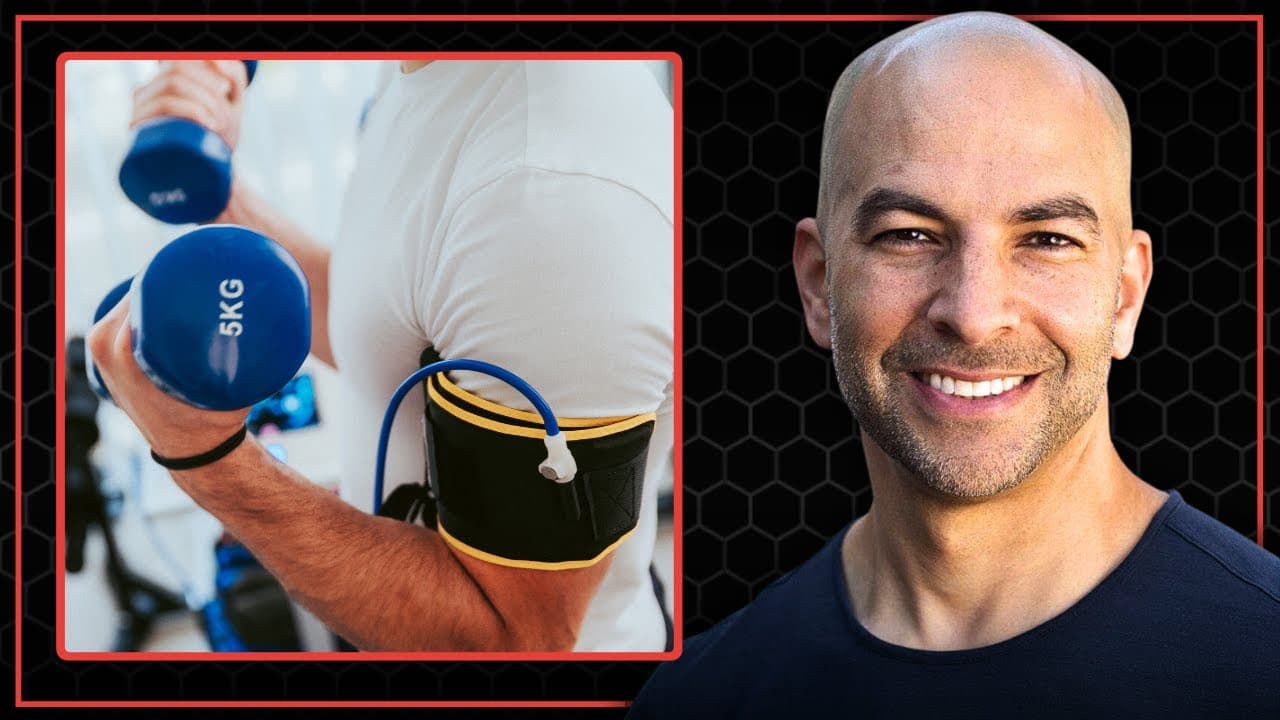
BFR training with low loads and higher reps often yields greater strength and hypertrophy than the same work with no BFR, though comparing it to high load, low rep training is still uncertain. It is most effective as a rehab tool and as a finisher rather than the main training method. Pressure must be carefully applied to trap metabolites without full occlusion.
Transcript
moving to the next topic something we get asked about especially after the podcast we did with Jeremy Leni which is Blood Flow Restriction and I think when you look at the muscle mass muscle strength sometimes people are dealing with injuries sometimes people maybe don't want to lift heavy weights and they're kind of dealing with various Orthopedic... Read More
Key Insights
- BFR with low-load resistance training clearly yields greater strength and hypertrophy than same work without BFR.
- The effectiveness of BFR is affected by the protocol and is still unknown when comparing high-load, low-rep training to high-rep, low-load BFR.
- BFR is particularly useful for rehabilitation or when conventional heavy lifting is not feasible.
- The research allows each patient to be their own control due to limb isolation in BFR studies.
- BFR should not be relied on exclusively and is best used as a finishing approach or during rehabilitation.
- Discomfort is a natural part of BFR due to venous return restriction which increases metabolite buildup.
- A plan with BFR should consider which muscles are trained and acknowledge limb centric limitations.
- The practical usage involves devices like cuff systems that inflate to a controlled pressure to balance blood inflow and outflow.
Install to Summarize YouTube Videos and Get Transcripts
Explore YouTube Video Summarizer or Get YouTube Transcript Extractor
Questions & Answers
Q: A real search query question about the video (e.g. 'How to...', 'What is...', 'Why does...', 'When should...'). Question 1
What is blood flow restriction training and how does it affect muscle strength and hypertrophy? Blood flow restriction training uses a tourniquet like cuff to partially limit venous return during exercise, which increases metabolite buildup and stress signals in the trained limb. This method allows similar or greater strength and size gains with much lighter loads compared to traditional high-load training, making it useful especially after injuries or surgeries where heavy loading is not feasible.
Q: Question 2
What evidence supports using BFR with low-load resistance training over no BFR? Meta-analyses and studies have shown that low-load resistance training with BFR leads to greater improvements in muscle strength and hypertrophy than the same work without BFR, indicating a clear advantage when using this technique under proper conditions and protocols.
Q: Question 3
Can BFR replace traditional heavy lifting in a training program? Currently the evidence suggests BFR is not a replacement for heavy lifting. It is best used as a finisher or as part of rehab, where the goal is to achieve training adaptations with lower loads or to gradually reintroduce movement after injury.
Q: Question 4
When is BFR most beneficial for athletes or patients? BFR is particularly beneficial during rehabilitation after surgery or injury and when a person cannot bear heavy loads. It can also serve as a finishing method to elicit additional training stimulus without overloading joints or repaired structures.
Q: Question 5
What are practical considerations for implementing BFR safely? Practical considerations include selecting an appropriate cuff type, choosing a pressure that blunts venous return but keeps arterial inflow, and applying BFR to targeted limbs while monitoring comfort and safety to avoid excessive occlusion.
Q: Question 6
What did the podcast guest say about the current state of BFR research? The guest noted that while there is strong evidence that BFR with low loads improves strength and hypertrophy, the direct comparison between high-load training and high-repetition BFR remains unclear, and individual protocols can significantly influence outcomes.
Q: Question 7
How should BFR be integrated into a training plan? Use BFR as a supplement rather than the main stimulus, placing it in rehab contexts or as a finisher. Pair it with conventional training to ensure a balanced program, and customize the protocol for the individual’s injury status and tolerance.
Q: Question 8
What brand and devices are commonly used for BFR according to the video, and why might choices matter? The speaker mentions brands like Katsu with cuffs for limbs and notes that different devices offer features such as active and passive cycling. Device choice matters for pressure control, comfort, and the ability to tailor the protocol to the user’s needs.
Summary & Key Takeaways
-
BFR can enhance muscle strength and size when used with light loads and higher repetitions, especially in rehab or when heavy lifting is not possible.
-
It is not a replacement for traditional high load training, but rather a supplementary method that can complement a broader program.
-
The practical use of BFR includes limb focused work and finisher sets, with careful attention to cuff pressure and protocol.
Read in Other Languages (beta)
Share This Summary 📚
Summarize YouTube Videos and Get Video Transcripts with 1-Click
Try YouTube Summary with ChatGPT & Claude or YouTube Transcript Generator
Explore More Summaries from Peter Attia MD 📚





Summarize YouTube Videos and Get Video Transcripts with 1-Click
Try YouTube Summary with ChatGPT & Claude or YouTube Transcript Generator