How was the first transatlantic telegraph cable built?
TL;DR
The first successful Atlantic telegraph cable required a redesigned, more robust line and careful laying from a ship large enough to carry it. Cyrus Field secured new investors, retrofitted the Great Eastern, and oversaw a hands on deployment that delivered a working line across the ocean. The achievement linked the US with Europe and Asia, transforming long distance communication.
Transcript
decades before the telephone a century before the internet long-distance communication is done by telegraph telegraph allows a real integration of communications unless there's an ocean in the way europe can integrate with asia because telegraphs can go across land but they can't grow across water america was cut off to become a superpower the unit... Read More
Key Insights
- The transatlantic cable linked North America and Europe after a long history of failed attempts.
- The redesign by William Thompson made the cable robust and significantly faster than prior lines.
- The Great Eastern was the only ship large enough to carry and lay the entire cable.
- Field secured new British investors and converted a passenger ship for the lay mission.
- The cable had to work continuously to count as a successful completion, with no partial credit for partial laying.
- Tension was high during the voyage, with threats of complete failure if anything went wrong at the last minute.
- The success demonstrated that long distance information networks over oceans were feasible.
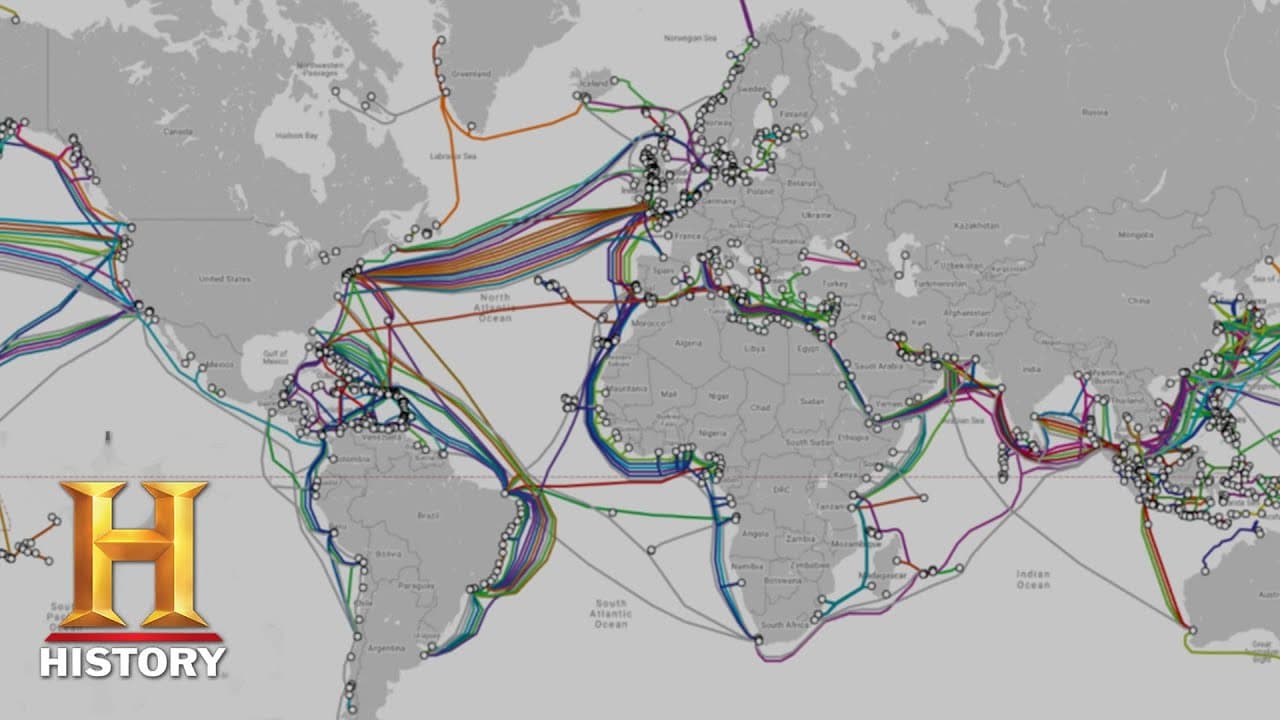
- Undersea cables today remain the backbone of international data traffic, tracing back to this achievement.
- More videos from this channel:
- More from this channel: HISTORY
Install to Summarize YouTube Videos and Get Transcripts
Explore YouTube Video Summarizer or Get YouTube Transcript Extractor
Questions & Answers
Q: A real search query question about the video (e.g. 'How to...', 'What is...', 'Why does...', 'When should...'). Question 1
How did Cyrus Field overcome the repeated failures and secure the resources needed to finally lay the first successful transatlantic telegraph cable? The answer lies in a combination of redesigned cable technology, a purpose built ship capable of carrying and laying the entire line, and securing new investors from Britain who believed in the project. Field coordinated large scale maritime logistics, ensured thorough testing of the cable over its entire length, and managed the high financial risk by presenting a clear long term benefit. This convergence of engineering rigor and financial backing allowed the mission to proceed despite earlier setbacks.
Q: Question 2
What role did the Great Eastern ship play in the cable project and why was it essential to success? The Great Eastern was the largest ship in the world at the time and uniquely capable of carrying the entire 18 million pounds of Thompson s cable in a single voyage. Its size and cargo capacity eliminated the need to transfer cable mid voyage, reducing handling risks and enabling a continuous laying operation. The ship also served as a stable platform for the crew to walk the cable out and monitor the process, greatly improving the chances of a successful connection.
Q: Question 3
How did the redesigned cable differ from earlier attempts and what effect did that have on performance? The redesigned cable, created by William Thompson, was more robust and tested along its entire length before deployment. It was also described as being 80 times faster than the previous line, which implies improvements in signal clarity and transmission speed that made practical, real time communication possible across the ocean. This robustness and speed were crucial to achieving a reliable connection.
Q: Question 4
Why was geography and sea travel risk a major factor in the transatlantic cable project? The Atlantic crossing posed extreme weather and sea conditions that could damage or destroy the cable if it was not laid with precision. The project required continuous work, with the crew walking the cable in the tank and along the deck to manage tension and prevent kinking or breakage. Any disruption near the end of the line could mean total failure, making the voyage a high stakes test of engineering and seamanship.
Q: Question 5
What was the immediate impact of completing the transatlantic cable on international communication? The completed cable enabled clear signals to be sent across the Atlantic in minutes, changing how markets and governments communicated and enabling closer economic and political ties between the United States and Europe. It established a new standard for long distance communication and laid the groundwork for the global undersea cable network described as the precursor to today s internet.
Q: Question 6
What ultimately caused the withdrawal of the rival cable and how did Field respond to it? The narrative notes that once Field s cable succeeded, Western Union pulled the plug on Perry Collins s competing line, effectively ending that attempt while Field s effort proved the viability of a functioning link. Field responded by securing new investors and pressing ahead with the successful installation, ensuring that his cable would be the one that connected continents and set the standard for future systems.
Q: Question 7
How does this project relate to modern communications infrastructure according to the video? The video frames the transatlantic cable as the precursor to modern information networks, explaining that while satellites exist, most international data traffic still travels via undersea cables. The successful cable demonstrated the feasibility of long distance digital communication and created a backbone that later systems would build upon to create today s global internet and communications infrastructure.
Q: Question 8
What challenges did Field face personally during the cable project and how were those challenges overcome? Field faced enormous financial risk, losses, and engineering obstacles that threatened the project multiple times. He continued to invest personal and investor funds, managed the redesign and testing of the cable, and coordinated the deployment by the Great Eastern. The perseverance and strategic partnerships ultimately led to a successful completion and vindication of his ambitious vision.
Summary & Key Takeaways
-
A working transatlantic cable connected the United States and Europe, ending long delays in cross ocean communication and enabling near real time messages. The project faced massive financial risk and technical challenges but succeeded through a redesigned cable and a purpose built ship. The event marked a turning point in global communication networks.
-
The Great Eastern played a pivotal role as the logistics backbone for laying the cable, carrying 18 million pounds of cable and supporting the crew as they laid thousands of miles of line with careful, continuous effort. Final success came after persistence, testing, and international investment.
-
The project is framed as a landmark achievement, showing how ambition, engineering, and strategic partnerships created a new communications infrastructure. It is presented as the precursor to modern data networks and a foundational step in a world increasingly connected by cables.
Read in Other Languages (beta)
Share This Summary 📚
Summarize YouTube Videos and Get Video Transcripts with 1-Click
Try YouTube Summary with ChatGPT & Claude or YouTube Transcript Generator
Explore More Summaries from HISTORY 📚





Summarize YouTube Videos and Get Video Transcripts with 1-Click
Try YouTube Summary with ChatGPT & Claude or YouTube Transcript Generator