How to implement a 4x1 MUX using 2x1 MUX
TL;DR
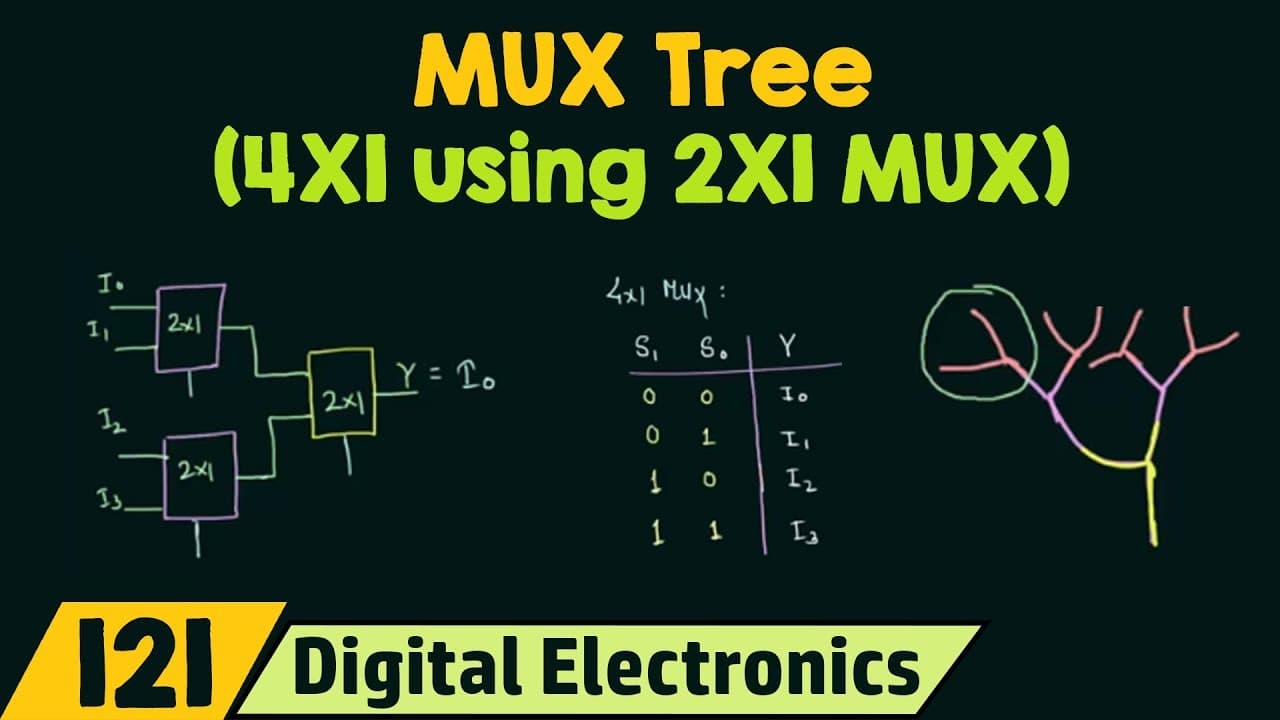
The 4x1 MUX is built by cascading two 2x1 MUX units to make a 4 input stage, then using another 2x1 MUX as the final stage. Inputs are divided into pairs, and the select lines are arranged so that the correct input is chosen at the output. This approach scales by repeating the same two stage pattern for higher orders.
Transcript
in this presentation we will study about the MX tree which is your multiplexor tree so what actually we do in the MX tree we obtain the higher order marks using the lower order marks okay and once you do that once you have your higher order marks using the lower order marks it will look something like a tree I have made a tree here to explain you w... Read More
Key Insights
- A MUX tree uses smaller multiplexers to build higher order multiplexers.
- Dividing the number of inputs by two helps determine the required smaller MUX stages.
- For a 4x1 MUX using 2x1 MUX, two 2x1 units feed a final 2x1 unit.
- The select lines must be consistently applied to corresponding points in all stages.
- The process can be extended to 8x1 or 16x1 by repeating the two stage pattern.
- Each 2x1 MUX has two inputs and one output that feed the next stage.
- The final output is taken from the last MUX in the chain after all stages.
- The sequence of operations follows a clear 2x1 then 2x1 arrangement until the target size is reached.
Install to Summarize YouTube Videos and Get Transcripts
Explore YouTube Video Summarizer or Get YouTube Transcript Extractor
Questions & Answers
Q: A real search query question about the video (e.g. 'How to...', 'What is...', 'Why does...', 'When should...'). Question 1
How is a 4x1 MUX built from 2x1 MUX units and how do you connect the stages to obtain the final output. The video shows two 2x1 MUXs feeding a third 2x1 MUX. The input data lines are grouped in pairs, and the final output is produced by the last 2x1 MUX after the pairwise selection. The select lines must be properly placed and synchronized across stages to ensure the correct input appears at the output.
Q: Question 2
Why do we divide the input count by two when constructing a larger MUX. The explanation in the video states that dividing by two gives the number of 2x1 MUX units required at the current stage and the remaining 1x1 unit for the final stage. This step ensures the tree structure correctly maps multiple inputs to a single output through staged selection.
Q: Question 3
What is the role of the two select lines in a 4x1 MUX assembled from 2x1 MUXs. The transcript notes there are two select lines S0 and S1. They determine which inputs are routed through each stage and must be consistently applied to corresponding inputs in all stages so that the final output matches the chosen data line.
Q: Question 4
How many inputs and what is the final output configuration when using the 2x1 MUX stages for a 4x1 MUX. The setup shows eight inputs in total before the final MUX, but for a 4x1 MUX we consider four data lines that get paired and then selected through the cascade of 2x1 MUX units, resulting in a single output.
Q: Question 5
How does the tree metaphor help in understanding MUX construction. The video uses a tree with sub branches and stems to illustrate how small MUX units combine to form larger ones. Each level serves as a data routing stage, with outputs of one level becoming inputs to the next until the final single output is produced.
Q: Question 6
What is the sequence of building order for a 4x1 MUX from 2x1 MUX. The sequence starts with two 2x1 MUX units at the first level, followed by a second 2x1 MUX unit that combines the outputs of the first level, and finally the arrangement ensures the selected input reaches the final output based on the select lines.
Q: Question 7
How are the select lines allocated to ensure correct data selection at the first and last stage. The video implies the select signals are assigned so that the chosen pair corresponds to the correct input, with the same mapping applied consistently at all stages to guarantee the final output matches the intended data line.
Q: Question 8
Can this method be extended to higher order MUXs beyond 4x1. Yes, the video hints that the same two stage pattern can be used to implement higher order MUXs like 8x1 and 16x1 by repeating the process of using two 2x1 MUX units and then feeding into another 2x1 unit, maintaining proper select line mapping.
Summary & Key Takeaways
-
The video explains the idea of a MUX tree using small 2x1 MUX blocks to form a larger 4x1 MUX, highlighting the tree structure of inputs and outputs.
-
It demonstrates counting inputs, dividing by two, and adding results to determine the required number of smaller MUX stages.
-
It also discusses how to place select lines to ensure the correct input is selected at each stage.
Read in Other Languages (beta)
Share This Summary 📚
Summarize YouTube Videos and Get Video Transcripts with 1-Click
Try YouTube Summary with ChatGPT & Claude or YouTube Transcript Generator
Explore More Summaries from Neso Academy 📚






Summarize YouTube Videos and Get Video Transcripts with 1-Click
Try YouTube Summary with ChatGPT & Claude or YouTube Transcript Generator