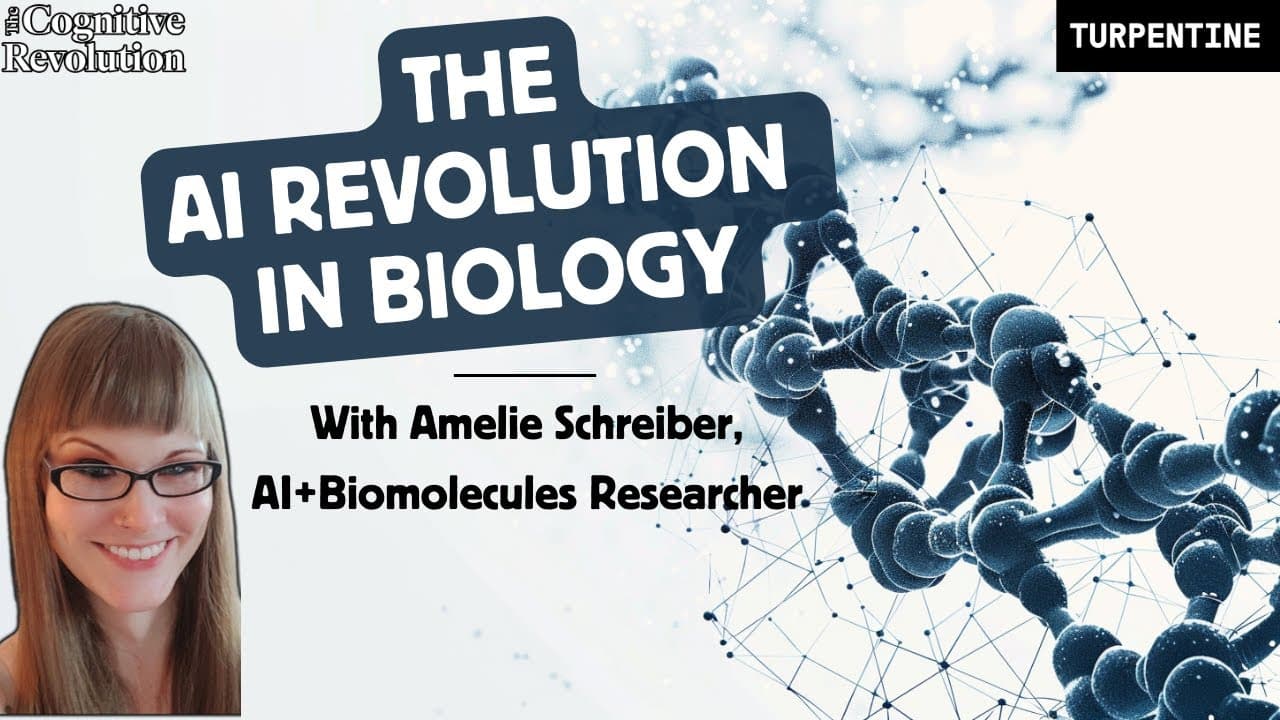
The AI Revolution in Biology: From Vaccines to Protein Engineering, With Amelie Schreiber
TL;DR
AI is transforming biology, enabling rapid advancements in drug design and protein engineering.
Transcript
hello and welcome to the cognitive Revolution where we interview Visionary researchers entrepreneurs and Builders working on the frontier of artificial intelligence each week we'll explore their revolutionary ideas and together we'll build a picture of how AI technology will transform work life and Society in the coming years I'm Nathan lens joined... Read More
Key Insights
- AI models are accelerating scientific discovery in biology, especially in understanding protein structures and interactions, which are crucial for drug design.
- Traditional methods like molecular dynamics simulations are computationally intensive, but AI offers faster and more efficient alternatives for modeling biological systems.
- AlphaFold and similar AI models predict protein structures with high accuracy, providing insights into protein dynamics and interactions.
- AI tools like RF Diffusion and Ligand PNN enable precise protein engineering, allowing for the design of proteins with specific structural and functional properties.
- The adoption of AI in biology is still limited due to the complexity of the tools, but platforms like 310 AI are making them more accessible.
- AI has the potential to revolutionize drug discovery by identifying targets and designing interventions with high specificity and minimal side effects.
- The integration of AI with biological data is paving the way for holistic modeling of cellular systems, potentially leading to breakthroughs in disease treatment.
- Ethical considerations and safety are paramount as AI advances in biotechnology, with the potential for misuse by bad actors.
Install to Summarize YouTube Videos and Get Transcripts
Explore YouTube Video Summarizer or Get YouTube Transcript Extractor
Questions & Answers
Q: What are the main challenges in understanding protein interactions?
Understanding protein interactions is complex due to the dynamic nature of proteins, which can exist in multiple low-energy states and interact with other molecules in various ways. Traditional methods like molecular dynamics simulations are computationally intensive, making it difficult to model these interactions accurately. AI offers a more efficient approach by predicting protein structures and interactions with high accuracy.
Q: How does AI improve drug discovery processes?
AI improves drug discovery by enabling the design of proteins and small molecules with specific properties, allowing for precise targeting of diseases. AI models can identify potential drug targets and design interventions with high specificity, reducing the likelihood of side effects. This accelerates the drug discovery process, making it more efficient and effective compared to traditional methods.
Q: What are the limitations of current AI models in biology?
Current AI models in biology face limitations in terms of adoption and accessibility, as they require specialized knowledge and computational resources. Additionally, while AI can predict protein structures and interactions, understanding the full complexity of biological systems, including dynamic interactions and higher-level processes, remains a challenge. Continued development and integration of AI with biological data are needed to overcome these limitations.
Q: What role do AI agents play in biological research?
AI agents can play a significant role in biological research by automating literature reviews, hypothesis generation, and experimental design. They can process vast amounts of data and identify potential research directions, making the research process more efficient. AI agents can also assist in the design and testing of new drugs, potentially accelerating the pace of scientific discovery and innovation in biotechnology.
Q: How do AI models like AlphaFold predict protein structures?
AI models like AlphaFold predict protein structures by using deep learning techniques to analyze amino acid sequences and predict their three-dimensional conformations. These models are trained on large datasets of known protein structures, allowing them to learn patterns and relationships that inform their predictions. AlphaFold achieves high accuracy in predicting protein structures, providing valuable insights into protein function and interactions.
Q: What are the ethical considerations in using AI for biotechnology?
Ethical considerations in using AI for biotechnology include ensuring the safety and security of AI applications, preventing misuse by bad actors, and addressing potential societal impacts. As AI enables more precise interventions in biological systems, there is a risk of unintended consequences or harmful applications. It is crucial to establish guidelines and oversight to ensure that AI is used responsibly and for the benefit of society.
Q: What advancements are needed to fully realize AI's potential in biology?
To fully realize AI's potential in biology, advancements are needed in the integration of AI with diverse biological data, the development of more accessible and user-friendly tools, and the training of researchers in AI methodologies. Additionally, improvements in computational efficiency and the ability to model complex biological systems holistically will enhance AI's capabilities in biotechnology.
Q: How does AI contribute to understanding protein dynamics?
AI contributes to understanding protein dynamics by predicting not only static structures but also the range of possible conformations and transitions between states. Models like AlphaFold Multimer and RF Diffusion provide insights into protein interactions and dynamics, enabling researchers to explore how proteins function in different environments and conditions. This understanding is crucial for drug design and therapeutic interventions.
Summary & Key Takeaways
-
In this episode, Amelie Schreiber discusses the transformative impact of AI on biology, particularly in drug design and protein engineering. AI models like AlphaFold are revolutionizing our understanding of protein structures and interactions, leading to faster scientific discoveries.
-
Traditional methods for studying protein dynamics are being replaced by AI, which offers more efficient and accurate alternatives. AI tools are enabling researchers to design proteins with specific properties, potentially accelerating drug discovery and treatment development.
-
The adoption of AI in biology is still in its early stages, but platforms are emerging to make these tools more accessible. Ethical considerations are crucial as AI advances in biotechnology, with the potential for both positive and negative impacts on society.
Read in Other Languages (beta)
Share This Summary 📚
Summarize YouTube Videos and Get Video Transcripts with 1-Click
Try YouTube Summary with ChatGPT & Claude or YouTube Transcript Generator
Explore More Summaries from Cognitive Revolution "How AI Changes Everything" 📚





Summarize YouTube Videos and Get Video Transcripts with 1-Click
Try YouTube Summary with ChatGPT & Claude or YouTube Transcript Generator