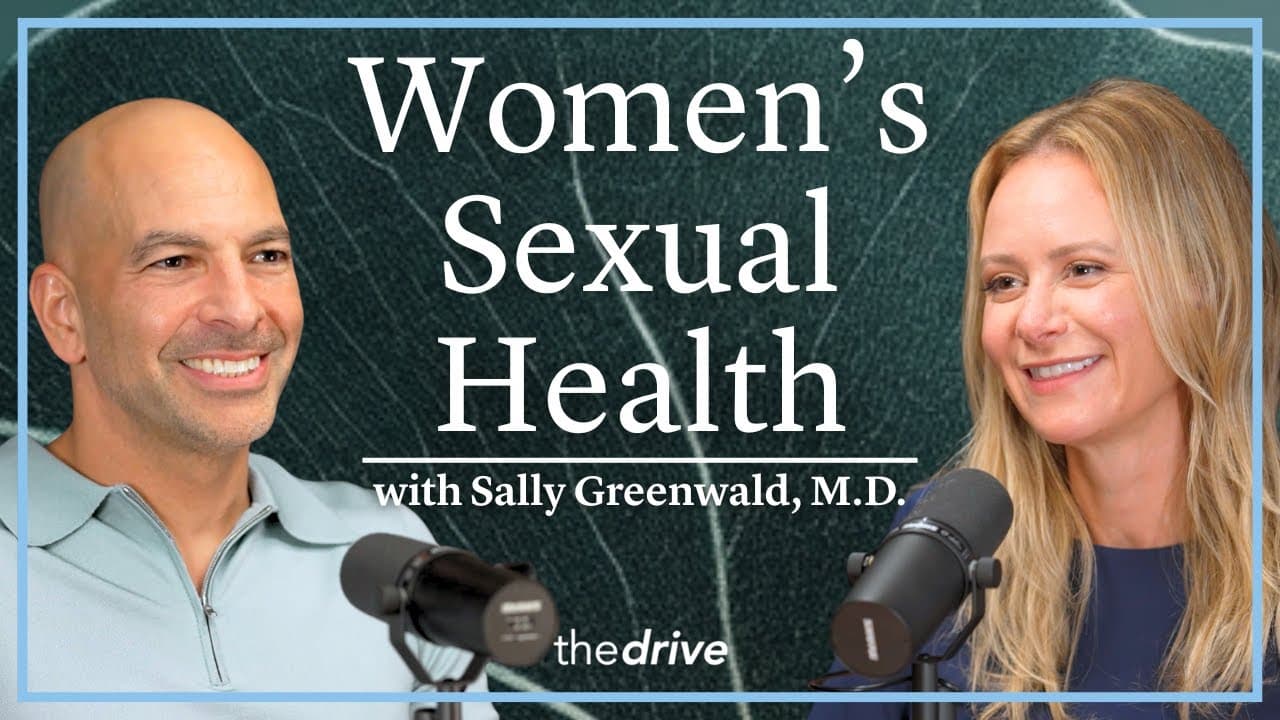
How to boost women's sexual health and desire
TL;DR
Sexual health is part of overall health and can affect sleep, mood, and relationships. Engaging in sexual activity or arousal improves parasympathetic activation, and orgasms can enhance sleep quality. Individual needs vary, but regular activity and good physical fitness may support sexual function and intimacy across life stages.
Transcript
Hey everyone, welcome to the Drive podcast. I'm your host Peter Aia. Sally, thank you so much for coming out to Austin. Thank you for having me. This is a topic that on the surface might seem somewhat directed towards 50% of the population, but I think it's safe to say it's probably going to be directed towards 100% of the population. Um, so you ha... Read More
Key Insights
- Sexual activity shifts the body from sympathetic to parasympathetic dominance, promoting relaxation and restorative processes.
- Orgasms release dopamine and oxytocin, contributing to improved sleep quality and mood.
- Women can experience sleep benefits from orgasms achieved alone or with a partner, with synergistic effects when both are involved.
- There is limited data on non heterosexual couples, highlighting the need for broader research in sexual health.
- On average, energy expenditure during sex is comparable to light activity, but subjective enjoyment can exceed that of similar physical tasks.
- Desire and arousal are influenced by hormonal and physiological factors that vary across individuals and life stages.
- Discordance in sexual desire between partners is a stronger predictor of relationship risk than overall frequency of sex.
- A healthy V2 max may support sexual activity in later life, emphasizing the role of fitness in sexual longevity.
Install to Summarize YouTube Videos and Get Transcripts
Explore YouTube Video Summarizer or Get YouTube Transcript Extractor
Questions & Answers
Q: What is the core link between sexual activity and overall health?
Sexual activity supports overall health by activating the parasympathetic nervous system after orgasm, which is associated with relaxation and recovery. Neurotransmitters such as dopamine and oxytocin are released, contributing to improved sleep, mood, and stress regulation. This link helps explain why sexual health is considered part of general well being, with benefits extending to emotional health and relationships.
Q: How does orgasm affect sleep quality in women?
Orgasm improves sleep quality in women by triggering neurochemical changes and promoting parasympathetic dominance. Studies show that both self stimulation and partner based intimacy can enhance sleep, with a synergistic effect when orgasm occurs in a sexual encounter with a partner. This results in shorter sleep latency and better sleep efficiency, contributing to daytime functioning and mood.
Q: What does the data say about men vs women in sexual health discussions?
The discussion notes that there is a data gap in non heterosexual populations, and much of the evidence comes from heterosexual contexts. This reflects a broader limitation in research, underscoring the need for more inclusive studies. Nevertheless, the available data supports that sexual health intersects with physical health, mental well being, and relationship quality for many individuals.
Q: What is the role of METs and V2 max in sexual activity, according to the discussion?
The talk explains that sexual activity can approximate seven METs, equating to roughly 25 ml/kg/min V2. To be able to be sexually active in later life, maintaining a higher V2 max is beneficial, potentially above 45 or 50, to account for aging. Fitness therefore contributes to sexual longevity by ensuring sufficient cardiovascular capacity during intimate activity.
Q: How do desire and arousal dynamics influence relationships?
Desire and arousal dynamics, including discordance between partners, impact relationship stability. The conversation emphasizes that while some couples have high or low frequency, the risk of divorce is more closely linked to mismatch in sexual desire than to how much sex occurs. Addressing this discordance through communication and adjustments can improve relationship satisfaction.
Q: What factors besides frequency affect sexual health in couples?
Besides frequency, factors such as hormonal health, pelvic floor function, contraception effects, and menopause symptoms influence sexual health. The discussion highlights that sexuality is shaped by physiology, hormones, and comfort levels, and that addressing underlying issues can improve desire, arousal, and comfort during sex.
Q: What practical steps can help improve arousal and connection for women?
Practical steps include focusing on foreplay to enhance arousal, addressing pelvic floor health, and optimizing sleep and stress management. Building intimacy through communication with a partner, evaluating medications that may affect sexual function, and strengthening physical fitness to improve V2 max can collectively support desire, arousal, and orgasm satisfaction over time.
Q: Why is more research needed in women’s sexual health and perimenopause?
More research is needed because this area is understudied and underinvestigated, with limited robust data. Understanding how hormones, aging, and physiology affect female sexual function can guide evidence based therapies for low desire and arousal, inform safe medical approaches, and improve overall health outcomes for women across stages of perimenopause and menopause.
Summary & Key Takeaways
-
Sexual health is a component of overall health and influences sleep, mood, and relationships through parasympathetic activation and neurochemical release.
-
There is evidence that orgasm and intimacy can improve sleep and general well being, with studies showing benefits in both self stimulation and partner-based sexual activity.
-
The level of sexual activity varies among couples, and discordance between partners is a key factor in relationship stress, rather than absolute frequency alone.
Read in Other Languages (beta)
Share This Summary 📚
Summarize YouTube Videos and Get Video Transcripts with 1-Click
Try YouTube Summary with ChatGPT & Claude or YouTube Transcript Generator
Explore More Summaries from Peter Attia MD 📚


Summarize YouTube Videos and Get Video Transcripts with 1-Click
Try YouTube Summary with ChatGPT & Claude or YouTube Transcript Generator