How to Scrape the Dark Web with Robin AI Tool
TL;DR
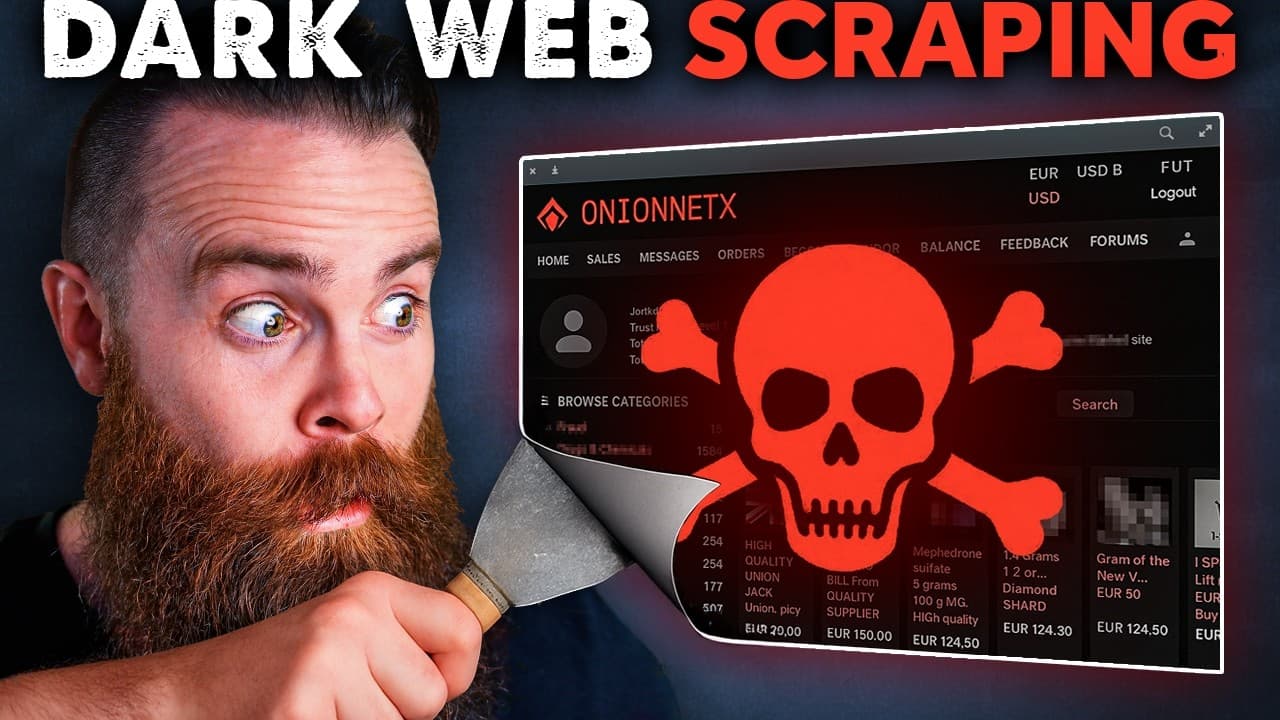
Robin is a free, open-source AI tool that searches and scrapes the dark web through Tor, cutting a six-to-eight hour research marathon down to about 30 minutes. It queries multiple search engines, filters over 900 results down to roughly 20 verifiable real sources using AI, scrapes them, and reports findings plus next research steps.
Transcript
So I met this dark web researcher at Defcon like you do, and this guy, he's legit, he actually infiltrates the dark web for a living. But he told me about this problem he has and we all have this problem. It's hard for him to find actual real stuff on the dark web until now. He built this AI tool that will search and scrape the dark web for him. Wh... Read More
Key Insights
- Most of the dark web is fake, consisting largely of law enforcement honeypots or forums where police are massively present, so what looks real when you visit is often all for show rather than genuine criminal activity.
- The dark web is hard to scrape because connections route through a series of onion relay servers, making them slow and prone to breaking, which forces researchers to recreate the circuit and restart their scraping scripts.
- Criminal dark web sites are deliberately hard to find because operators are paranoid; some sites are only operational about two days a week and you never know which two days they will be up.
- Robin is an AI tool named after a One Piece character that automates dark web research by improving your query, scouring multiple search engines, and identifying real sources among the results.
- Robin reduces a list of over 900 search results down to just 20 verifiable real results using AI, then scrapes those 20 sites and reports what it found plus next steps for continuing research.
- Running Robin requires two things: Tor, installed as a package, and Docker, which runs the Robin container; Windows users can run it through WSL, the Windows Subsystem for Linux.
- Robin lets you choose your AI backend, supporting ChatGPT, Anthropic, or local models like Llama 3.1, with API keys stored securely inside a .env file copied from the provided .env.example template.
- Cyber criminals on the dark web sell exploits that abuse legitimate software already running on your network, such as Microsoft Word and PowerShell, which is hard to stop with traditional antivirus because those tools are allowed to run.
Install to Summarize YouTube Videos and Get Transcripts
Explore YouTube Video Summarizer or Get YouTube Transcript Extractor
Questions & Answers
Q: What is Robin and what does it do?
Robin is a free, open-source AI-powered tool built by dark web researcher Apurv to search and scrape the dark web. It refines your query, scours the dark web using multiple search engines, and uses AI to identify real sources, reducing a list of over 900 results down to just 20 verifiable real results. It then scrapes those 20 sites and uses AI to report what it found and even suggest next steps for continuing your research, cutting a six to eight hour research marathon down to about 30 minutes.
Q: Why is most of the dark web fake?
Most of the dark web is fake because law enforcement people are either controlling it or are massively present on those forums. When you visit, it looks real and spooky, but most of it is law enforcement honeypots set up for show. There is real stuff buried in there, but the genuine criminal content is difficult to find amid all the fake and monitored sites, which is exactly the problem Robin was built to solve.
Q: Why is the dark web so hard to scrape?
There are two main reasons. First, the dark web runs on onion relay servers, so every website connection routes through a series of relays rather than directly to the server. This keeps things anonymous but makes connections slow and prone to breaking; when a circuit breaks, you have to recreate it and restart your script. Second, criminals are paranoid, so some sites are only operational about two days a week and you never know which two days, making them almost impossible to consistently find and scrape.
Q: What software do you need to run Robin?
You need two things to run Robin: Tor and Docker. Tor is installed as a package, using sudo apt install tor on Linux or brew install tor on Mac. Docker runs the Robin container. You install and run both on Linux-based machines or Mac, and Windows users can run Linux through WSL, the Windows Subsystem for Linux. After installing Tor, you clone the Robin GitHub repo, set up your API keys, and build the Robin Docker container.
Q: Which AI models can you use with Robin?
With Robin, the choice of AI is up to you. You can use ChatGPT (OpenAI), Anthropic, or even local models like Llama 3.1. You configure this by adding the appropriate API keys inside a .env file, which is created by copying the provided .env.example template. The example file has slots for Anthropic, OpenAI, Google, and an Ollama base URL. In the video, the presenter chooses to use ChatGPT and Ollama by adding an OpenAI key and an Ollama base URL.
Q: How does Robin filter real dark web sources from fake ones?
Robin first takes your query and improves it. It then scours the dark web using multiple search engines and gathers all the results, which can be over 900. It uses AI to identify the real sources among them, reducing that list from over 900 down to just 20 verifiable real results. After that, it scrapes those 20 sites and uses AI to tell you what it found and provides suggested next steps for how to continue your research.
Q: How do threat actors attack you using legitimate software?
According to Apurv, cyber criminals on the dark web sell exploits, which are tools that abuse legitimate software already running on your network, such as Microsoft Word and PowerShell. This is hard to stop with traditional antivirus because these tools are allowed to run; your security sees Microsoft Word and permits it, but does not see that Word just called PowerShell and executed a ransomware payload. An example is the Felina vulnerability, which weaponizes Word to launch PowerShell.
Q: How much faster does Robin make dark web research?
Robin dramatically speeds up dark web research. According to the video, it takes what would normally be a six to eight hour research marathon and gets it down to about a 30 minute stroll in the park. It achieves this by automating the querying, searching across multiple engines, AI-based filtering of over 900 results down to 20 real sources, scraping, and reporting, all of which a researcher like Apurv would otherwise have to do manually while fighting slow, breaking Tor connections.
Summary & Key Takeaways
-
A dark web researcher named Apurv, met at DEF CON, built an AI tool called Robin because finding real content on the dark web is extremely difficult. Most of what appears on the dark web is fake, dominated by law enforcement honeypots, while genuine criminal material is buried and hard to reach.
-
Scraping the dark web is painful for two reasons: connections route through slow onion relay servers that frequently break and require restarting scripts, and criminal operators are paranoid, running sites that may only be online about two days a week with unpredictable schedules.
-
Robin automates this by refining your query, searching multiple engines, using AI to narrow over 900 results down to 20 verifiable real sources, scraping them, and summarizing findings with next steps. It runs via Docker and Tor, supports ChatGPT, Anthropic, or local Llama models, and cuts research from six to eight hours to about 30 minutes.
Read in Other Languages (beta)
Share This Summary 📚
Summarize YouTube Videos and Get Video Transcripts with 1-Click
Try YouTube Summary with ChatGPT & Claude or YouTube Transcript Generator
Explore More Summaries from NetworkChuck 📚
Summarize YouTube Videos and Get Video Transcripts with 1-Click
Try YouTube Summary with ChatGPT & Claude or YouTube Transcript Generator