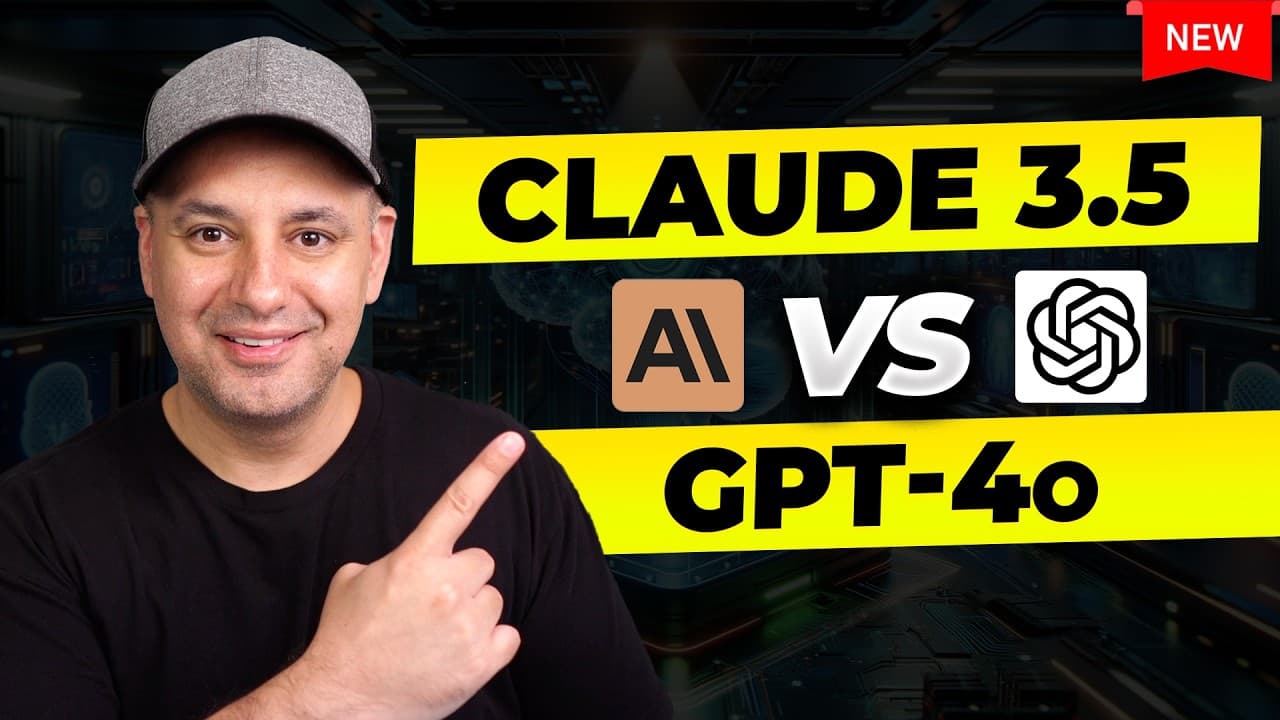
GPT-4 gegen Claude 3.5: Wer ist besser?
TL;DR
Claude 3.5 und GPT-4 zeigen ähnliche Leistungen, wobei Claude in den Bereichen Codierung und Interaktivität überragend ist. GPT-4 bietet jedoch Vorteile wie prägnantere Antworten, Bildgenerierung und Webzugang, was es für alltägliche Anwendungen und gezielte Recherchen vorteilhaft macht.
Transcript
in this video I want to do a comprehensive head-to-head test comparing GPT 40 versus claw 3.5 Sonet which just came out and it beats GPT 40 in their Benchmark testing but I don't want to do a scientific test like they do in their benchmarks I want to do a practical test how we use these AI models every day for work and business so then we could act... Read More
Key Insights
- ✍️ Both GPT-4 and Claude 3.5 have similar overall performance, excelling in writing and analysis tasks.
- 💁 GPT-4's concise responses are attractive for users needing streamlined information quickly.
- 👨💻 Claude 3.5's capabilities in coding and interactive data projects highlight its utility for technical users.
- 💁 Missing web browsing capabilities in Claude make it less effective for real-time information retrieval compared to GPT-4.
- 👤 GPT-4’s memory features enhance personalization, creating a more responsive user interaction.
- 👤 Image generation is a crucial differentiator for GPT-4, benefiting users needing visual content.
- 👨💼 Custom GPTs provide tailored experiences, making GPT-4 more versatile for specific business needs.
Install to Summarize YouTube Videos and Get Transcripts
Explore YouTube Video Summarizer or Get YouTube Transcript Extractor
Questions & Answers
Q: How do GPT-4 and Claude 3.5 compare in text writing tasks?
In the analysis, both models performed strongly in writing tasks without a clear victor. GPT-4 provided more concise and straightforward responses ideal for copy-pasting, while Claude 3.5’s responses were slightly longer and sometimes included unnecessary prompts. Personal preference plays a significant role in determining which model is better for writing tasks, depending on whether brevity or elaboration is desired.
Q: What are the major strengths of Claude 3.5 over GPT-4?
Claude 3.5 outperformed GPT-4 in coding tasks and visual data analysis. It quickly created interactive visualizations from large datasets, allowing users to engage with the data meaningfully. This capability was highlighted in the comparison, showcasing its strength in technical tasks where clarity of output is critical. Users focused on these functions may find Claude more useful than GPT-4.
Q: Why is web browsing functionality significant in GPT-4?
Web browsing functionality allows GPT-4 to access real-time information and updates. This is particularly advantageous for tasks requiring current data, such as research projects or website crawling for optimization tips. Users can leverage GPT-4's ability to fetch recent online information, pushing it ahead of Claude 3.5, which lacks such capabilities.
Q: How do the memory functions of GPT-4 enhance user interaction?
GPT-4's memory function enables it to recall previous interactions, tailoring responses based on past queries. This leads to a more personalized and efficient user experience, as it can build upon prior conversations. Claude 3.5, lacking this feature as of the analysis, does not benefit from this adaptability, making GPT-4 preferable for ongoing user needs requiring consistency.
Q: What limitations does Claude 3.5 have compared to GPT-4?
Claude 3.5 lacks web browsing and image generation capabilities, which limits its effectiveness in certain tasks. While it excels in coding and data visualization, these limitations can hinder users who require up-to-date internet information or who depend on AI for visual content creation. This can be a significant downside based on user needs.
Q: In which scenarios should users prefer GPT-4 over Claude 3.5?
Users who need accurate real-time research, image generation, or concise writing tasks should opt for GPT-4. Its integrated web browsing function allows it to provide up-to-date information, and its capabilities in generating visual content with the DALL-E model offer substantial advantages in creative tasks not addressed by Claude 3.5.
Q: How do the two models perform in data analytics tasks?
Both models demonstrated comparable effectiveness in performing data analytics, generating interpretable outputs from complex datasets. However, Claude 3.5 had an edge in creating interactive visualizations more rapidly and efficiently than GPT-4. Nevertheless, GPT-4's integration with applications suitable for more detailed data manipulation was noted as a beneficial feature.
Q: What should users consider when deciding between the two models?
Users should assess their specific needs—if coding, data visualization, or concise writing is a priority, Claude 3.5 shines. Conversely, those requiring real-time data access, image generation, or personalized interaction should prefer GPT-4. Additionally, the availability of custom GPTs in GPT-4 enables tailored experiences, which is a significant consideration for many users.
Summary & Key Takeaways
-
This analysis compares GPT-4 and Claude 3.5 based on their performance across various practical applications such as writing, summarizing, coding, and visual tasks.
-
Both models excelled in writing tasks, but GPT-4 often provided more concise outputs, favoring users who prefer direct answers without additional commentary.
-
In areas like vision capability and data analytics, Claude 3.5 showcased impressive results but fell short in functionalities like image generation and real-time internet access, which GPT-4 offers.
Read in Other Languages (beta)
Share This Summary 📚
Summarize YouTube Videos and Get Video Transcripts with 1-Click
Try YouTube Summary with ChatGPT & Claude or YouTube Transcript Generator
Explore More Summaries from Skill Leap AI 📚





Summarize YouTube Videos and Get Video Transcripts with 1-Click
Try YouTube Summary with ChatGPT & Claude or YouTube Transcript Generator