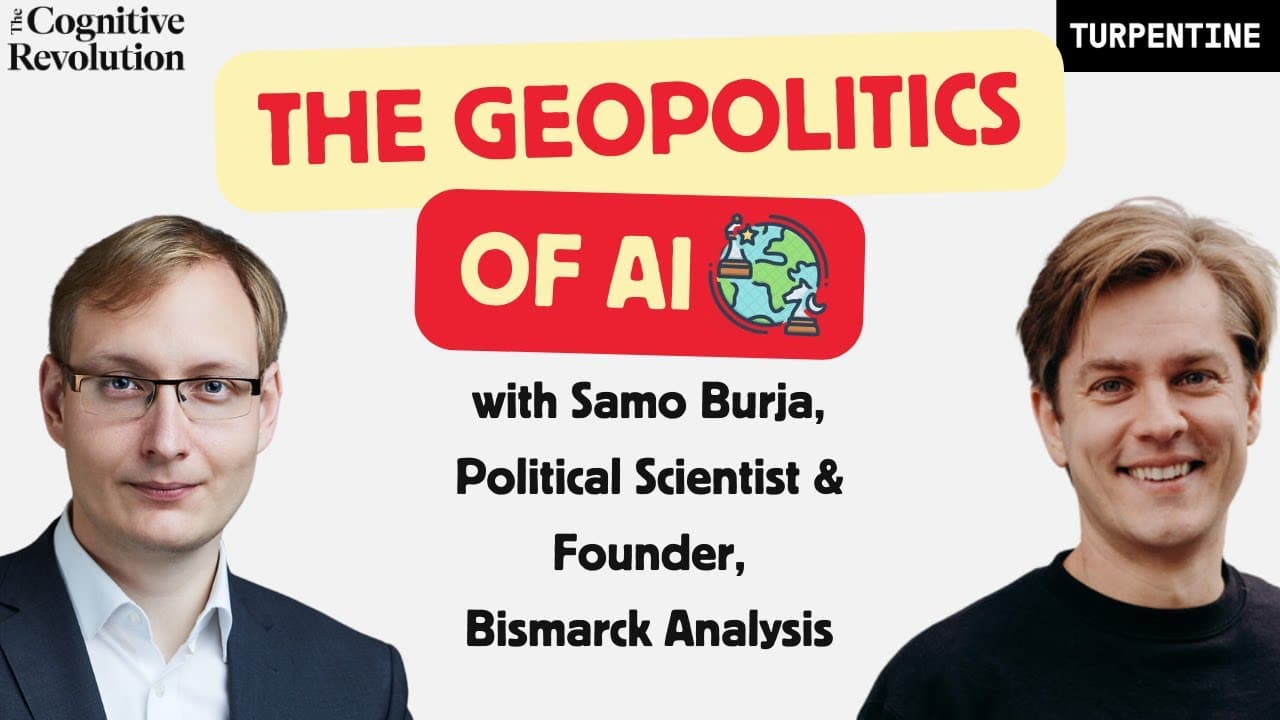
How Do AI Live Players Shape Geopolitics and Strategic Dynamics? Samo Burja of Bismarck Analysis
TL;DR
AI is reshaping geopolitics through competition over advanced chips, industrial capacity, research priorities, open models, and military applications. Samo Burja of Bismarck Analysis argues for fundamental science, stronger US industrial policy, economic rather than geopolitical competition with China, and ideological diversity in AI governance. He also warns that unrestricted proliferation and AI militarization carry serious risks. Read on for his analysis of each strategic trade-off.
Transcript
hello and welcome to the cognitive Revolution where we interview Visionary researchers entrepreneurs and Builders working on the frontier of artificial intelligence each week we'll explore their revolutionary ideas and together we'll build a picture of how AI technology will transform work life and Society in the coming years I'm Nathan lens joined... Read More
Key Insights
- AI is reshaping global power dynamics, with the US and China as key players in the race for technological dominance.
- Samo Burja questions the long-term dominance of the Transformer architecture, suggesting new AI paradigms may emerge.
- Industrial policy and regulatory overhaul are crucial for boosting US competitiveness in the chip supply chain.
- US-China relations should be framed as economic competition rather than geopolitical conflict to avoid escalation.
- Open source AI models present trade-offs between power concentration and potential misuse by bad actors.
- The militarization of AI poses existential risks and should be approached with extreme caution.
- Ideological diversity in AI research and governance is essential to prevent blind spots in safety considerations.
- A focus on fundamental science rather than engineering scale-ups is necessary for sustained AI progress.
Install to Summarize YouTube Videos and Get Transcripts
Explore YouTube Video Summarizer or Get YouTube Transcript Extractor
Questions & Answers
Q: How does AI shape global geopolitics and strategy?
AI shapes geopolitics through competition over advanced chips, industrial capacity, scientific research, and control of powerful models. Samo Burja argues that governments must weigh technological competitiveness against the risks of concentrated power, unrestricted proliferation, and military escalation.
Q: What does Samo Burja predict about the future of Transformer-based AI?
Burja questions whether the Transformer architecture will remain dominant over the long term. He suggests that qualitatively different AI paradigms may emerge, which is why nations should continue supporting fundamental science instead of putting all their effort into engineering scale-ups.
Q: How could the US become more competitive in advanced chips?
Burja advocates industrial policy and regulatory reform to strengthen US competitiveness in the advanced chip supply chain. His proposals include designating special economic zones and, if necessary, having the government directly purchase domestically manufactured chips.
Q: How should the US approach AI competition with China?
Burja recommends framing the US-China relationship as economic competition rather than geopolitical conflict. He argues that a more constructive approach is preferable to treating continued decoupling and escalation as inevitable.
Q: Why does Samo Burja criticize the 2022 Biden chip export controls?
Burja views the 2022 Biden chip export controls as potentially counterproductive. He argues that restricting exports may accelerate the development of China's domestic chip industry rather than preserving the intended US advantage.
Q: What trade-offs do open-source AI models create?
Concentrating AI power among a few technology companies or governments could produce an Orwellian surveillance state. Yet unrestricted AI proliferation could also allow bad actors to destabilize societies, so Burja says there is no simple answer and that finding the right balance is crucial.
Q: Why does AI militarization increase existential risk?
Burja warns that defense technology startups could raise money to build a system resembling Skynet. He believes such military development could dramatically increase existential risks and therefore should be approached with extreme caution.
Q: Why is ideological diversity important in AI safety and governance?
Burja argues that a monoculture shaped by effective altruists, corporate interests, or any single perspective can create blind spots in safety decisions. He recommends intentionally placing people with diverse viewpoints in key AI research and governance roles.
Summary & Key Takeaways
-
Artificial intelligence is reshaping global geopolitics, with nations like the US and China competing for technological dominance. Key issues include the chip supply chain and AI safety, with Samo Burja emphasizing the importance of fundamental science and industrial policy. He advocates for framing US-China relations as economic competition and highlights the risks of AI militarization.
-
Samo Burja questions the long-term dominance of the Transformer architecture, suggesting that new AI paradigms may soon emerge. He stresses the need for ideological diversity in AI governance to prevent blind spots in safety considerations. Open source AI models present trade-offs between power concentration and potential misuse by bad actors.
-
The US must focus on industrial policy and regulatory overhaul to boost competitiveness in the chip supply chain. Burja argues that nations should prioritize fundamental science over engineering scale-ups to ensure sustained AI progress. The militarization of AI poses existential risks and should be approached with extreme caution.
Read in Other Languages (beta)
Share This Summary 📚
Summarize YouTube Videos and Get Video Transcripts with 1-Click
Try YouTube Summary with ChatGPT & Claude or YouTube Transcript Generator
Explore More Summaries from Cognitive Revolution "How AI Changes Everything" 📚





Summarize YouTube Videos and Get Video Transcripts with 1-Click
Try YouTube Summary with ChatGPT & Claude or YouTube Transcript Generator