How Can Founders Build Leverage With AI Agents?
TL;DR
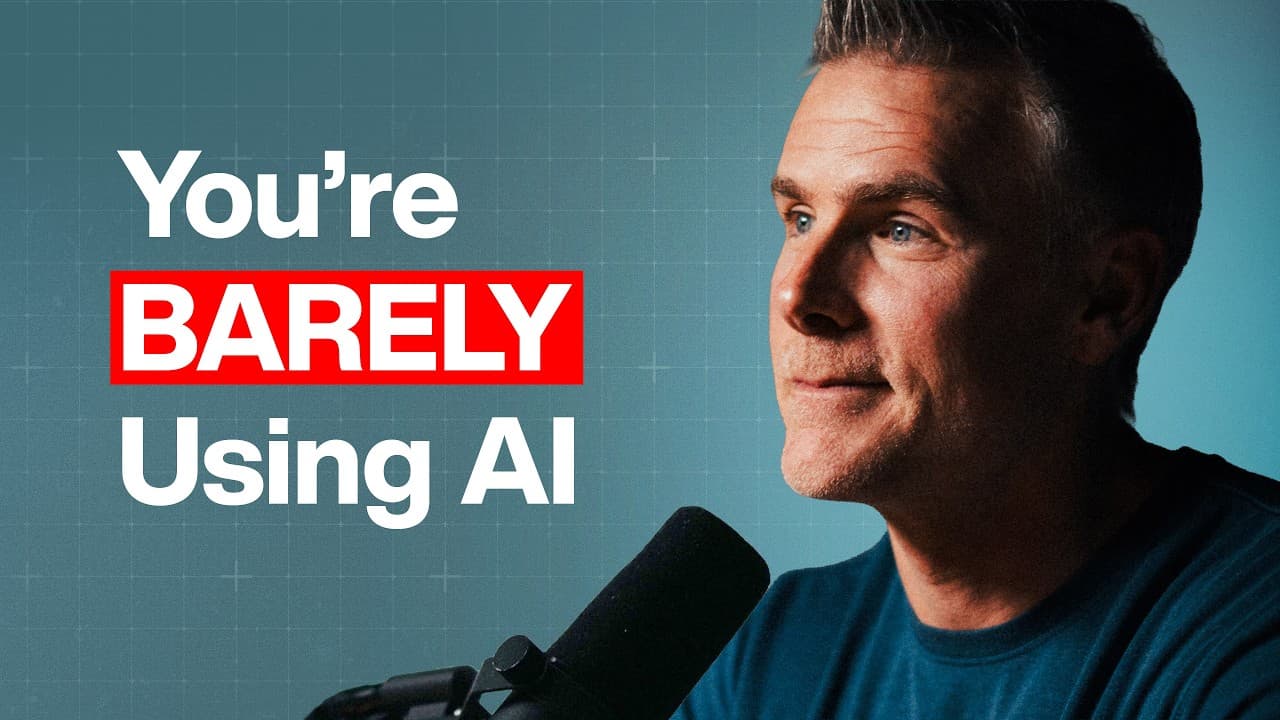
Start with the desired outcome, give the AI enough business context, and let agentic tools perform the work instead of merely answering questions. Dan Martell argues that founders can gain greater leverage by using Claude, its browser extension, and Claude Code to build applications, handle browser tasks, restructure information, connect finance systems, and automate documented workflows.
Transcript
If everybody listening stopped over prompting and instead [music] start with the outcome, the current AI would blow your mind. >> Dan Martell has tested over 500 AI tools and he's here today to make you feel behind on purpose. You can triple your [music] profit in 60 days. Have it analyzed, have it write the emails. It can do all that if you let it... Read More
Key Insights
- Start with the desired outcome instead of over-prompting. Martell argues that current AI becomes far more useful when users clearly state what they want accomplished, then let the system ask questions, propose a plan, and help execute the work.
- Claude is Martell's top-ranked general AI tool. He estimates that its model is 30% to 40% better than competing options and praises its ability to solve problems, visualize outputs, and guide users toward practical applications within its product.
- ChatGPT is Martell's fourth-tier choice for general use. He says it won widespread recognition by introducing a chat interface and becoming a generic name for AI, but he considers its responses agreeable, watered down, and insufficiently detailed without strong context.
- Paid AI adoption is still limited according to the data Martell cites. He says fewer than 5% of AI users have a paid plan and illustrates shallow adoption with a family member who claimed to use AI but had not asked it anything in seven days.
- Claude's browser extension turns webpage context into actionable assistance. It can examine Slack threads for unanswered questions, understand surrounding messages, compose replies in the user's voice, and post them when requested, or carry out spreadsheet instructions inside the browser.
- Claude Code is controlled through ordinary English rather than programming syntax. Martell says nontechnical users can ask it to create applications, dashboards, travel schedules, research projects, information systems, websites, and migrations without first learning braces, syntax, or conventional coding workflows.
- Technical expertise can sometimes inhibit experimentation with AI. Martell argues that knowledgeable engineers may overcomplicate projects or dismiss simple ideas, while less technical users can advance by describing ambitious outcomes, watching the tool build, and repeatedly refining the result.
- Finance automation can begin by asking AI to design its own implementation path. Martell describes a finance manager who asked how to automate departmental functions, answered follow-up questions, received a plan, and then used AI-generated connectors and plugins to manage financial work across 17 companies.
Install to Summarize YouTube Videos and Get Transcripts
Explore YouTube Video Summarizer or Get YouTube Transcript Extractor
Questions & Answers
Q: How should founders prompt AI for better business results?
Founders should begin by stating the outcome they want instead of spending excessive effort constructing elaborate prompts. They can then answer the AI's follow-up questions, review its proposed plan, and continue asking how each unfamiliar step should be completed. Martell demonstrates this approach through finance automation, where each obstacle became another direct question for the AI.
Q: Why does Dan Martell rank Claude above ChatGPT?
Martell ranks Claude in his first tier because he believes its model produces substantially better output, solves practical problems, and makes useful capabilities easier to discover. He specifically highlights visualization, the browser extension, chat, and Claude Code. He places ChatGPT in the fourth tier for general use, although he still considers its deep research capability useful.
Q: What can Claude's browser extension do for everyday work?
Claude's browser extension can operate alongside the user on a website or inside a browser-based application. Martell says it can review Slack messages, find questions that have not received replies, read the full thread, draft context-aware responses, and post them when instructed. It can also follow natural-language directions to perform spreadsheet work inside the browser.
Q: Do users need programming experience to use Claude Code?
Users do not need to learn traditional programming syntax before trying Claude Code, according to Martell. They can describe an application or workflow in English, watch the system create it, and refine the result through conversation. His suggested beginner exercise is to install Claude Code, request a simple application such as a fitness tracker, and observe what it builds.
Q: What business projects can founders build with Claude Code?
Martell says Claude Code can build far more than conventional software projects. His examples include voice systems, business dashboards, family travel schedules, research projects, information-system restructurings, websites based on an existing template, and migrations from Google Docs to Notion. Users can also request progress dashboards and allow longer tasks to continue while they sleep.
Q: How can AI automate a company's finance operations?
A finance leader can ask AI how to automate the department, answer questions about the existing operation, and use the resulting plan to identify required tools and connections. When implementation questions arise, the leader can ask the AI to explain the next step or create the necessary connectors and plugins. Martell says this approach supports one person managing finance across 17 companies.
Q: Why can nontechnical founders succeed with AI tools?
Nontechnical founders may approach AI without assumptions about what software development traditionally requires. Martell argues that technical experts sometimes overcomplicate projects, criticize simple ideas, or insist on writing code manually. A founder can instead specify a desired result in plain English, let the AI create an initial version, and iterate repeatedly until the application or workflow fits the need.
Q: What is the difference between AI chat and AI agents?
AI chat primarily behaves like a research assistant that returns information or written responses. Agentic tools go further by acting within applications and completing tasks. In Martell's examples, an agent can inspect Slack, draft and post replies, change a spreadsheet, build an application, migrate documents, create system connectors, and display progress through a dashboard.
Summary & Key Takeaways
-
Dan Martell ranks Claude above ChatGPT, describing ChatGPT as useful mainly for deep research but otherwise overly agreeable and dependent on extensive prompting. He believes Claude produces stronger output and makes valuable capabilities more obvious, particularly through visualization, browser interaction, and tools that can perform work rather than only return written answers.
-
The central distinction is between conversational assistance and agentic execution. Claude's browser extension can inspect the context of a webpage or web application, identify unanswered Slack messages, draft replies, post them when authorized, and modify spreadsheets through natural-language instructions. This turns AI from a research assistant into an active operator.
-
Claude Code can be directed in ordinary English, so users do not need to understand programming syntax before building useful systems. Martell describes using it for dashboards, voice systems, family travel schedules, research, information restructuring, website creation, document migrations, and finance automation across 17 companies with one finance manager.
Read in Other Languages (beta)
Share This Summary 📚
Summarize YouTube Videos and Get Video Transcripts with 1-Click
Try YouTube Summary with ChatGPT & Claude or YouTube Transcript Generator
Explore More Summaries from Open Residency 📚

Summarize YouTube Videos and Get Video Transcripts with 1-Click
Try YouTube Summary with ChatGPT & Claude or YouTube Transcript Generator