How to Combine Reasoning with Neural Nets in AI
TL;DR
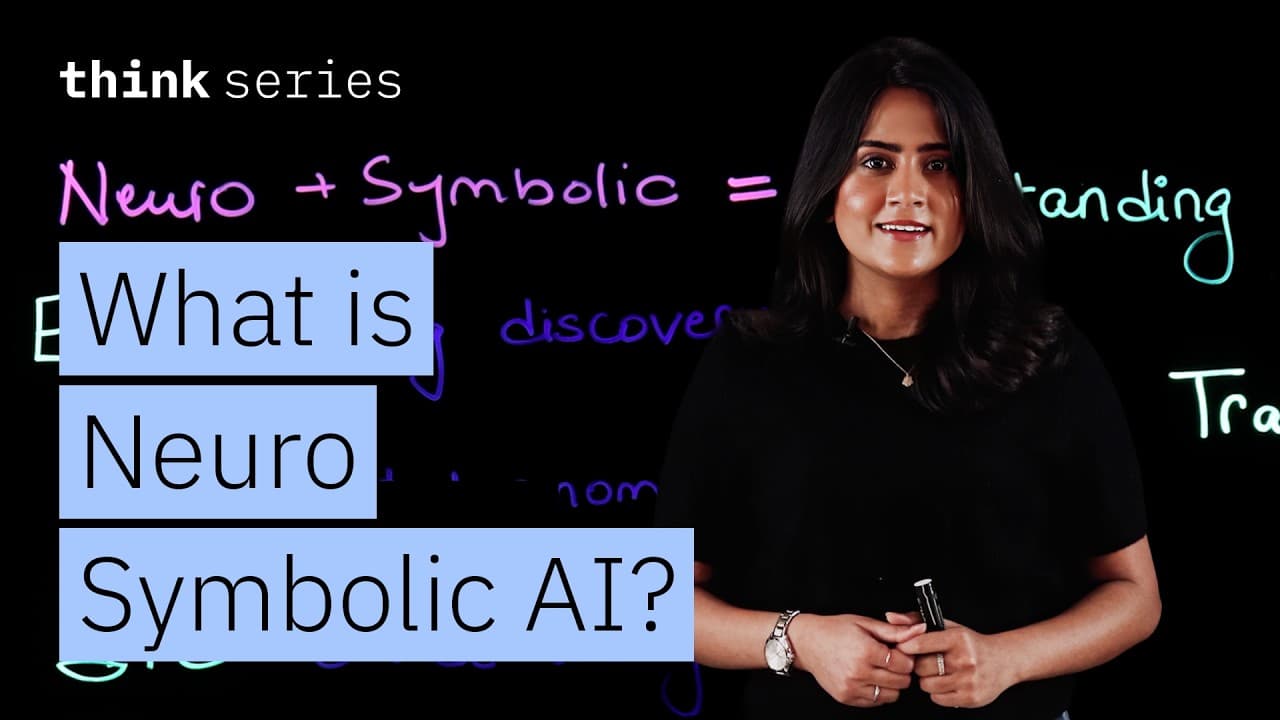
Neurosymbolic AI blends neural learning with symbolic reasoning to enable both pattern recognition and logical inference. It adds reasoning layers on top of neural outputs using frameworks like first-order logic, and can learn new rules through meta-learning, improving explainability and robustness across domains.
Transcript
Modern AI models excel at pattern recognition, classifying images, generating text and finding relationships in data. So, you upload a photo and your phone instantly tags it a cat or a beach or a birthday. Which is pretty impressive, right? But here's the catch: if you ask why it knows it's a cat, it can't explain it. It just recognizes what it's s... Read More
Key Insights
- Neurosymbolic AI merges learning and logic to deliver both perception and explanation.
- The neural component handles recognition while symbolic reasoning provides structured rules.
- First order logic can be layered on top of neural outputs to reason about observations.
- Meta learning trains models to update reasoning rules based on new evidence.
- Systems can detect and reason about objects like signs even with changes in lighting or stickers.
- Symbolic reasoning makes models more explainable and easier to audit.
- Integrating with reinforcement learning can make reasoning more robust in decision tasks.
- Applications span science, finance, and law by analyzing structures, patterns and clauses.
Install to Summarize YouTube Videos and Get Transcripts
Explore YouTube Video Summarizer or Get YouTube Transcript Extractor
Questions & Answers
Q: How does neurosymbolic AI improve explainability compared to pure neural models
Neurosymbolic AI improves explainability by adding symbolic reasoning layers that use rules to interpret neural outputs. This means the system can show why a decision was made, such as a stop sign being identified because it is red and octagonal, rather than relying solely on pattern recognition. The approach formalizes the reasoning steps, making outputs auditable and more transparent.
Q: What role does first order logic play in neurosymbolic AI
First order logic provides a structured framework for reasoning about observed data. In neurosymbolic AI, outputs from neural networks are combined with logical rules to derive conclusions, allowing the system to infer properties and relationships beyond surface patterns. This enhances generalization when faced with novel but related cases.
Q: What is meta learning in the context of neurosymbolic AI
Meta learning in neurosymbolic AI refers to teaching the model how to learn and adapt its reasoning rules from new data. Rather than memorizing examples, the system updates its logic to accommodate new observations, such as recognizing that mammals include whales despite lacking typical fur, enabling flexible and robust reasoning across domains.
Q: Can neurosymbolic AI handle changes in input like lighting or occlusion
Yes, by combining neural recognition with symbolic reasoning, neurosymbolic AI can maintain correct inferences when inputs change. Neural components detect features such as color and shape, while rules verify the appropriate category, allowing the system to resist being misled by lighting changes or stickers that alter appearances.
Q: What are practical fields where neurosymbolic AI could be useful
Potential fields include science for analyzing molecular structures and properties, finance for detecting transaction anomalies, and law for extracting and reasoning about clauses. The technology aims to make outputs more explainable and reliable, helping practitioners debug models, validate outputs and support governance.
Q: How does neurosymbolic AI differ from rule based AI
Rule based AI relies on fixed human crafted rules, while neurosymbolic AI combines those rules with learned representations from neural networks. This allows the system to reason with both explicit knowledge and learned patterns, adapting rules when new evidence is encountered, leading to better handling of real world variability.
Q: What is the relationship between reasoning and learning in this approach
Reasoning and learning are integrated rather than separate. Learning comes from neural networks that detect patterns, while reasoning comes from symbolic rules that interpret and generalize those patterns. Together they create systems that can explain their decisions and adapt their logic over time through meta learning.
Q: Is the goal of neurosymbolic AI to replace humans
The goal is not to replace humans but to augment decision making. By combining logic with learning, systems become better at explaining their reasoning and handling complex tasks, while humans provide creativity, judgment and empathy. The objective is to create collaborative AI that supports human teams.
Summary & Key Takeaways
-
Neurosymbolic AI couples neural networks with symbolic logic to enable reasoning on top of learned patterns, improving interpretability.
-
The approach uses rule based thinking combined with data driven learning to adapt to new concepts without relying solely on millions of examples.
-
Developers can integrate symbolic reasoning with pretrained models to debug, validate and reason about model outputs across applications.
Read in Other Languages (beta)
Share This Summary 📚
Summarize YouTube Videos and Get Video Transcripts with 1-Click
Try YouTube Summary with ChatGPT & Claude or YouTube Transcript Generator
Explore More Summaries from IBM Technology 📚




Summarize YouTube Videos and Get Video Transcripts with 1-Click
Try YouTube Summary with ChatGPT & Claude or YouTube Transcript Generator