How AI is Revolutionizing Food Assembly with Robots
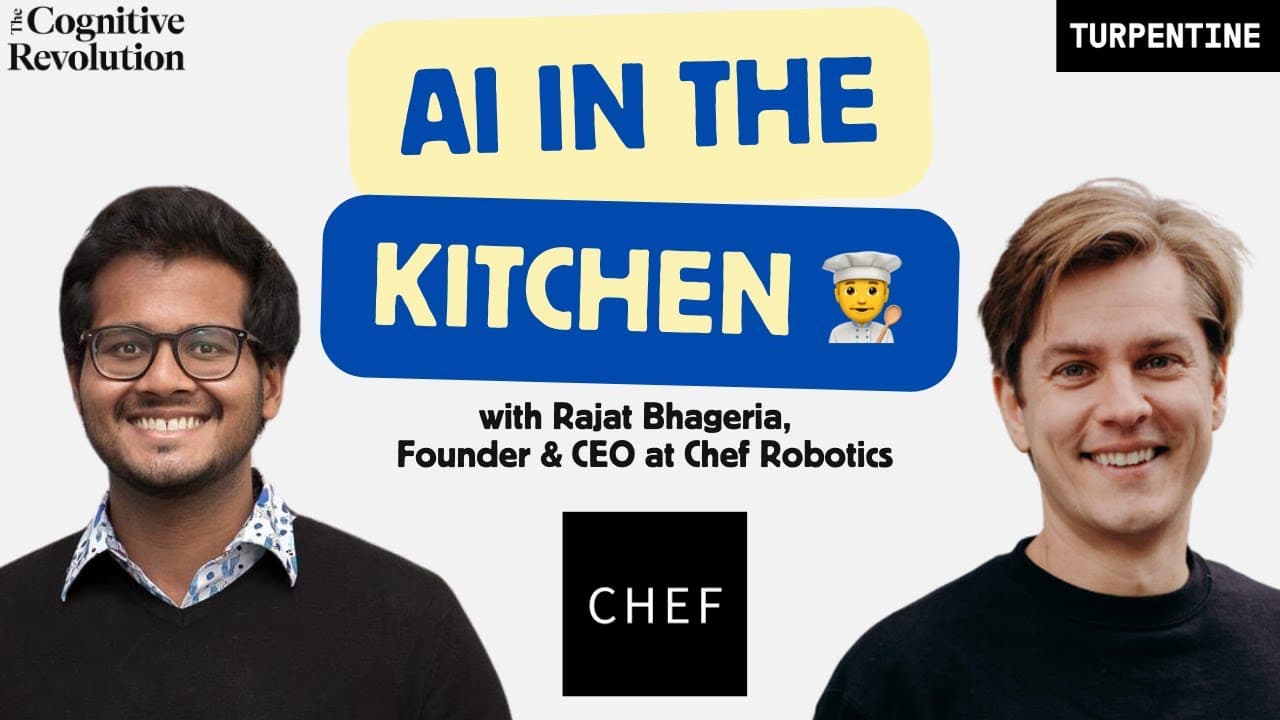
TL;DR
Chef Robotics is transforming the food industry by using AI-enabled robots to automate food assembly, which constitutes 70% of labor costs in food manufacturing. These robots use imitation learning and data flywheel effects to adapt to dynamic environments and improve efficiency. The ultimate vision includes robotic ghost kitchens providing affordable, customizable meals, potentially leading to a reorganization of the food industry.
Transcript
hello and welcome to the cognitive Revolution where we interview Visionary researchers entrepreneurs and Builders working on the frontier of artificial intelligence each week we'll explore their revolutionary ideas and together we'll build a picture of how AI technology will transform work life and Society in the coming years I'm Nathan lens joined... Read More
Key Insights
- Chef Robotics focuses on automating food assembly, which is the most labor-intensive part of food manufacturing, accounting for 70% of labor costs.
- The company's robots use imitation learning to adapt to the variability of food properties, ensuring consistency and efficiency in assembly tasks.
- Chef Robotics aims to deploy robots in every commercial kitchen, potentially leading to cheaper and more customizable meal options.
- The robots are designed to be a drop-in replacement for human workers, requiring minimal setup and adapting to existing production lines.
- The business model is based on robotics as a service, offering customers a cost-effective alternative to human labor without significant upfront investment.
- The company leverages data flywheel effects, where more deployed robots lead to better data, improving the robots' performance over time.
- Chef Robotics envisions a future with robotic ghost kitchens, where meals are prepared by robots and delivered by autonomous drones, reducing costs and increasing convenience.
- The integration of AI and robotics in food production could significantly reduce food waste and improve supply chain efficiency.
Install to Summarize YouTube Videos and Get Transcripts
Explore YouTube Video Summarizer or Get YouTube Transcript Extractor
Questions & Answers
Q: How does Chef Robotics automate food assembly?
Chef Robotics automates food assembly by using AI-enabled robots designed to handle the most labor-intensive tasks in food manufacturing. These robots use imitation learning to adapt to the variability of food properties, ensuring consistency and efficiency. They are drop-in replacements for human workers, requiring minimal setup and adapting to existing production lines.
Q: What is the business model of Chef Robotics?
Chef Robotics operates on a robotics as a service model, providing a cost-effective alternative to human labor without significant upfront investment. Customers pay a yearly recurring fee, which is less than the cost of their staff workers. This model allows for quick deployment and scaling, making it attractive for food manufacturers facing labor shortages and high costs.
Q: What are the key benefits of using Chef Robotics' technology?
The key benefits of using Chef Robotics' technology include reduced labor costs, increased efficiency, and improved consistency in food assembly. The robots can adapt to the variability of food properties, ensuring consistent portion sizes and reducing waste. Additionally, the service model allows for quick deployment and scaling without significant upfront costs.
Q: How do Chef Robotics' robots adapt to different food properties?
Chef Robotics' robots use imitation learning to adapt to different food properties. They fine-tune their actions based on the specific batch of ingredients, considering factors such as stickiness, density, and particle size. This adaptive capability ensures consistent and efficient assembly, even when there is variability in the food properties.
Q: What is the long-term vision for Chef Robotics?
The long-term vision for Chef Robotics includes deploying robots in every commercial kitchen worldwide, leading to cheaper and more customizable meal options. The company envisions robotic ghost kitchens producing meals delivered by autonomous drones, potentially reorganizing the food industry and making high-quality food more accessible and affordable.
Q: How does Chef Robotics' technology impact food waste?
Chef Robotics' technology can significantly reduce food waste by ensuring precise portion sizes and minimizing overpicking. The robots' ability to consistently measure and dispense ingredients reduces the likelihood of excess food being used, which in turn decreases waste and improves supply chain efficiency. This is particularly beneficial in large-scale food production settings.
Q: What challenges does Chef Robotics face in food manipulation?
Chef Robotics faces challenges in food manipulation due to the variability of food properties, such as stickiness, density, and particle size. The robots must consistently adapt to these properties to ensure efficient and accurate assembly. The company addresses these challenges by leveraging imitation learning and data flywheel effects to improve the robots' performance over time.
Q: How does Chef Robotics' technology improve supply chain efficiency?
Chef Robotics' technology improves supply chain efficiency by automating the most labor-intensive tasks in food manufacturing, reducing labor costs and increasing throughput. The robots' precision in portioning and assembly minimizes waste and ensures consistent product quality, which can lead to more efficient inventory management and distribution processes.
Summary & Key Takeaways
-
Chef Robotics is revolutionizing food assembly by using AI-enabled robots to handle the most labor-intensive tasks in food manufacturing. These robots leverage imitation learning to adapt to the variability of food properties, ensuring consistent and efficient assembly. The company's vision includes deploying robots in commercial kitchens worldwide, leading to more affordable and customizable meal options.
-
The business model of Chef Robotics is based on robotics as a service, offering a cost-effective alternative to human labor without requiring significant upfront investment. This approach allows for quick deployment and scaling within existing production lines, making it an attractive option for food manufacturers facing labor shortages and high costs.
-
In the future, Chef Robotics envisions a world where robotic ghost kitchens produce meals that are delivered by autonomous drones, potentially leading to a reorganization of the food industry. This could result in cheaper, more customizable meals and a reduction in food waste, transforming the way we think about food production and consumption.
Read in Other Languages (beta)
Share This Summary 📚
Summarize YouTube Videos and Get Video Transcripts with 1-Click
Try YouTube Summary with ChatGPT & Claude or YouTube Transcript Generator
Explore More Summaries from Cognitive Revolution "How AI Changes Everything" 📚






Summarize YouTube Videos and Get Video Transcripts with 1-Click
Try YouTube Summary with ChatGPT & Claude or YouTube Transcript Generator