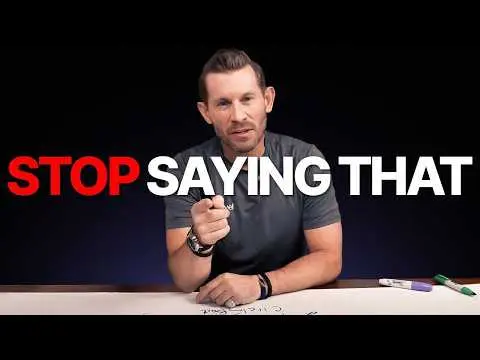
Complete Sales Skills Tier List: Which Skills Should New Reps Learn First?

TL;DR
New sales reps should learn problem finding first because prospects often do not understand a problem’s root cause, severity, effects, or consequences. The complete tier list places problem finding in S tier, objection prevention in A tier, time management in B tier, and objection handling in C tier. Read on to see how questioning, prospect time blocking, objection clarification, and early communication cues improve sales conversations.
Transcript
you know I get asked every day by salespeople Jeremy what are the most important skills I need to learn and in what order especially brand new salespeople so today what I'm going to do is I'm going to break it down in a tier list for you order of most important to the least important so you know what to focus on so the very first skill that you nee... Read More
Key Insights
- Problem finding is the highest-ranked sales skill because prospects may not recognize their actual problems, understand their depth, identify their root causes, or appreciate the consequences of leaving them unresolved. The salesperson’s first responsibility is to help make those issues visible.
- Effective questioning is the mechanism for uncovering several problems that a prospect may not know exist. Questions should be asked at the right time and should establish a gap between the prospect’s current position and the outcome the prospect wants to achieve.
- Problem solving is less immediately important than problem finding because the seller cannot deliver the proposed solution unless the prospect first decides to buy. The transcript therefore places problem finding in the S tier as the foundational capability for new salespeople.
- Time management is the discipline of focusing working hours on income-producing activities. Relevant activities include calling outbound leads, handling inbound leads, cold calling when appropriate, following up with previous prospects, answering concerns, preparing proposals, closing prospects, and advancing opportunities through the pipeline.
- Prospect time blocking is a scheduling approach that reserves specific periods for prospecting and other periods for proposals, meetings, or related selling work. Email should be checked during designated times so incoming messages do not repeatedly interrupt prospecting and pipeline activity.
- Objection clarification is necessary because one phrase can represent several different concerns. “Too expensive” might refer to insufficient funds, delayed access to money, internal budget movement, a lower-priced competitor, or comparison with an existing provider, so the salesperson should clarify before answering.
- Objection prevention is ranked above objection handling because uncertainty can be addressed before the close. Words, questions, omitted questions, and tone can trigger uncertainty, so salespeople should notice warning signs and help prospects work through concerns during the conversation.
- Sales resistance can form within the first 7–12 seconds of a sales conversation as prospects interpret verbal, nonverbal, and social cues. Aggressive, overly excited, salesy, or pushy behavior can affect that reaction, making early delivery and tone important parts of the interaction.
Install to Summarize YouTube Videos and Get Transcripts
Explore YouTube Video Summarizer or Get YouTube Transcript Extractor
Questions & Answers
Q: What sales skill should a new salesperson learn first?
A new salesperson should first learn problem finding, which is ranked in the S tier. By asking the right questions at the right time, a rep can help prospects uncover two, three, or four problems they may not have recognized and clarify the gap between their current and desired situations.
Q: What is the complete sales skills tier list?
Problem finding is placed in the S tier, making it the most important skill discussed. Objection prevention ranks in A tier, time management in B tier, and objection handling in C tier.
Q: How can salespeople become better problem finders?
Salespeople become better problem finders by asking well-timed questions that reveal hidden problems, root causes, effects, and consequences. These questions should help prospects understand where they are, where they want to be, and what stands between those positions.
Q: Why is problem finding more important than problem solving in sales?
Problem finding comes first because the salesperson cannot deliver the proposed solution unless the prospect buys. Problem solving happens after the purchase, while problem finding helps prospects recognize why their situation may require action.
Q: What counts as an income-producing sales activity?
Income-producing activities include calling outbound leads, handling inbound leads, cold calling where relevant, following up with previous prospects, answering questions, addressing concerns, preparing proposals, closing prospects, and moving opportunities through the pipeline. Social media browsing, constant email checking, and unproductive conversations should not displace those activities.
Q: How should salespeople manage their working time?
Salespeople should schedule their work around income-producing activities through prospect time blocking. They can reserve certain hours for prospecting and others for proposals, meetings, questions, and pipeline work, while checking email only at designated times.
Q: How should a salesperson respond to an objection?
The salesperson should clarify what the objection means before answering it. For example, “too expensive” could reflect unavailable money, a temporary delay, a departmental budget issue, a cheaper competitor, or comparison with an existing provider, so a question such as “How do you mean?” can expose the real concern.
Q: How can a salesperson prevent objections and reduce early sales resistance?
Objection prevention means noticing uncertainty and helping the prospect work through it before the closing stage. Because prospects may begin interpreting verbal, nonverbal, and social cues within the first 7–12 seconds, salespeople should avoid aggressive, overly excited, salesy, or pushy behavior and pay attention to tone and visible hesitation.
Summary & Key Takeaways
-
Problem finding receives the S-tier ranking because a salesperson must uncover the prospect’s real problems before offering a solution. Effective questions reveal root causes, consequences, and gaps between the prospect’s current and desired situations. Problem solving matters after a purchase, while problem finding helps create the conditions for that purchase.
-
Time management receives a B-tier ranking. Salespeople should schedule prospecting blocks and concentrate on income-producing activities, including calling leads, handling inbound inquiries, cold calling where relevant, following up with previous prospects, preparing proposals, answering questions, closing prospects, and moving opportunities through the pipeline instead of reacting constantly to email and distractions.
-
Objection handling receives a C-tier ranking, while objection prevention receives an A-tier ranking. Clarifying statements such as “too expensive” or “I want to think it over” reveals the underlying concern. Prevention goes further by identifying uncertainty during the conversation and asking questions that help prospects resolve concerns before the closing stage.
Read in Other Languages (beta)
Share This Summary 📚
Summarize YouTube Videos and Get Video Transcripts with 1-Click
Try YouTube Summary with ChatGPT & Claude or YouTube Transcript Generator
Explore More Summaries from Jeremy Miner 📚





Summarize YouTube Videos and Get Video Transcripts with 1-Click
Try YouTube Summary with ChatGPT & Claude or YouTube Transcript Generator