How to Scale Facebook Ads Without Killing ROAS
TL;DR
Scale Facebook ad budgets by roughly 20% to 30% when performance is above the target, then allow enough time for upper-funnel prospects to convert. Track cost per link click, add to cart, initiated checkout, and purchase, while checking that additional spend reaches new and engaged audiences instead of existing customers.
Transcript
99% of people running Facebook ads scale completely wrong. And this is why your CPM spike, your rorowaz drops, and ultimately it's why you feel like you hit a wall and everything hits the fan the moment you spend an extra few dollars. But after spending $500 million to drive well over a billion dollars in revenue for the brands that we work with he... Read More
Key Insights
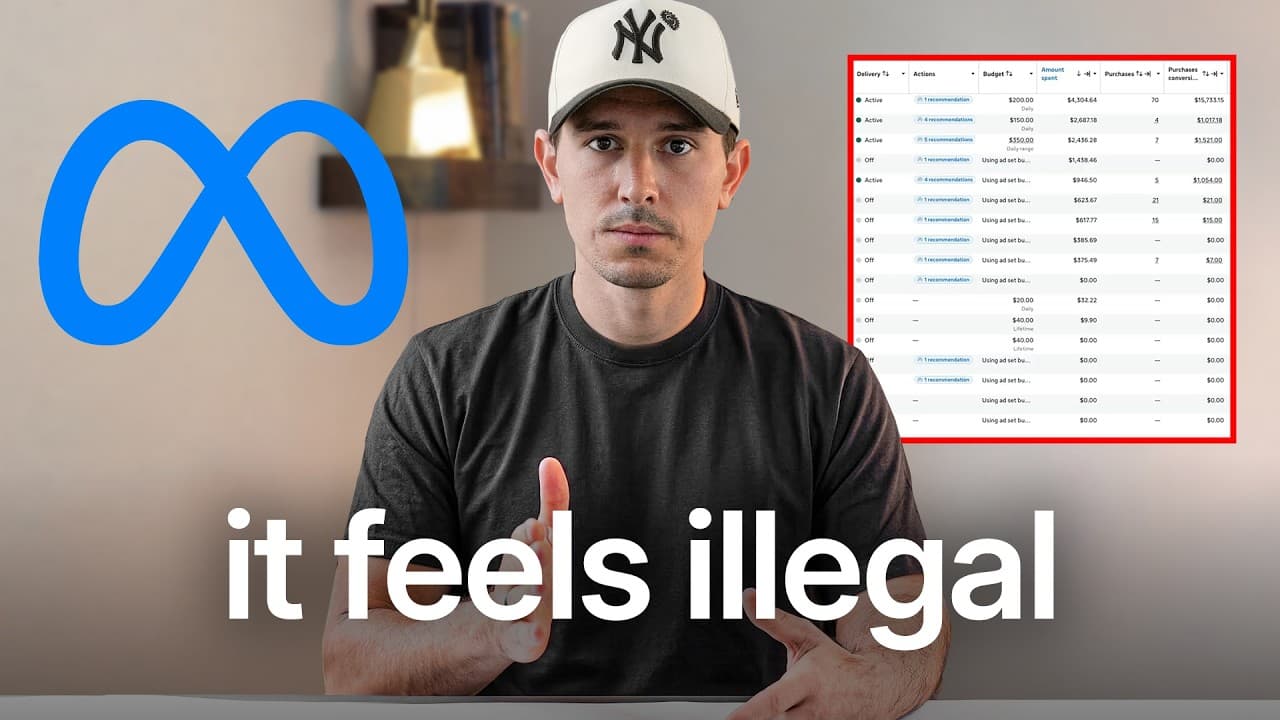
- Sudden budget increases can sharply raise acquisition costs because the algorithm may not know how to accommodate a large change at once. In the example shown, costs per purchase near $88 and $106 rose to $299, $252, and $269 after the budget increased.
- Adding new ads to an established consolidated campaign can unexpectedly redirect most of the account's budget. One audited ad moved from $11 in spending over a 30-day period to $2,000, displacing other ads and reducing the account's overall return on ad spend.
- High-spending ads can support conversions credited elsewhere in an account, so pausing them based only on their individual return can damage broader performance. In the example account, the top 10 ads represented a large share of spending and helped feed purchases occurring lower in the account.
- Additional advertising dollars increasingly reach upper-funnel consumers because the pool of people already ready to buy is limited. These prospects take longer to convert, which can make results initially appear weaker after a budget increase even when later conversions are still developing.
- Funnel metrics provide early evidence of whether paid traffic may progress toward purchases. The recommended column order is cost per link click, cost per add to cart, cost per initiated checkout, and cost per purchase, allowing advertisers to follow movement through successive conversion stages.
- Vertical scaling is the process of increasing a campaign budget when performance is already above the required target. The recommended increase is roughly 20% to 30% at a time, rather than pursuing the highest possible return on ad spend while leaving profitable growth unused.
- New-customer acquisition should remain the focus during vertical scaling. The audience-segment breakdown should show most spending assigned to new and engaged audiences, with very little going to existing customers, as illustrated by only $200 of $25,000 reaching existing customers.
- Incremental attribution can estimate the return associated with the next advertising dollar more conservatively than standard attribution. In the example prospecting campaign, the displayed return on ad spend was 2.65, while incremental attribution suggested an expected return of 1.86 on additional spending.
Install to Summarize YouTube Videos and Get Transcripts
Explore YouTube Video Summarizer or Get YouTube Transcript Extractor
Questions & Answers
Q: How should I scale a profitable Facebook ad campaign?
Increase the campaign budget when its return on ad spend is above the actual target, using increments of roughly 20% to 30% at a time. Do not try to maximize efficiency indefinitely if the campaign is already profitable and above break-even. Controlled increases create room to acquire more new customers without imposing one abrupt, overleveraged change on delivery.
Q: Why does cost per purchase rise after increasing a Facebook ad budget?
A sharp increase can force the algorithm to accommodate too much change at once and expand delivery beyond the lowest-hanging fruit. In the example provided, costs per purchase around $88 and $106 climbed to $299, $252, and $269 after the client raised the budget. Additional spending also reaches more upper-funnel consumers, who generally require longer to convert.
Q: What metrics should I track when scaling Facebook ads?
Track cost per link click, cost per add to cart, cost per initiated checkout, and cost per purchase. Arrange them in that order to see how spending moves people from a site visit through cart and checkout toward a completed purchase. These secondary metrics can indicate downstream progress before enough final purchases appear in the account.
Q: Why should advertisers wait before reversing a budget increase?
Higher spending increasingly reaches people who are farther from making a purchase, so conversions may take longer to appear. Advertisers who raise a budget, see no immediate improvement, and quickly lower it can misread this delay. Later conversions may come from the earlier increase, creating a misleading cycle of raising and cutting budgets based on incomplete results.
Q: When can a Facebook ad budget be increased by more than 30%?
A larger increase may be considered when the campaign is substantially above its target and can tolerate reduced efficiency. The example describes a campaign with a 2.3 target: if its return were 5 rather than 2.65, the budget might be doubled because even a meaningful performance decline could leave the campaign comfortably above the required target.
Q: Why is pausing high-spending Facebook ads risky?
High-spending ads may feed demand and purchases that appear elsewhere in the account, even when their individual return looks less impressive. The example account had 186 ads, while its top 10 represented a large portion of total spending. Cutting these ads too quickly based only on return on ad spend can remove the activity supporting stronger lower-account results.
Q: How can I check whether scaling is reaching new customers?
Open the audience-segment breakdown and inspect how spending is divided among new, engaged, and existing audiences. Most spending should reach the new and engaged segments, while very little should reach existing customers. In the managed-account example, only $200 out of $25,000 went to existing customers, indicating a strong focus on new-customer acquisition.
Q: What is horizontal scaling for Facebook ads?
The described modern approach to horizontal scaling starts with ads already working inside existing campaigns, especially proven performers at the ad level, and builds on them horizontally. It rejects older tactics such as creating hundreds of duplicate low-budget ad sets or applying many different cost caps, which are characterized as short-lived rather than sustainable scaling systems.
Summary & Key Takeaways
-
Large budget increases and numerous simultaneous campaign changes can disrupt delivery, sharply increase cost per purchase, and concentrate spending on a newly added ad. Scaling therefore requires a controlled methodology, patience, and attention to how Meta distributes each additional dollar across audiences at different stages of the purchasing journey.
-
Vertical scaling means increasing a profitable campaign's budget when its return on ad spend exceeds the required target. The recommended adjustment is roughly 20% to 30% at a time, although substantially larger increases may be reasonable when performance is about 100% above target and has enough room to decline.
-
Advertisers should evaluate scaling through the entire conversion path rather than judging only immediate purchases. Cost per link click, add to cart, initiated checkout, and purchase reveal whether traffic is progressing toward conversion. Audience-segment and incremental-attribution breakdowns help assess new-customer spending and the likely return from the next advertising dollar.
Read in Other Languages (beta)
Share This Summary 📚
Summarize YouTube Videos and Get Video Transcripts with 1-Click
Try YouTube Summary with ChatGPT & Claude or YouTube Transcript Generator
Explore More Summaries from Sam Piliero 📚




Summarize YouTube Videos and Get Video Transcripts with 1-Click
Try YouTube Summary with ChatGPT & Claude or YouTube Transcript Generator