Is AGI Coming Soon? Insights from Economist Robin Hanson
TL;DR
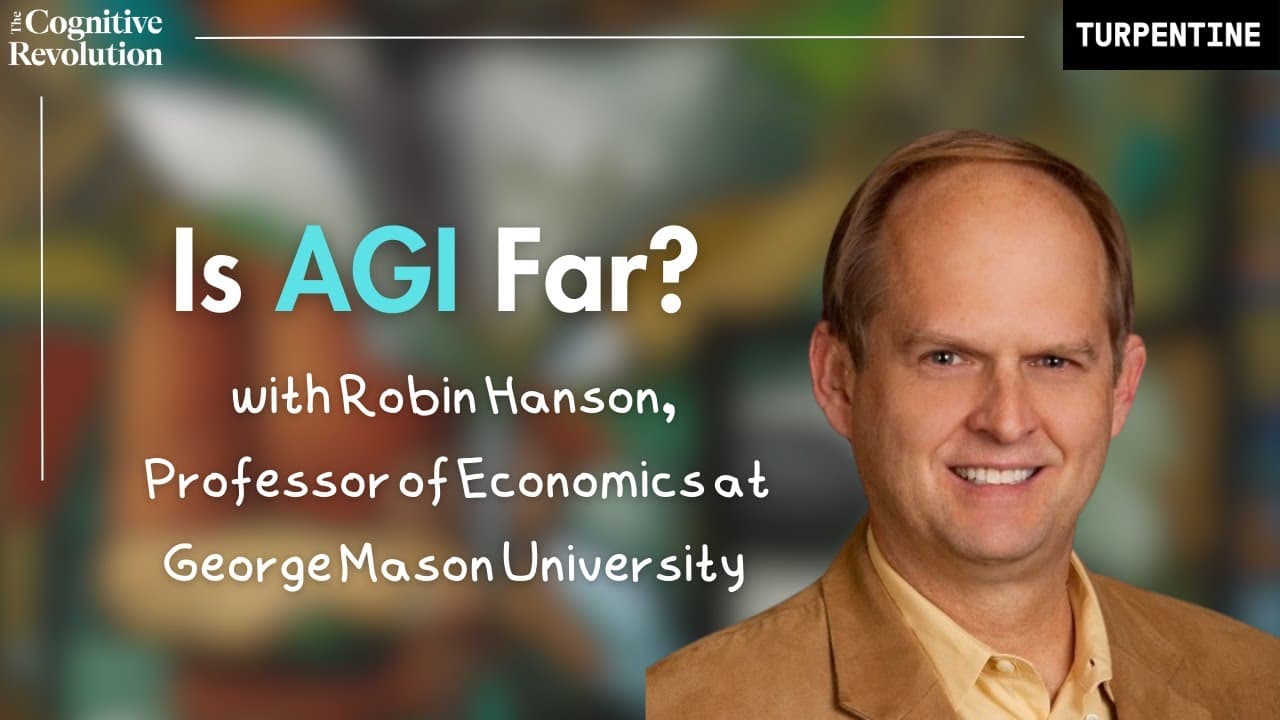
Robin Hanson argues that we're not as close to achieving artificial general intelligence (AGI) as many believe. He suggests that past overestimations of AI progress indicate a cautious outlook for future capabilities. Hanson also highlights that AI's economic impacts may slow due to declining population trends, emphasizing the need for careful analysis over emotional value-driven discussions.
Transcript
we're on this upward growth trajectory we have the potential to taking a big chunk of the universe and doing things with it and I'm excited by that potential so I want us to keep growing and I see how much we've changed to get to where we are my book age of M is about brain emulations so that's where you take a particular human brain and you scan i... Read More
Key Insights
- Robin Hanson discusses the concept of 'dream time,' highlighting how our current rapid growth and wealth are anomalies in human history, suggesting a return to a slower, more Malthusian world.
- The Age of Em envisions a future where brain emulations, or 'ems,' replicate human brains digitally, allowing for infinite copies and pauses, but not easy merging.
- Current AI models, like large language models, show significant progress but remain limited in scope compared to the comprehensive human brain emulations envisioned in the Age of Em.
- Hanson argues that while AI has made strides, such as in medical diagnosis, legal barriers and societal acceptance are significant hurdles to widespread implementation.
- The current trajectory of AI development suggests a gradual increase in automation, but not at a pace that would avert economic decline due to population decrease.
- Hanson posits that AI systems, like human institutions, suffer from 'rot' over time, necessitating periodic renewal to maintain functionality.
- The economic impact of AI, particularly in programming, could see increased productivity, but wage effects remain uncertain due to elastic demand.
- Moral considerations for AI, particularly ems, suggest that as they become more integrated into society, they will command respect akin to human co-workers.
Install to Summarize YouTube Videos and Get Transcripts
Explore YouTube Video Summarizer or Get YouTube Transcript Extractor
Questions & Answers
Q: What is 'dream time' according to Robin Hanson?
Robin Hanson describes 'dream time' as the current period of rapid economic growth and technological change, which is an anomaly in human history. He suggests that this period is unsustainable and that humanity will eventually return to a slower, more Malthusian world. Dream time allows for less discipline by functionality, leading to a focus on abstract and emotional pursuits.
Q: How does Hanson compare brain emulations to current AI models?
Hanson's concept of brain emulations, or 'ems,' involves digitizing human brains to create copies that can perform all human tasks. In contrast, current AI models, like large language models, are limited in scope and cannot fully replicate human cognitive abilities. Ems would allow for infinite copying and pausing, but not easy merging, unlike some potential capabilities of future AI models.
Q: What are Hanson's views on AI's impact on the economy?
Hanson is skeptical about AI's immediate transformative impact on the economy. He believes that while AI has made progress, such as in medical diagnosis, legal and societal barriers limit its widespread adoption. He predicts a gradual increase in automation but not at a pace that would prevent economic decline due to population decrease. Hanson also highlights the issue of 'rot' in AI systems, which requires periodic renewal.
Q: Why does Hanson believe there might be an innovation pause?
Hanson suggests that declining population and fertility rates could lead to an innovation pause, as fewer people result in slower economic growth and reduced innovation. He predicts that this pause could last several centuries until insular fertile subcultures, like the Amish, become dominant, leading to a resurgence of innovation and eventually, the development of full human-level AI.
Q: What are some challenges in merging AI models, according to the discussion?
The discussion highlights that while AI models can be trained and fine-tuned, merging them remains a challenge. Current practice typically involves starting with a blank representation rather than building on existing models due to issues like 'rot' in software. This suggests that while AI models can be adapted for specific tasks, creating a unified, general AI remains complex.
Q: How does Hanson address the moral weight of AI?
Hanson argues that as AI, particularly ems, becomes more integrated into society, they will command respect akin to human co-workers. This moral consideration arises from their ability to perform human-like tasks and potentially insist on being treated with dignity. He suggests that societal interactions with AI will require a degree of respect to maintain cooperation and functionality.
Q: What is the significance of 'rot' in AI systems?
Hanson introduces the concept of 'rot' in AI systems, analogous to the decay seen in human institutions and software. Rot implies that AI systems degrade over time, necessitating periodic renewal to maintain functionality. This challenge suggests that AI, like biological and social systems, requires ongoing maintenance and adaptation to remain effective and relevant.
Q: What economic changes does Hanson predict due to AI in programming?
Hanson predicts that AI could significantly increase productivity in programming by automating routine tasks. However, the impact on wages is uncertain due to the elastic demand for programming. While increased productivity could lead to more programming jobs, the influx of new programmers and automation might stabilize or even reduce wages, depending on market dynamics.
Summary & Key Takeaways
-
In this episode, Nathan Lens interviews Robin Hanson, an economist known for his work on futurism and AI. They discuss the potential of AI and automation to transform the economy, drawing comparisons between human brains, large language models (LLMs), and Hanson's brain emulation concept from his book, The Age of Em.
-
Hanson expresses skepticism about the imminent arrival of full human-level AI, citing historical overestimations of AI progress. He predicts a potential innovation pause due to declining population and fertility rates, suggesting that AI's economic impact may be slower than anticipated.
-
The discussion also covers the moral and ethical implications of AI, particularly the respect and rights that ems might demand in the future. Hanson emphasizes the importance of distinguishing between value-driven discussions and factual analysis when considering AI's future.
Read in Other Languages (beta)
Share This Summary 📚
Summarize YouTube Videos and Get Video Transcripts with 1-Click
Try YouTube Summary with ChatGPT & Claude or YouTube Transcript Generator
Explore More Summaries from Cognitive Revolution "How AI Changes Everything" 📚



Summarize YouTube Videos and Get Video Transcripts with 1-Click
Try YouTube Summary with ChatGPT & Claude or YouTube Transcript Generator