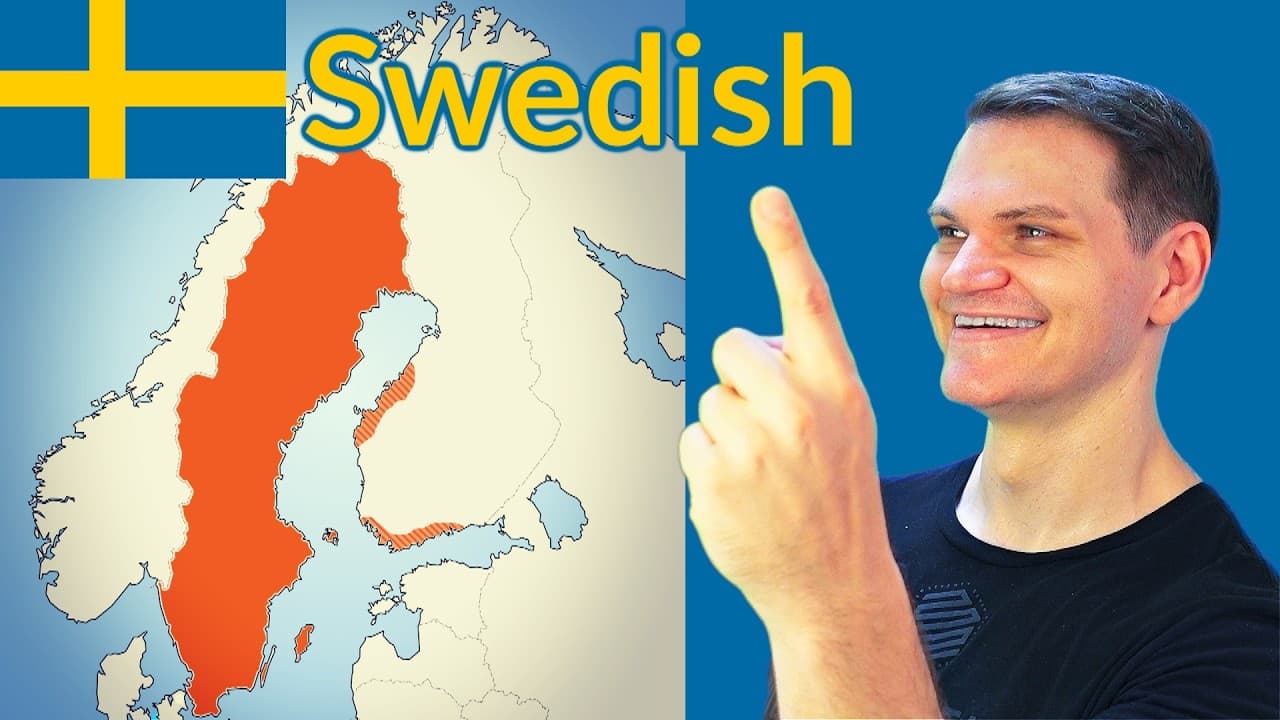
Swedish - The #1 North Germanic language!
TL;DR
The video explores the Swedish language, its history, and learning resources.
Transcript
this video is brought to you by swedish pod 101 pod 101 courses are one of my favorite ways to start learning a new language online click the link in the description for a free lifetime account to give it a try hello everyone welcome to the langfocus channel and my name is paul today we're going to focus on the swedish language the svenska sprucket... Read More
Key Insights
- Swedish is a North Germanic language spoken by around 10 million people, primarily in Sweden and Finland.
- It evolved from Old Norse and underwent significant changes in grammar and vocabulary due to historical influences like the Hanseatic League.
- Swedish uses a 29-letter alphabet with specific vowel length distinctions that affect word meanings.
- Standard Swedish is predominant, though regional dialects still exist, with accent being the main differentiator.
- Swedish grammar features two genders and a simplified verb system compared to its historical forms.
- The language has pitch accent, distinguishing words through tone patterns, similar to Norwegian.
- Swedish shares many grammatical similarities with English, making it relatively intuitive for English speakers to learn.
- Swedishpod101 offers comprehensive resources for learning Swedish, including audio and video lessons, flashcards, and quizzes.
Install to Summarize YouTube Videos and Get Transcripts
Explore YouTube Video Summarizer or Get YouTube Transcript Extractor
Questions & Answers
Q: What is the historical origin of the Swedish language?
Swedish is a North Germanic language that evolved from Old Norse, which developed from Proto-Germanic by the 8th century. It underwent significant changes over the centuries, influenced by historical events like the Hanseatic League, which impacted its vocabulary and grammar. This evolution led to the modern Swedish language spoken today.
Q: How does the Swedish alphabet differ from the English alphabet?
The Swedish alphabet consists of 29 letters, compared to the 26 letters in the English alphabet. It includes additional vowel letters and specific distinctions between long and short vowels, which affect word meanings. These vowel distinctions are crucial in Swedish pronunciation and orthography, contributing to the language's unique phonetic characteristics.
Q: What are the main dialectal differences in Swedish?
While Standard Swedish is predominantly spoken, regional dialects still exist, with accent being the primary differentiator. These dialects are less distinct than they once were due to the influence of Standard Swedish. However, pronunciation variations, especially in accents, remain a notable feature of Swedish dialects, presenting challenges for learners.
Q: How does Swedish grammar compare to English grammar?
Swedish grammar shares many similarities with English, making it relatively intuitive for English speakers to learn. It features a subject-verb-object word order, similar to English, and uses definite articles as suffixes. However, Swedish has two genders and a simplified verb system compared to its historical forms, which can differ from English.
Q: What is pitch accent in Swedish, and how does it affect meaning?
Swedish, like Norwegian, has pitch accent, where the tone pattern on stressed syllables distinguishes words. There are two tone patterns: tone one (rising) and tone two (falling-rising-falling). These tonal differences can change the meaning of words, making pitch accent an essential aspect of Swedish pronunciation and comprehension.
Q: What resources does Swedishpod101 offer for learning Swedish?
Swedishpod101 offers a comprehensive suite of resources for learning Swedish, including audio and video lessons, downloadable books, and PDF materials. It provides vocabulary flashcards, quizzes, and spaced repetition tools to aid memorization. The platform emphasizes reinforcing and reviewing lessons to ensure effective learning and language retention.
Q: What challenges do learners face when studying Swedish?
Learners of Swedish often find pronunciation challenging due to vowel length distinctions and pitch accent. Additionally, getting accustomed to dialectal variations and different accents can be difficult. Despite these challenges, Swedish's grammatical similarities to English make it intuitive for English speakers, and learners generally enjoy the process.
Q: How has Swedish grammar simplified from its historical forms?
Swedish grammar has become simpler over time, with a reduction in the number of cases from four to two and a decrease in gender categories from three to two. The verb system has also been simplified, making modern Swedish grammar more accessible compared to its historical forms, which featured more complex grammatical structures.
Summary & Key Takeaways
-
Swedish, a North Germanic language, is primarily spoken in Sweden and Finland, with around 10 million speakers. It evolved from Old Norse, influenced by historical events like the Hanseatic League, which impacted its vocabulary and grammar. Modern Swedish has two genders and a simplified verb system.
-
The Swedish alphabet consists of 29 letters, with distinct vowel lengths affecting word meanings. Standard Swedish is widely spoken, though regional dialects persist. The language features pitch accent, distinguishing words through tone patterns, and shares grammatical similarities with English, aiding English-speaking learners.
-
Swedishpod101 provides extensive resources for learning Swedish, offering audio and video lessons, flashcards, and quizzes. The platform emphasizes reinforcing and reviewing lessons for effective learning. Swedish's similarities to English make it intuitive for learners, though pronunciation and dialectal variations pose challenges.
Read in Other Languages (beta)
Share This Summary 📚
Summarize YouTube Videos and Get Video Transcripts with 1-Click
Try YouTube Summary with ChatGPT & Claude or YouTube Transcript Generator
Explore More Summaries from Langfocus 📚


Summarize YouTube Videos and Get Video Transcripts with 1-Click
Try YouTube Summary with ChatGPT & Claude or YouTube Transcript Generator