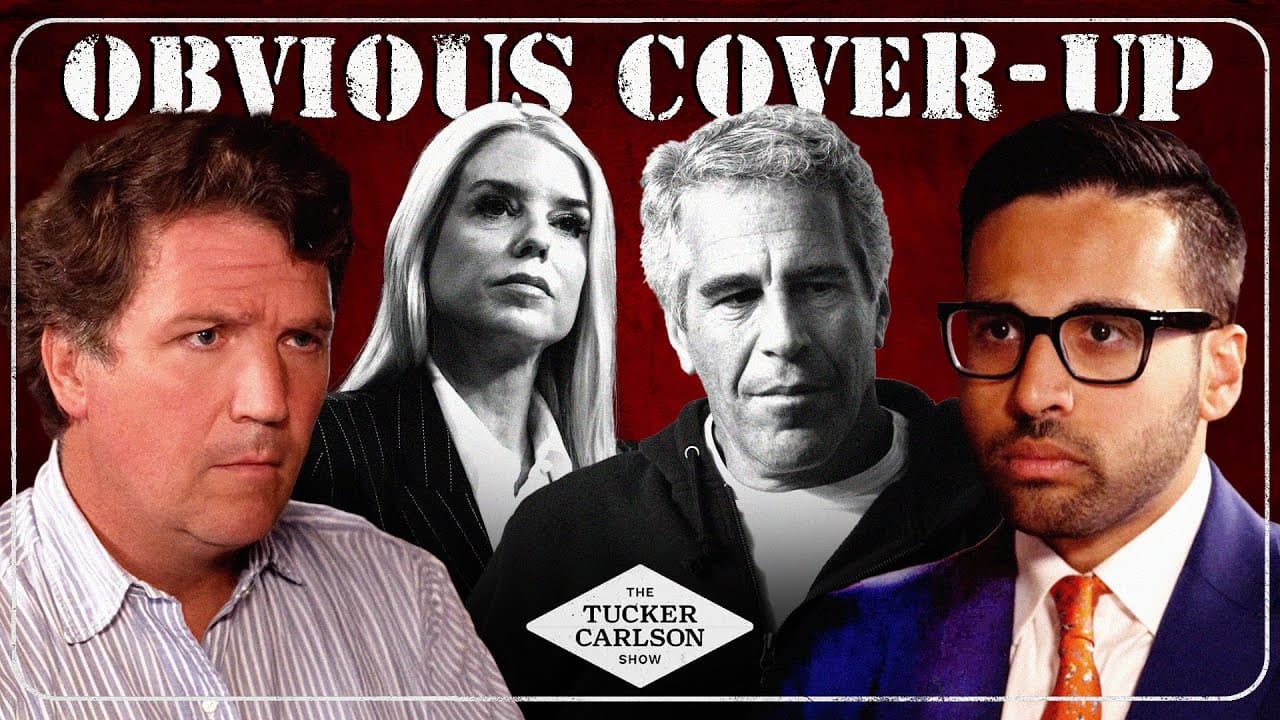
Why Do Tucker Carlson and Saagar Enjeti Accuse Pam Bondi of an Epstein Cover-Up?
TL;DR
The government is withholding additional Epstein records, according to Tucker Carlson and Saagar Enjeti, while asking the public to accept conclusions they consider inconsistent with officials’ earlier promises. They contrast Pam Bondi’s references to a client list, flight logs, and thousands of victims with a later document reportedly denying a client list and systematic blackmail. Read on for their specific transparency demands, financial leads, and allegations.
Transcript
I'll speak for myself. I never thought that I would be offering an apology to Jeffrey Epstein. I think of all the times I've maligned that guy. All the times I'm accused him of crimes, of blackmailing people, of trafficking children, to powerful figures around the world on behalf of Global Intel Services. And then I learned yesterday from Attorney ... Read More
Key Insights
- Government credibility is the central issue in the discussion, as Carlson and Enjeti object to officials asking for trust after allegedly changing their public positions on Epstein-related evidence once they entered the administration.
- Pam Bondi’s statements are presented as contradictory because the interview says she previously referred to possessing a client list and flight logs, yet a later government document reportedly said there was no client list or systematic blackmail operation.
- The term client list is described as misleading because Enjeti does not expect a simple ledger linking named individuals to crimes. He instead wants victim records, flight logs, financial evidence, and documentation that could establish specific relationships and conduct.
- Financial records are portrayed as essential evidence because Enjeti argues that Epstein’s influence depended partly on high-finance expertise and relationships with wealthy people. He cites Leon Black’s reported payment of $170 million through various corporations for tax advice as an example requiring scrutiny.
- Leslie Wexner’s relationship with Epstein is identified as another financial lead because Enjeti says Wexner granted Epstein full power of attorney in 1991. The discussion treats this arrangement and Epstein’s role with the Wexner Foundation as relevant to understanding his rise.
- Victim protection is presented as compatible with disclosure, not as an automatic reason for secrecy. Enjeti argues that officials should ask Epstein’s victims themselves, claiming that victims have sought the release of information capable of identifying powerful people who victimized them.
- Intelligence involvement is an allegation advanced by the participants, not an established conclusion in the supplied material. Enjeti theorizes that Epstein’s finances, trafficking network, Robert Maxwell, and Israeli and United States intelligence interests were connected, but the discussion does not provide conclusive documentary proof.
- Political trust is portrayed as vulnerable across partisan lines because Carlson says even people who voted and campaigned for President Trump may view the government’s response as unacceptable. He warns that unresolved inconsistencies could damage support for the broader MAGA agenda.
Install to Summarize YouTube Videos and Get Transcripts
Explore YouTube Video Summarizer or Get YouTube Transcript Extractor
Questions & Answers
Q: Why do Tucker Carlson and Saagar Enjeti believe the government is withholding Epstein files?
They point to apparent contradictions between officials’ earlier disclosure promises and their positions after entering office. They say Pam Bondi previously referred to a client list, flight logs, and thousands of victims, while a later government document reportedly denied a client list and systematic blackmail and withheld further information.
Q: What contradiction do they identify in Pam Bondi’s statements about the Epstein files?
They say Bondi stated on the White House lawn that officials had the client list and flight logs and referred to thousands of victims. They contrast those remarks with a later government document that they describe as denying both a client list and a systematic blackmail operation.
Q: Why do they criticize Kash Patel and Dan Bongino?
Enjeti says Kash Patel and Dan Bongino built expectations that they would uncover and release Epstein-related information. He argues that they changed their positions after assuming office and then asked the public to trust the government’s conclusions.
Q: What Epstein records do Tucker Carlson and Saagar Enjeti want disclosed?
They demand broad transparency concerning victim records, flight logs, financial transactions, and the identities and conduct of people connected to Epstein. Enjeti emphasizes that the evidence should establish what particular individuals did rather than merely publish names without context.
Q: Why does Saagar Enjeti consider the term “client list” misleading?
Enjeti does not expect a simple ledger matching named people with crimes or favors. He argues that victim testimony, flight logs, financial transfers, corporate structures, and documented relationships must instead be examined together.
Q: Why are Epstein’s financial relationships important to Enjeti’s argument?
Enjeti treats financial records as essential to understanding Epstein’s influence and relationships with wealthy people. He cites Leon Black’s reported payment of $170 million through various corporations for tax advice and Leslie Wexner’s granting of full power of attorney to Epstein in 1991 as leads requiring scrutiny.
Q: How do they respond to concerns about protecting Epstein’s victims?
Enjeti rejects the idea that victim protection automatically requires withholding all records. Responding to Kash Patel’s reported concern about revictimization, he says officials should ask the victims themselves and claims they have sought information that could identify powerful people who victimized them.
Q: Do they prove that Epstein was connected to intelligence operations?
No conclusive documentary proof is provided in the supplied discussion. Enjeti alleges connections involving Epstein’s finances, trafficking network, Robert Maxwell, and United States and Israeli intelligence interests, but these remain his theories and suspicions.
Summary & Key Takeaways
-
Tucker Carlson and Saagar Enjeti criticize the Justice Department’s handling of Epstein-related records. They contrast Pam Bondi’s earlier references to a client list, flight logs, and thousands of victims with a later government position that, according to the discussion, denied a client list and systematic blackmail while withholding additional information.
-
Enjeti argues that the phrase client list oversimplifies the evidence people actually need. He calls for records identifying victims, people appearing in flight logs, and especially the movement of money. He highlights Epstein’s financial relationships with Leon Black and Leslie Wexner as leads that deserve closer scrutiny and documented public accounting.
-
The conversation frames transparency as a test of government credibility. Carlson and Enjeti say officials including Kash Patel, Dan Bongino, and Bondi previously encouraged expectations of disclosure but changed their positions after entering office. They contend that protecting victims should involve listening to victims who have requested accountability, while handling identities and evidence responsibly.
Read in Other Languages (beta)
Share This Summary 📚
Summarize YouTube Videos and Get Video Transcripts with 1-Click
Try YouTube Summary with ChatGPT & Claude or YouTube Transcript Generator
Explore More Summaries from Tucker Carlson 📚






Summarize YouTube Videos and Get Video Transcripts with 1-Click
Try YouTube Summary with ChatGPT & Claude or YouTube Transcript Generator