What Is the ChatGPT Apps SDK and AgentKit?
TL;DR
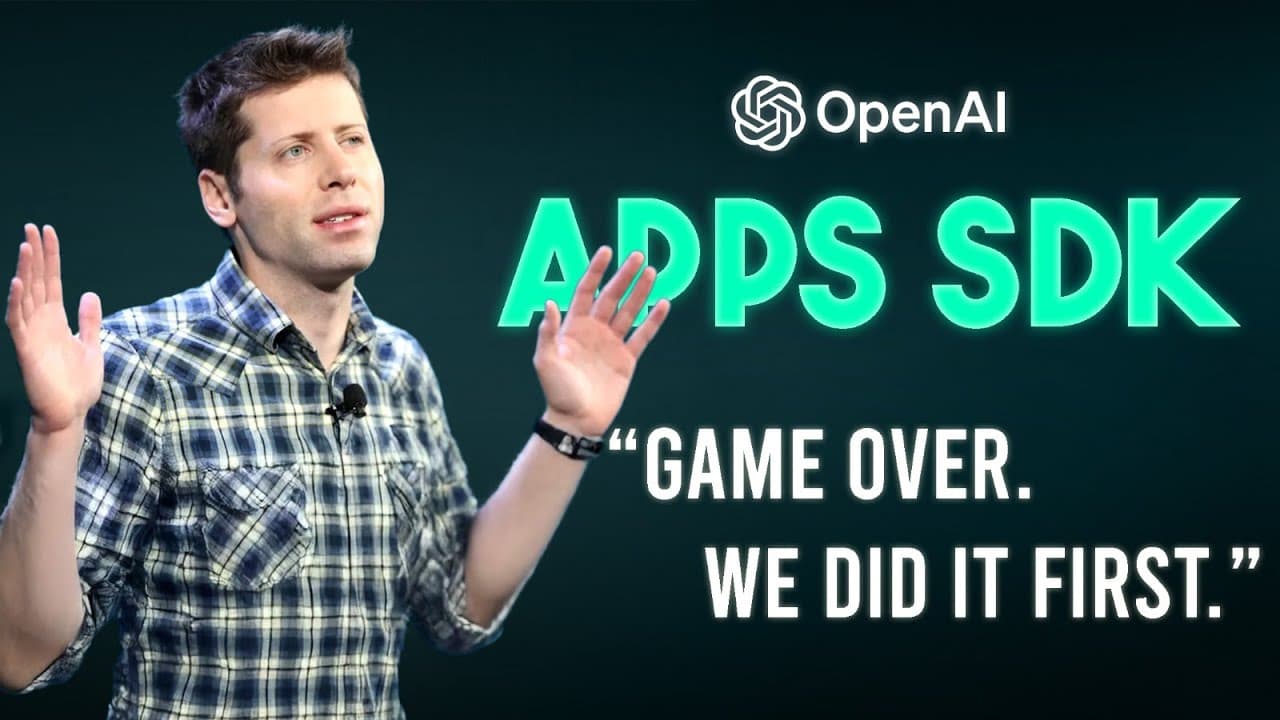
OpenAI's new Apps SDK lets developers build interactive apps that run inside ChatGPT, launching with Booking.com, Canva, Coursera, Expedia, Figma, Spotify, and Zillow. Alongside it, AgentKit offers drag-and-drop tools for building autonomous agents, while Codex handles engineering. Multi-billion-dollar AMD and NVIDIA chip deals supply the compute powering the whole ecosystem.
Transcript
Open AAI just changed the game again. Chat GPT is turning into a full platform packed with apps, autonomous agents, and even its own hardware. There's the new apps SDK bringing Spotify, Canva, and Zillow inside your chats. Agent Kit for building AI agents that can actually think and act. Codeex powering developers everywhere. And massive AMD and Nv... Read More
Key Insights
- The Apps SDK is built on the Model Context Protocol and lets developers create interactive apps that live directly inside ChatGPT, launching with Booking.com, Canva, Coursera, Expedia, Figma, Spotify, and Zillow.
- Apps work through natural language: you mention an app, ChatGPT tells you what data it needs, asks permission, and connects seamlessly, replacing traditional menus with plain conversation.
- Monetization arrives through the Agentic Commerce Protocol, which enables instant checkout inside ChatGPT, with submissions, reviews, and an official app directory going live later this year.
- AgentKit is a drag-and-drop system for building autonomous agents, including Agent Builder for visual multi-agent logic, a Connector Registry linking Dropbox, Google Drive, SharePoint, and Microsoft Teams, and ChatKit for embedding chat interfaces.
- Evals is OpenAI's toolkit for measuring agent performance, adding datasets for grading, trace grading for end-to-end runs, automatic prompt optimization, and support for testing third-party models to catch errors before they reach users.
- Codex is now officially available with a Slack integration, SDK, and admin dashboard, built on GPT-5-Codex fine-tuned for speed, precision, and structured output, and plugs into CI/CD pipelines using GitHub Actions.
- Inside OpenAI, engineers say weekly code merges rose about 70% and nearly every pull request is auto-reviewed before production, while Cisco reported code review times cut in half.
- OpenAI signed a deal giving it the option to buy up to 10% of AMD while securing six gigawatts of compute via AMD's MI450 chips, following a separate $100 billion NVIDIA partnership for ten gigawatts.
Install to Summarize YouTube Videos and Get Transcripts
Explore YouTube Video Summarizer or Get YouTube Transcript Extractor
Questions & Answers
Q: What is the ChatGPT Apps SDK?
The Apps SDK is built on the Model Context Protocol and lets developers create interactive apps that live directly inside ChatGPT. The launch lineup includes Booking.com, Canva, Coursera, Expedia, Figma, Spotify, and Zillow. Each app works through natural language: you mention it, and when used for the first time, ChatGPT tells you what data it needs, asks permission, and connects you seamlessly, replacing traditional menus with plain conversation.
Q: Which apps are available in the ChatGPT Apps SDK launch lineup?
The launch lineup already includes Booking.com, Canva, Coursera, Expedia, Figma, Spotify, and Zillow. According to the video, 11 more partner apps are already on the way. Developers can connect their own backends, test everything in developer mode, and reach hundreds of millions of users. Submissions, reviews, and an official app directory go live later this year, with monetization through the Agentic Commerce Protocol.
Q: What is AgentKit and how does it work?
AgentKit is a drag-and-drop system for creating autonomous AI agents, small reasoning systems that can plan, fetch data, and take action. It includes Agent Builder, a visual canvas for designing multi-agent logic using nodes and connections; a Connector Registry hub linking data across Dropbox, Google Drive, SharePoint, and Microsoft Teams; ChatKit for embedding customized chat interfaces; and Evals for measuring agent performance.
Q: What does OpenAI's Evals toolkit do for agents?
Evals is OpenAI's toolkit for measuring how well agents perform. It includes datasets for grading, trace grading for end-to-end runs, automatic prompt optimization, and support for testing third-party models. Because accuracy becomes the make-or-break factor once agents act autonomously, developers can simulate tasks, test workflows, compare models, preview every run, roll back changes, and catch errors before they reach real users.
Q: What is Codex and what can it do?
Codex is OpenAI's engineering layer, now officially available with a Slack integration, SDK, and full admin dashboard. Built on GPT-5-Codex fine-tuned for speed, precision, and structured output, it remembers context, resumes sessions, and plugs into CI/CD pipelines using GitHub Actions. Codex can review code, propose fixes, and push updates automatically. You can tag it in Slack to pull context, run tasks in the Codex cloud, and receive results.
Q: How much has Codex improved developer productivity?
Inside OpenAI, engineers rely on Codex every day and say weekly code merges went up by about 70%, with almost every pull request now auto-reviewed before it hits production. Companies like Cisco, Instacart, Duolingo, Vanta, and Rocket use it too. Cisco's engineers reported code review times cut in half, and Instacart uses Codex to clean up dead code and automate repetitive maintenance.
Q: What are the AMD and NVIDIA deals OpenAI signed?
OpenAI signed a multi-billion-dollar partnership with AMD that gives it the option to buy up to 10% of AMD while securing six gigawatts of AI compute through AMD's upcoming MI450 chips, roughly the energy of 5 million US homes or three Hoover dams. AMD expects over $100 billion in new revenue. This follows NVIDIA's own $100 billion partnership with OpenAI for ten gigawatts of compute.
Q: What is the Jony Ive AI device OpenAI is developing?
OpenAI is teaming with Apple designer Jony Ive to create a small, screenless AI companion device that listens, sees, and speaks. The goal is a palm-sized device that sits on your desk or travels with you, using microphones, cameras, and speakers to interact naturally without trigger words. It faces compute challenges and delays, but Sam Altman reportedly aims to ship 100 million units, counting on ChatGPT's 700 million weekly users.
Summary & Key Takeaways
-
The new Apps SDK, built on the Model Context Protocol, turns ChatGPT into a platform where developers build interactive apps that live inside chats. The launch lineup includes Booking.com, Canva, Coursera, Expedia, Figma, Spotify, and Zillow, each accessed by natural language with permission-based data connections.
-
AgentKit provides drag-and-drop tools for building autonomous agents: Agent Builder for visual workflows, a Connector Registry hub for data services, ChatKit for embedded interfaces, and Evals for measuring agent performance through grading, trace grading, and prompt optimization to catch errors early.
-
Codex becomes the engineering layer with a Slack integration, SDK, and admin dashboard, reportedly raising weekly merges 70% at OpenAI. Massive AMD and NVIDIA compute deals plus a screenless Jony Ive AI companion device round out OpenAI's shift from product to full platform.
Read in Other Languages (beta)
Share This Summary 📚
Summarize YouTube Videos and Get Video Transcripts with 1-Click
Try YouTube Summary with ChatGPT & Claude or YouTube Transcript Generator
Explore More Summaries from AI Revolution 📚



Summarize YouTube Videos and Get Video Transcripts with 1-Click
Try YouTube Summary with ChatGPT & Claude or YouTube Transcript Generator