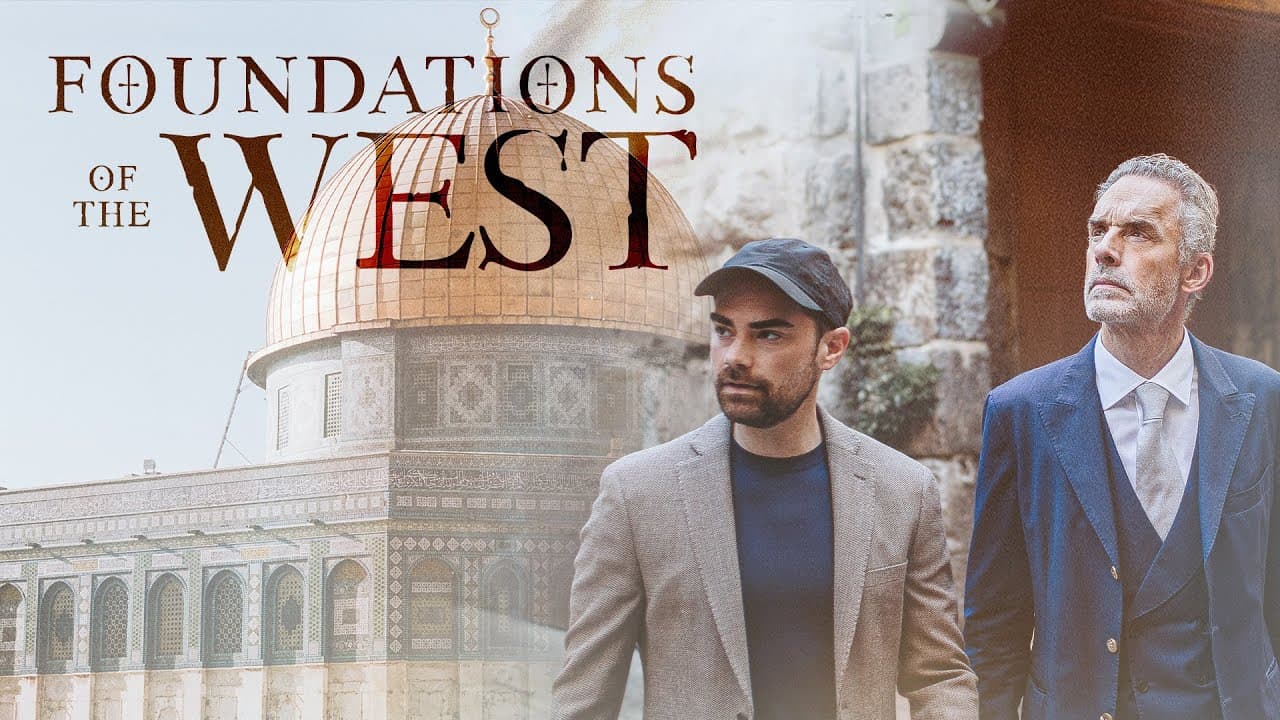
Why Is Jerusalem Central to Western Civilization? | Foundations of the West Episode I with Ben Shapiro
TL;DR
Jerusalem is central to Western civilization because it contributed a spiritually grounded morality that places godly values above human authority. In Foundations of the West Episode I, Jerusalem is identified with Athens and Rome as one of the West’s three pillars, while the Temple Mount’s foundation stone symbolizes an axis mundi connecting creation, consciousness, and moral orientation. Read on to understand how these ideas also illuminate Jerusalem’s enduring conflict.
Transcript
last year daily wire plus and I released a fantastic series on the origins of Western culture entitled foundations of the West the series had a tremendously positive impact because of this the daily wire and I have decided to share the first episode with you free of charge you're about to watch episode one in it Ben Shapiro and I discuss the lastin... Read More
Key Insights
- Jerusalem is presented as the birthplace of Western civilization because its religious tradition placed a set of godly values above human authority, making spiritual morality a communal foundation rather than merely a private belief.
- Western civilization is described as resting on Jerusalem, Athens, and Rome: Jerusalem supplied spiritual morality, Athens emphasized the logos within the material domain, and Rome demonstrated both the advantages and dangers of power, empire, and reach.
- Monotheism is portrayed as a source of social unity because people require a shared central animating spirit, while the Bible is described as an answer to the enduring Jewish question of what that spirit should be.
- Jerusalem’s geography is unusually compressed, with the Temple Mount, the Mount of Olives, Jewish graves, Arab communities, and protected Jewish residences situated close together, making simple proposals for population separation difficult to apply.
- The Temple Mount is a constructed platform created by flattening part of a mountain, building retaining walls, and filling the enclosed area with dirt, producing a space described as approximately three football fields in size.
- The foundation stone is understood in Jewish theology as the basis God used for creation, while the Latin term axis mundi expresses the related idea that the world possesses a central spiritual point around which orientation becomes possible.
- The Temple Mount carries overlapping sacred histories because it is associated with the Jewish temples, Abraham’s intended sacrifice of Isaac, Jacob’s ladder, and the Muslim belief that Muhammad used the rock as the point of ascent to heaven in his dream.
- Consciousness is presented as an irreducible mystery and the experiencer assumed by descriptions of reality, while the Judeo-Christian tradition symbolizes its ordering function through the word that draws clear existence from the chaotic void.
Install to Summarize YouTube Videos and Get Transcripts
Explore YouTube Video Summarizer or Get YouTube Transcript Extractor
Questions & Answers
Q: Why is Jerusalem considered a foundation of Western civilization?
Jerusalem is presented as the birthplace of Western civilization because people there began thinking communally about godly values that stand above human authority. It supplied the West with spiritually grounded morality, alongside Athens’ focus on logos in the material domain and Rome’s lessons about power, empire, and reach.
Q: What are the three pillars of Western civilization discussed in Foundations of the West?
The three pillars are Jerusalem, Athens, and Rome. Jerusalem offered spiritually based morality, Athens concentrated on the logos revealed in the material domain, and Rome demonstrated the advantages and perils of power, empire, and reach.
Q: How does monotheism create social unity according to Ben Shapiro’s discussion?
Monotheism gives a community one central animating spirit and a shared object of worship. The discussion argues that unity requires people to worship the same God, pursue the same project, and be guided by the same spirit; the Bible is presented as an answer to what that spirit should be.
Q: What does axis mundi mean in relation to Jerusalem?
Axis mundi describes a spiritual center that provides a fixed point for orienting the world. In Jerusalem, this center is associated with the foundation stone on the Temple Mount, which Jewish theology presents as the basis God used for creation.
Q: Why is the Temple Mount sacred to both Jews and Muslims?
For Jews, the Temple Mount is the holiest site and the location of the first and second temples, the holy of holies, and the foundation stone. The site is also connected with Abraham’s intended sacrifice of Isaac and Jacob’s ladder. For Muslims, the nearby Al-Aqsa area is described as the third-holiest site, and the rock is associated with Muhammad’s ascent to heaven in his dream.
Q: How was the Temple Mount constructed?
The Temple Mount was created by flattening part of the mountain, building retaining walls, and filling the enclosed space with dirt. This produced a large platform described as approximately three football fields in size.
Q: What happened to the first and second Jewish temples?
The first temple stood on the Temple Mount and was destroyed in 576 BCE. It was rebuilt about 70 years later, and the second structure remained for approximately half a millennium before its destruction in 70 CE. Roughly a thousand years later, the Dome of the Rock was built above the associated location of the holy of holies and foundation stone.
Q: Why is resolving conflict in Jerusalem geographically difficult?
Jerusalem’s important communities and sacred places are packed extremely close together. The Temple Mount, Mount of Olives, centuries-old Jewish graves, Arab communities, and protected Jewish residential pockets occupy the same tightly layered landscape. This high-resolution geography makes a quick population separation far more complicated than it sounds.
Summary & Key Takeaways
-
Jerusalem is presented as one of Western civilization’s three pillars, alongside Athens and Rome. It contributed a spiritually grounded morality in which godly values stand above human authority. The discussion connects monotheism with communal unity, arguing that a shared central spirit provides common moral direction and helps a civilization organize itself.
-
The Temple Mount concentrates Jewish and Muslim sacred meanings within one small area. The first and second Jewish temples stood there, while the Dome of the Rock was later built above the associated location of the holy of holies and foundation stone. Muslims connect the rock with Muhammad’s ascent to heaven in his dream.
-
The foundation stone represents the axis mundi, a spiritual center that orients the world like a fixed point on a map. The discussion links this symbolism to Abraham, Isaac, Jacob’s ladder, the North Star, consciousness, and the word that brings ordered existence from a chaotic void into clarity within the Judeo-Christian tradition.
Read in Other Languages (beta)
Share This Summary 📚
Summarize YouTube Videos and Get Video Transcripts with 1-Click
Try YouTube Summary with ChatGPT & Claude or YouTube Transcript Generator
Explore More Summaries from Jordan B Peterson 📚



Summarize YouTube Videos and Get Video Transcripts with 1-Click
Try YouTube Summary with ChatGPT & Claude or YouTube Transcript Generator