Why Did Europeans Explore and Colonize America?
TL;DR
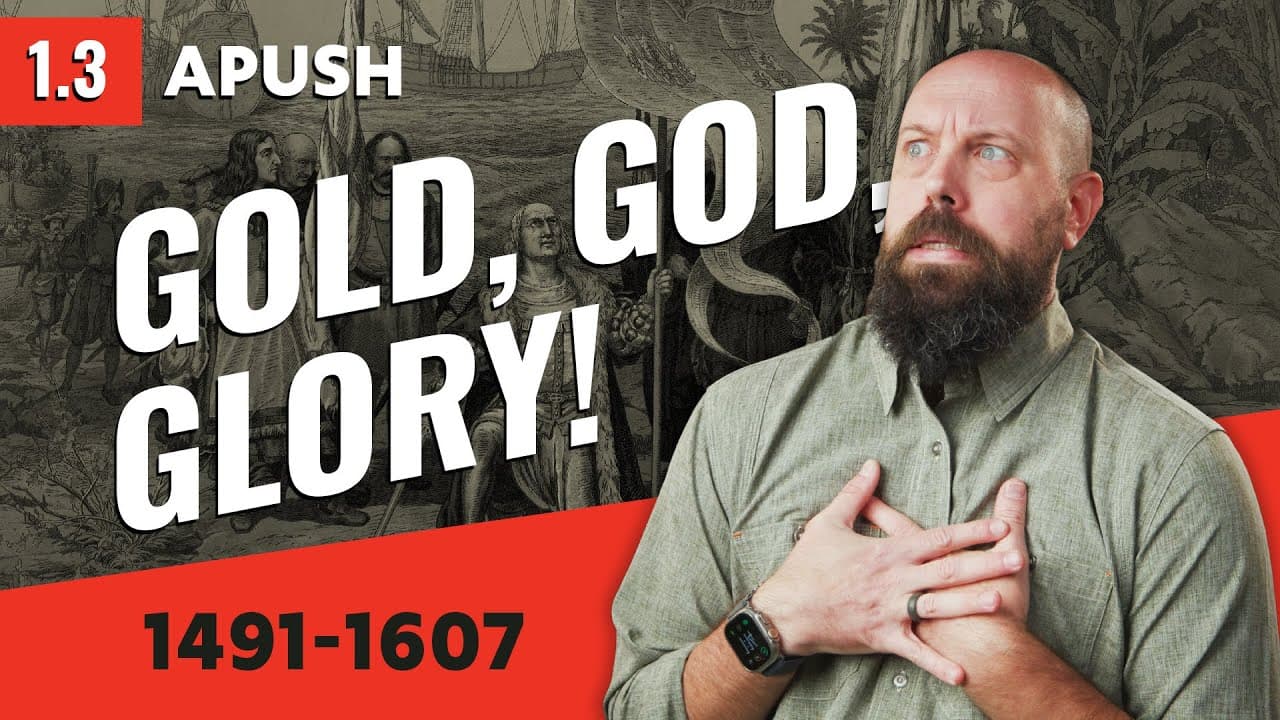
European exploration grew from stronger states, agricultural recovery, population growth, renewed trade, and demand for Asian luxury goods. Europeans pursued maritime expansion for gold, God, and glory: gaining wealth through trade, spreading competing forms of Christianity, and securing colonies that could strengthen their political power against rival states.
Transcript
Well, it sure was nice to meet all the indigenous peoples of the Americas in the last video. But hold on to your butts because here come the Europeans, y'all. And if you're in the mood to understand the causes of European exploration, then I'm in the mood to explain it up real nice for you. So, if you're ready to get them brain cows milt, let's get... Read More
Key Insights
- European exploration was enabled by agricultural, demographic, cultural, and political recovery. Warmer conditions, improved farming techniques, greater food production, population growth, revived trade, the Renaissance, and stronger unified governments made European states more stable and capable of financing maritime expeditions.
- Gold represented the economic motive for exploration. Growing European demand for Asian luxury goods, combined with improved banking systems and dissatisfaction with established land-trade conditions, encouraged rulers and merchants to search for profitable ocean routes to Asian markets.
- The Ottoman conquest of Constantinople in 1453 changed European access to Asian trade. Because Constantinople was a key choke point and the Ottoman Empire could dictate trade terms, Europeans had a stronger incentive to find alternative maritime passages.
- Portugal pioneered the ocean route around Africa under Prince Henry the Navigator's leadership. Vasco da Gama successfully sailed around the Cape of Good Hope in 1498, helping Portugal establish trading posts along African coasts and throughout the Indian Ocean.
- Portugal's overseas network was a trading post empire rather than a system of conventional colonies. Its strategically placed posts gave Portugal extensive influence over Indian Ocean commerce and, by the end of the 16th century, made the kingdom exceptionally wealthy.
- Christopher Columbus sailed west in 1492 with support from Ferdinand and Isabella. He sought Asian and Southeast Asian markets, but calculations underestimated Earth's size by about 25 percent, causing him to mistake the Caribbean for Asia.
- God represented the religious motive for exploration. The Protestant Reformation permanently divided Christianity, and Catholic and Protestant states used maritime expansion and missionary activity to spread their beliefs while competing over religious legitimacy and political influence.
- Glory represented the political motive for exploration and colonization. Once Europe contacted the Americas, colonial possessions became tools for shifting the balance of power, prompting rival states to expand because Spain was gaining extensive territory and influence.
Install to Summarize YouTube Videos and Get Transcripts
Explore YouTube Video Summarizer or Get YouTube Transcript Extractor
Questions & Answers
Q: Why did Europeans begin exploring overseas?
Europeans began exploring because several developments made overseas expeditions possible and attractive. Warmer conditions and improved farming increased food production, which supported population growth. Trade revived, demand for Asian luxury goods expanded, and improved banking facilitated commerce. The Renaissance encouraged cultural renewal, while political unification strengthened governments that could support exploration. These conditions combined with economic, religious, and political ambitions.
Q: What do gold, God, and glory mean in European exploration?
Gold, God, and glory summarize the three main motives for European exploration. Gold refers to gaining wealth through trade, especially access to Asian luxury goods and later American resources. God refers to spreading Christianity during conflict between Catholics and Protestants. Glory refers to political competition, because rulers sought colonies and influence that could strengthen their states against European rivals.
Q: How did the Ottoman conquest of Constantinople encourage exploration?
The Ottoman Empire conquered Constantinople in 1453, taking control of a key choke point in trade between Europe and Asia. Because the Ottomans could dictate the terms of commerce, Europeans wanted another way to reach Asian markets. Rising demand for Eastern luxury goods therefore encouraged maritime experimentation, including Portuguese voyages around Africa and Spanish support for a westward Atlantic route.
Q: How did Portugal build a maritime trading empire?
Portugal pursued an ocean route around Africa under the leadership of Prince Henry the Navigator. In 1498, Vasco da Gama successfully sailed around the Cape of Good Hope and established a Portuguese presence in the east. Portugal then created trading posts along African coasts and throughout the Indian Ocean, forming a trading post empire that eventually dominated much of the region's commerce.
Q: Why did Spain fund Christopher Columbus's voyage?
Spain wanted a different route to Asian markets because Portugal had already established itself around Africa and in the Indian Ocean. Christopher Columbus proposed sailing west across the Atlantic, and Ferdinand and Isabella financed his expedition. Spain expected commercial benefits, but its recent Catholic victories during the Reconquista also made religious expansion an important reason for supporting the voyage.
Q: Why did Columbus believe he had reached Asia?
Columbus sailed west from Spain in 1492 intending to reach Asian and Southeast Asian markets. Although educated people understood that Earth was spherical, Columbus and the calculations supporting his voyage underestimated Earth's size by about 25 percent. When he reached the Caribbean, that mistaken estimate led him to believe he had successfully crossed the Atlantic to Asia.
Q: How did religious conflict motivate European expansion?
Religious conflict motivated expansion because the Protestant Reformation permanently divided European Christianity into competing Catholic and Protestant traditions. Since church and state were not separate, theological disputes also became political struggles and contributed to religious wars. Overseas exploration offered European states an opportunity to spread their own version of Christianity, win converts, and demonstrate religious and political power.
Q: How did political rivalry encourage colonization of the Americas?
Political rivalry intensified after contact between Europe and the Americas because colonial possessions could increase a state's wealth, territory, and influence. Spain gained a major advantage by colonizing extensively during the 16th century. Other European powers feared that Spanish expansion would shift the balance of power, so they pursued exploration and colonization partly to prevent Spain from becoming overwhelmingly dominant.
Summary & Key Takeaways
-
Europe became capable of overseas exploration after warmer conditions and improved farming increased agricultural productivity. Greater food supplies supported population growth, renewed participation in world trade, and demand for Asian luxury goods. The Renaissance and political unification also strengthened European cultures and governments, creating more stable states able to finance maritime ventures.
-
Economic motives drove Europeans to seek ocean routes to Asian markets after the Ottoman conquest of Constantinople in 1453 affected a key trade choke point. Portugal sailed around Africa and built a trading post empire, while Spain funded Christopher Columbus's westward voyage in 1492, which unexpectedly reached the Caribbean instead of Asia.
-
Religious conflict and political rivalry reinforced economic incentives for expansion. The Protestant Reformation divided European Christianity, while Spain's Reconquista and Inquisition strengthened its Catholic mission. After contact with the Americas, colonies became instruments of wealth, religious conversion, and international power, encouraging European rivals to challenge Spain's expanding influence.
Read in Other Languages (beta)
Share This Summary 📚
Summarize YouTube Videos and Get Video Transcripts with 1-Click
Try YouTube Summary with ChatGPT & Claude or YouTube Transcript Generator
Explore More Summaries from Heimler's History 📚


Summarize YouTube Videos and Get Video Transcripts with 1-Click
Try YouTube Summary with ChatGPT & Claude or YouTube Transcript Generator