How Are AI Platforms and Quantum Computing Evolving?
TL;DR
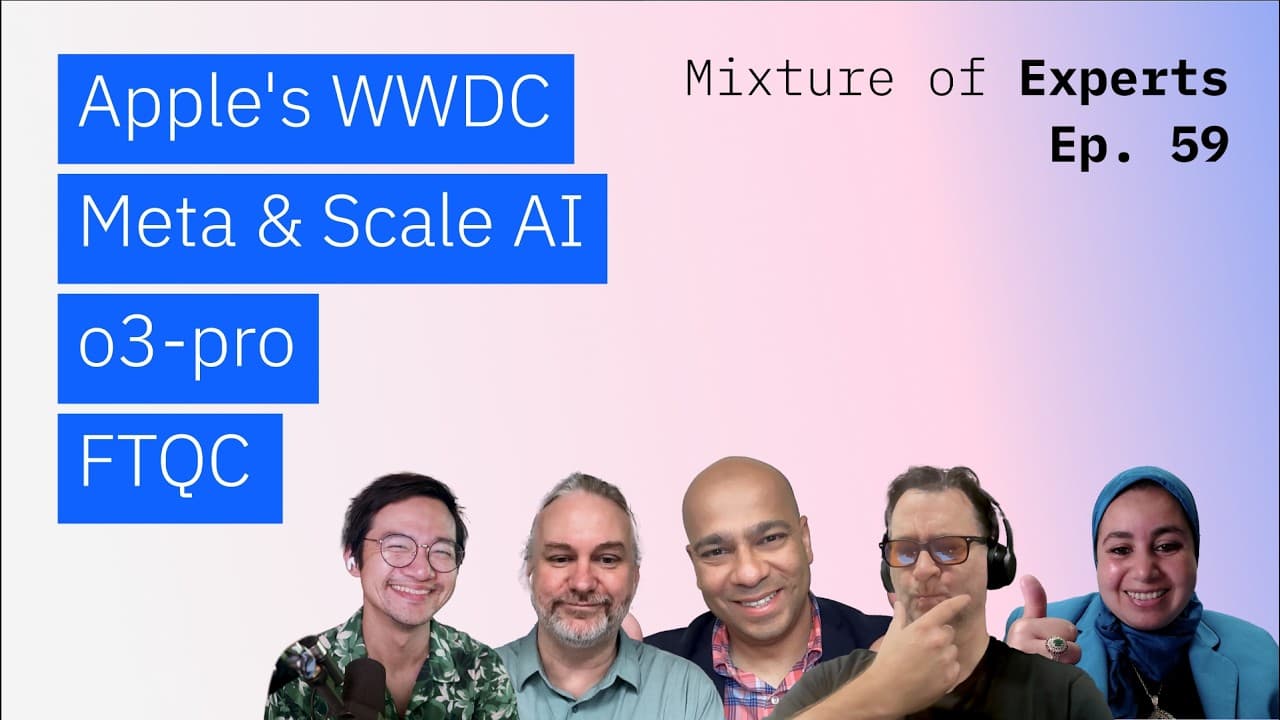
Apple’s strongest AI opportunity is integrating on-device models across its trusted hardware and software ecosystem, although its delayed Siri overhaul and incremental features leave it behind competitors. Meta’s Scale AI deal reflects the strategic importance of data and evaluation infrastructure, while o3-pro highlights a tradeoff between deeper reasoning and speed. IBM Quantum Starling, planned for 2029, represents a path toward large-scale, fault-tolerant quantum computing.
Transcript
I think double WWDC would start being called, why was design changed? I really want Apple to focus on having a good platform, right? The mobile devices, the iPad, the Mac all coming together, and I, I actually think that's the bigger story of WWDC So I think Meta is really betting on securing its foundational AI supply chain with this acquisition, ... Read More
Key Insights
- Apple’s main AI advantage is its integrated ecosystem of mobile devices, iPads, Macs, Apple silicon, developer frameworks, and trusted access to personal data. The panel argues that these assets could support personalized intelligence even if Apple does not lead the competition to build the strongest underlying models.
- Apple Intelligence is still viewed as underwhelming because the promised Siri overhaul was delayed and several announced features appear incremental. The panel suggests Apple cannot afford an AI gap year while OpenAI, Meta, Google, and Samsung continue applying competitive pressure across models, devices, and consumer experiences.
- On-device language model access is a significant developer capability because applications can use a common Apple framework instead of installing separate small models. The panel expects these software development tools to create new applications while taking advantage of Apple silicon and the broader device ecosystem.
- Privacy and trust are central to Apple’s AI opportunity because customers already place sensitive personal and family information inside its ecosystem. The panel argues that Apple could use this position to deliver personalized experiences that providers without comparable access to user data cannot easily reproduce.
- Liquid Glass is the most controversial design change discussed from WWDC because panelists consider the interface unfinished and potentially difficult to use. One participant compares the risk to a Windows Vista moment and questions why Apple would ship an immature design while delaying AI features that were not ready.
- o3-pro demonstrates a tradeoff between reasoning depth and response time because one paper-reading test required 13 minutes. The panel questions the practical value of waiting that long when a person might read the material independently, even though the system is intended for more demanding reasoning work.
- Meta’s Scale AI acquisition is portrayed as a strategic attempt to secure its foundational AI supply chain. The panel’s central argument is that competition depends not only on models, but also on training infrastructure, data, evaluation processes, and human feedback needed to develop and assess them.
- Fault-tolerant quantum computing is presented as a route toward useful large-scale quantum systems, with IBM Quantum Starling planned for 2029. A participant predicts that quantum advantage, defined here as performing something better, faster, or cheaper than a classical computer, could be demonstrated by 2026 or sooner.
Install to Summarize YouTube Videos and Get Transcripts
Explore YouTube Video Summarizer or Get YouTube Transcript Extractor
Questions & Answers
Q: What were the most important AI announcements at Apple’s WWDC?
Developer access to on-device language models is presented as one of the most consequential announcements because applications can connect to Apple’s models through a shared framework. Apple Intelligence is also gaining more ways to see and interact with content on a user’s screen. However, the promised Siri overhaul remains delayed, and the panel considers Apple’s overall AI progress less prominent and less impressive than expected.
Q: Why is Apple considered behind its competitors in artificial intelligence?
Apple is considered behind because its Siri overhaul was delayed, its announced AI improvements appear incremental, and its on-device models are described as weaker than comparable Google models. The panel contrasts Apple’s position with pressure from OpenAI, Meta, Google, and Samsung. Although Apple possesses strong hardware, a broad ecosystem, and substantial user trust, the participants believe it has not converted those advantages into sufficiently capable AI experiences.
Q: How could on-device language models benefit Apple developers?
On-device language model access gives developers a common framework for adding AI functions to applications without requiring every app to install its own small model. The panel believes this approach could make model access more widespread across Apple devices and encourage new applications. It also connects AI development with Apple silicon, which the participants regard as exceptionally capable hardware, even while debating the current quality of Apple’s models.
Q: Why are privacy and user trust important to Apple Intelligence?
Privacy and trust matter because Apple customers already keep extensive personal and family information within the company’s devices and services. One participant says that Apple has earned enough trust for family use and parental controls, creating an opportunity to provide highly personalized intelligence. The panel argues that Apple and Google possess data relationships that other AI providers cannot easily match, although Apple must still turn that advantage into useful products.
Q: What concerns did the panel raise about Apple’s Liquid Glass design?
The panel raises concerns that Liquid Glass does not appear ready for release and may make interface flaws more visible. One participant suggests WWDC could eventually be remembered for questions about why the design changed and compares its potential reception to a Windows Vista moment. The discussion also highlights an apparent inconsistency: Apple is willing to ship an unfinished-looking interface while delaying artificial intelligence features because they are not ready.
Q: What does the o3-pro paper-reading test reveal about AI reasoning?
The test reveals a practical tension between the time spent reasoning and the usefulness of the final result. A participant reports that o3-pro took 13 minutes to read a paper, prompting the reaction that a person might have read it independently in that time. The example does not establish that slow reasoning is always ineffective, but it raises the question of when additional processing time produces enough value to justify waiting.
Q: Why did Meta pursue a $15 billion deal involving Scale AI?
The discussion interprets Meta’s $15 billion Scale AI deal as a strategic move to secure more of its foundational artificial intelligence supply chain. The panel emphasizes that AI competition is not determined by models alone. Training infrastructure, high-quality data, evaluation systems, and human feedback also shape model development and performance. Gaining stronger control over these resources could support Meta’s effort to build a superintelligence lab.
Q: What is IBM Quantum Starling and why does fault tolerance matter?
IBM Quantum Starling is identified in the description as a planned large-scale, fault-tolerant quantum computer arriving in 2029. The discussion connects fault-tolerant systems with the prospect of practical quantum advantage, described as completing something better, faster, or cheaper than a classical computer. One participant predicts that a demonstration of such an advantage could occur by 2026 and suggests it might happen even sooner.
Summary & Key Takeaways
-
Apple’s WWDC discussion centers on Liquid Glass, delayed Siri improvements, and developer access to on-device language models. The panel sees Apple’s integrated hardware, software, personal data, privacy reputation, and developer frameworks as valuable advantages, but argues that incremental interface features and underwhelming AI progress are weakening its competitive position for now.
-
OpenAI’s o3-pro is presented as a reasoning system that may spend considerable time processing demanding material. One panelist reports waiting 13 minutes for it to read a paper, raising a practical question about whether stronger reasoning justifies slower responses when a person might complete the same reading task within a comparable period.
-
Meta’s $15 billion Scale AI deal is interpreted as an effort to secure foundational AI capabilities beyond models themselves. The discussion emphasizes that training infrastructure, data, evaluation, and human feedback are major competitive resources. The episode concludes with IBM Quantum Starling, planned for 2029, and expectations that quantum advantage could appear earlier.
Read in Other Languages (beta)
Share This Summary 📚
Summarize YouTube Videos and Get Video Transcripts with 1-Click
Try YouTube Summary with ChatGPT & Claude or YouTube Transcript Generator
Explore More Summaries from IBM Technology 📚


Summarize YouTube Videos and Get Video Transcripts with 1-Click
Try YouTube Summary with ChatGPT & Claude or YouTube Transcript Generator