How to Evaluate AI Outputs and Interactions
TL;DR
Discernment is the quality control system for AI collaboration, helping you evaluate the accuracy and value of outputs, the effectiveness of the AI’s process, and the quality of its interaction with you. Strong discernment combines domain expertise with knowledge of AI limitations, then turns identified problems into specific feedback, revised instructions, or better delegation decisions.
Transcript
In this video, we'll dig deeper into the AI fluency competency of discernment. AI fluency means working with AI effectively, efficiently, ethically, and safely. Discernment is specifically about evaluating AI outputs, processes, and behaviors. essentially your quality control system for AI collaboration. Discernment is your ability to critically ev... Read More
Key Insights
- Discernment is the quality control system for AI collaboration, covering critical evaluation of what an AI produces, how it produces it, and how it behaves during the interaction.
- Effective discernment requires both domain expertise and an understanding of AI systems, because users need enough subject knowledge to judge quality and enough AI knowledge to recognize typical shortcomings.
- Product discernment is the ability to judge the accuracy and value of AI-created output by checking factual accuracy, audience suitability, coherence, compliance with requirements, and usefulness for the intended problem.
- Process discernment is the ability to assess the quality and effectiveness of the AI’s work, including whether it makes logical errors, loses attention, takes inappropriate steps, fixates on one interpretation, or reasons circularly.
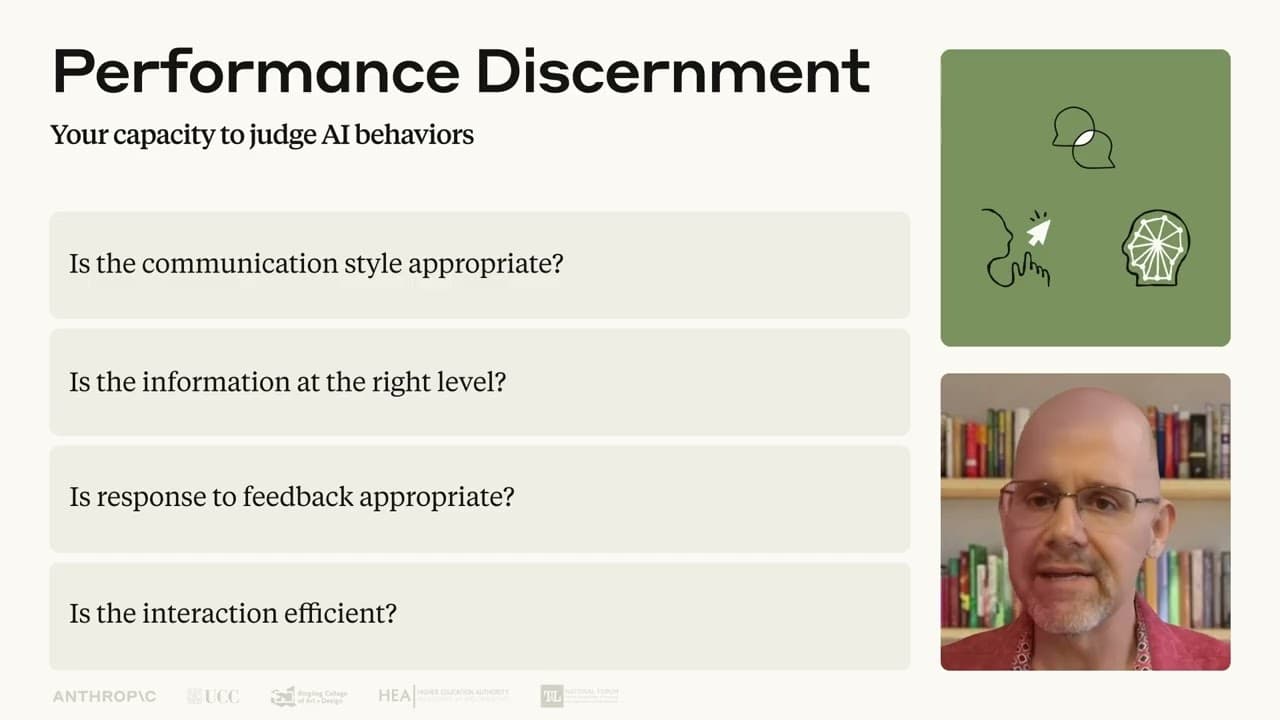
- Performance discernment is the ability to judge the quality of the human-AI interaction, including whether communication is helpful, responsive to feedback, appropriately detailed, and efficient rather than unnecessarily complex.
- Complex tasks make process discernment especially important because the correct answer may not be immediately obvious, making confidence in how the AI is working essential to keeping the collaboration aligned with the user’s vision.
- Effective feedback specifies the identified problem, explains clearly why it is a problem, offers concrete suggestions for improvement, and revises the instructions or examples used to guide the AI.
- Discernment and description form a continuous loop of instruction and evaluation: description communicates what the user needs, while discernment determines how well the AI met those needs and whether another approach is required.
Install to Summarize YouTube Videos and Get Transcripts
Explore YouTube Video Summarizer or Get YouTube Transcript Extractor
Questions & Answers
Q: What is discernment in AI fluency?
Discernment is the ability to critically evaluate what an AI produces, how it produces the result, and how it behaves during collaboration. It functions as quality control by helping users distinguish valuable outputs from problematic ones, recognize strengths and limitations, and decide whether a result is ready to use, needs revision, or requires a different approach.
Q: How do you evaluate the quality of an AI output?
Evaluate an AI output by asking whether it is factually accurate, suitable for the intended audience and purpose, coherent, well structured, compliant with the stated requirements, and valuable for solving the intended problem. This form of evaluation is product discernment, which focuses specifically on the accuracy and usefulness of the content the AI created.
Q: What is the difference between product and process discernment?
Product discernment judges the accuracy and value of the final AI-created output. Process discernment examines the work the AI performed to reach that output. It looks for logical errors, attention lapses, inappropriate steps, fixation on a minor detail or single interpretation, circular reasoning, and the reintroduction of ideas that the user previously rejected.
Q: What is performance discernment in AI collaboration?
Performance discernment evaluates how well an AI interacts with the user while completing its work. It asks whether the AI communicates helpfully, provides the needed information, responds effectively to feedback and direction, and keeps the interaction efficient. It also identifies mismatches, such as asking too many questions for a concise task or being too brief when comprehensive information is needed.
Q: Why does AI discernment require domain expertise?
Domain expertise is necessary because a user must know enough about the subject to judge whether an AI output is accurate, appropriate, coherent, and valuable. Discernment also requires an understanding of how AI systems work and where they commonly fall short, since even advanced systems can make factual mistakes, reasoning errors, or behave in unexpected ways.
Q: How should you give feedback when an AI response has problems?
Effective feedback should identify exactly what the problem is, explain clearly why it is a problem, and provide concrete suggestions for improvement. The user can also revise the original instructions or supply better examples. When discernment reveals that an output does not meet the need, improved description often gives the AI clearer guidance for producing a stronger result.
Q: When should you reconsider delegating a task to AI?
Reconsider delegation when feedback and revised instructions are unlikely to solve the identified problem. A poor result may indicate that the wrong tool is being used or that the problem is being approached in an unsuitable way. Discernment therefore involves more than correcting outputs, since it can also reveal the need to change the broader delegation decision or working approach.
Q: How do description and discernment work together?
Description communicates what the user wants from the AI, while discernment evaluates whether the AI actually met those needs. When evaluation identifies a problem, the user can improve the description through clearer instructions, explanations, or examples. Together, description and discernment create a continuous loop of instruction, evaluation, feedback, and revision that keeps AI collaboration guided by human judgment.
Summary & Key Takeaways
-
Discernment is the AI fluency competency used to evaluate AI outputs, processes, and behaviors. It determines whether an AI response meets the intended need, adds value, and is ready to use. This judgment requires relevant domain expertise and awareness that advanced AI systems can still make factual, reasoning, and behavioral mistakes.
-
Product discernment assesses the accuracy and value of AI-created output, while process discernment examines how the AI reached its result. Performance discernment evaluates how effectively the AI interacts with the user. Together, these perspectives reveal content problems, faulty reasoning, attention lapses, inefficient communication, and poor responses to feedback or direction.
-
Effective discernment leads to action through feedback, revised instructions, improved examples, or reconsidered delegation. Useful feedback identifies the problem, explains why it matters, and suggests concrete improvements. Discernment and description therefore form a continuous quality loop in which human judgment evaluates results and clearer communication guides the next AI response.
Read in Other Languages (beta)
Share This Summary 📚
Summarize YouTube Videos and Get Video Transcripts with 1-Click
Try YouTube Summary with ChatGPT & Claude or YouTube Transcript Generator
Explore More Summaries from Anthropic 📚





Summarize YouTube Videos and Get Video Transcripts with 1-Click
Try YouTube Summary with ChatGPT & Claude or YouTube Transcript Generator