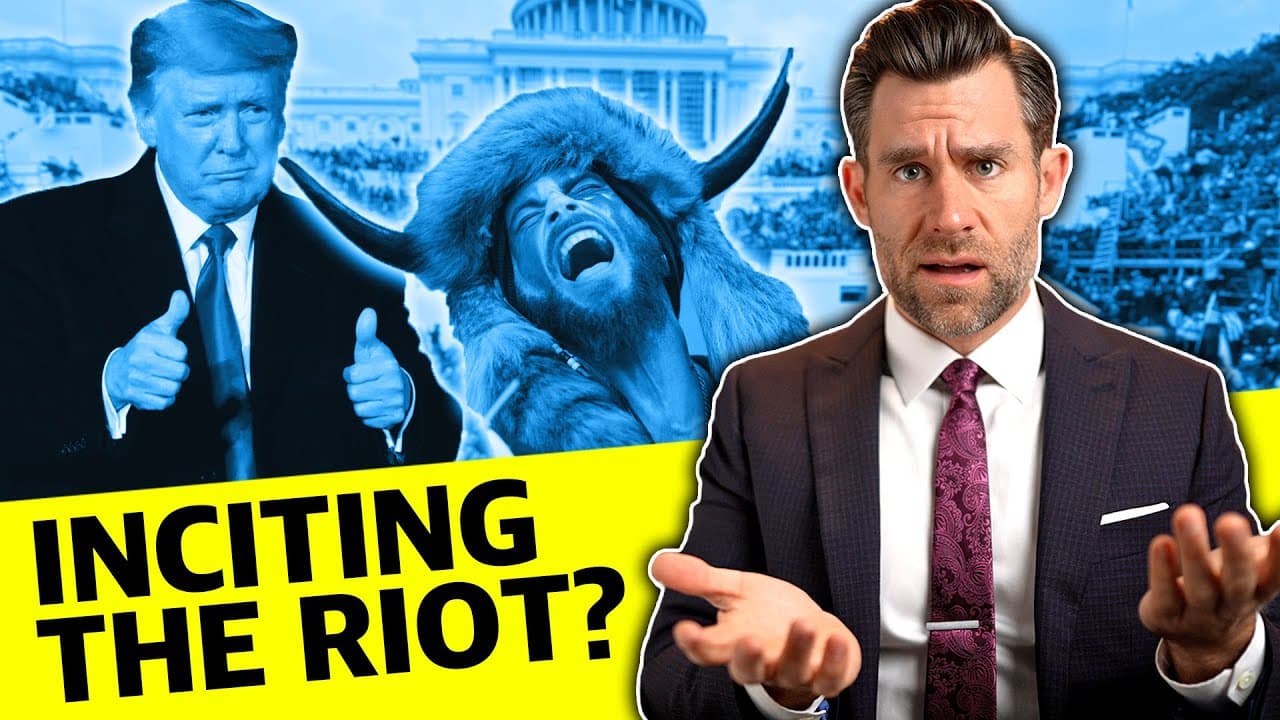
Is Trump Legally Guilty of Inciting the Capitol Riot?
TL;DR
President Trump is accused of inciting the Capitol riots, but legal analysis suggests his speech may not technically meet the standard for incitement. The First Amendment protects political speech, making a legal conviction unlikely; however, his actions could still warrant impeachment based on public trust breaches. Incitement involves complex considerations of context, intent, and potential outcomes.
Transcript
- By now we've all seen what happened at the Capitol riots on January 6th. And we now have a pretty good idea of what precipitated those events. The house is moving forward with impeachment and the articles of impeachment are likely to pass. Though, at this point it's unclear at what point the Senate will take up the articles of impeachment and act... Read More
Key Insights
- ❓ Incitement to riot hinges on advocating imminent lawless action that is likely to occur.
- 😯 The First Amendment protections for political speech are substantial, with courts giving high scrutiny to potential restrictions.
- 🧑🏭 Impeachment doesn't necessarily require a criminal act, but can be based on breaching public trust or committing heinous behavior.
- 😯 Legal analysis of incitement cases considers context, intent, and the likelihood of lawless action resulting from the speech.
- 🥶 Incitement involves a delicate balance between free speech rights and public safety considerations.
- ❓ The moral implications of incitement may differ from the legal standards applied in courts.
- ☸️ Impeachment is a political solution for political problems, focusing on actions that harm the country, regardless of technical legal definitions.
Install to Summarize YouTube Videos and Get Transcripts
Explore YouTube Video Summarizer or Get YouTube Transcript Extractor
Questions & Answers
Q: What is incitement to riot and how is it defined in legal contexts?
Incitement to riot involves speech encouraging imminent lawless action, as determined by the Brandenburg test in Supreme Court rulings.
Q: Can political speech be protected under the First Amendment, even if it appears to incite violence?
Political speech receives strong protections under the First Amendment, with courts applying a high level of scrutiny, especially in cases of incitement.
Q: How do courts differentiate between advocating violence and protected political speech?
Courts consider the context, content, and intent of the speech to determine if it crosses the line into incitement, balancing free speech rights and public safety.
Q: What is the significance of the historical Brandenburg test in evaluating incitement cases?
The Brandenburg test establishes a high bar for incitement charges, focusing on the likelihood of imminent lawless action resulting from the speech.
Summary & Key Takeaways
-
The Capitol riots on January 6th led to concerns of incitement, with President Trump potentially facing charges.
-
Incitement is a complex legal concept involving speech that can lead to imminent lawless action.
-
Legal analysis suggests that while Trump's words may not meet the incitement standard, his actions could still be impeachable.
Read in Other Languages (beta)
Share This Summary 📚
Summarize YouTube Videos and Get Video Transcripts with 1-Click
Try YouTube Summary with ChatGPT & Claude or YouTube Transcript Generator
Explore More Summaries from LegalEagle 📚
Summarize YouTube Videos and Get Video Transcripts with 1-Click
Try YouTube Summary with ChatGPT & Claude or YouTube Transcript Generator