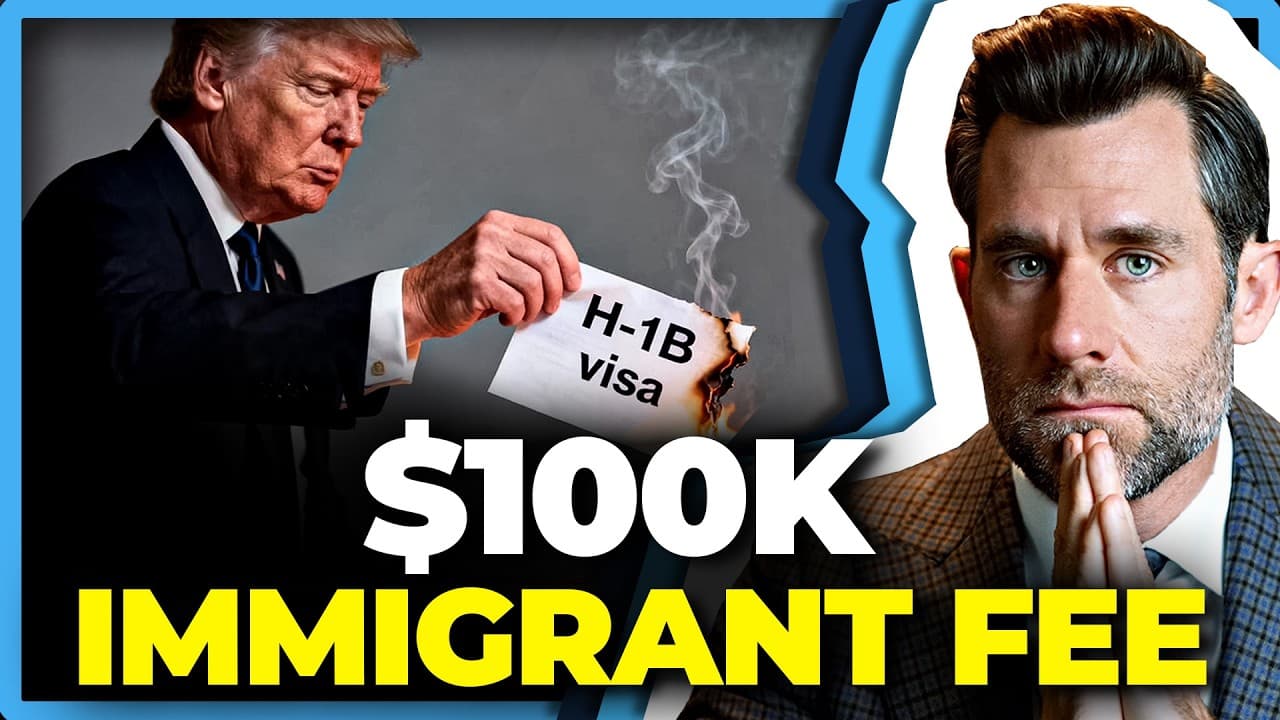
How Does Trump’s $100,000 H-1B Visa Fee Affect Legal Immigrants?
TL;DR
Trump’s $100,000 non-refundable H-1B application fee raises hiring costs, restricts access to skilled foreign workers, and creates legal uncertainty for immigrants and employers. Announced on a Friday and set to take effect at 12:01 a.m. EDT on September 21, 2025, the vaguely worded order triggered rushed travel and company warnings before the administration clarified that it applied only to prospective applicants. Read on for the legal, workplace, and humanitarian implications.
Transcript
If you thought Trump was only going after criminal immigrants, uh, I have a bridge to sell you. President Trump ruined the weekend of a lot of highly skilled workers and immigration attorneys with a Friday announcement that all H1B visa applicants would now have to pay a whopping $100,000 non-refundable fee to have their applications processed. Now... Read More
Key Insights
- Trump's executive order imposes a $100,000 fee on H1B visa applications.
- The fee was not created by statute or agency rulemaking, raising legal concerns.
- Tech companies advised H1B visa holders to avoid international travel due to uncertainty.
- India's government warned of humanitarian consequences due to the sudden fee.
- The fee could disrupt the US tech industry by limiting access to skilled workers.
- Legal experts question the president's authority to impose the fee unilaterally.
- The executive order's vague language led to widespread confusion and chaos.
- The H1B visa program was established by Congress to fill specialized job roles.
Install to Summarize YouTube Videos and Get Transcripts
Explore YouTube Video Summarizer or Get YouTube Transcript Extractor
Questions & Answers
Q: What impact does Trump’s $100,000 H-1B visa fee have?
The fee makes obtaining an H-1B visa difficult or impossible for many qualified workers and could leave substantial gaps in U.S. industries, especially technology. Its abrupt introduction also caused travel disruption and uncertainty among visa holders, employers, and immigration attorneys.
Q: Who must pay the new $100,000 H-1B fee?
The executive order initially appeared to restrict H-1B entry unless a worker’s petition included a $100,000 payment. A Saturday administration memo later clarified that the fee applied only to prospective applicants, although the executive order’s language was not revised.
Q: When did Trump’s H-1B fee take effect?
The proclamation specified an effective time of 12:01 a.m. Eastern Daylight Time on September 21, 2025. Because it was announced on Friday and was due to take effect in less than 48 hours, affected workers had very little time to respond.
Q: Why is the legality of Trump’s H-1B fee questioned?
The fee was not created by statute or through agency rulemaking. The transcript argues that an executive order cannot change or contradict a law passed by Congress and describes Trump’s claimed authority under sections 1185F and 1182A of the Immigration and Nationality Act as extremely legally questionable.
Q: How did Amazon and Microsoft respond to the H-1B order?
Amazon, Microsoft, and other employers urged H-1B workers to remain in the United States and told employees already abroad to return before the September 21 deadline. These warnings followed interpretations that travelers might need to pay $100,000 merely to reenter the country.
Q: Why did the H-1B order cause travel chaos?
Its vague wording appeared to cover current H-1B holders returning from international travel, not merely new applicants. People therefore canceled trips, booked expensive last-minute flights, rushed back to the United States, and even deboarded international flights.
Q: Are exemptions available from the $100,000 H-1B fee?
The order says the Secretary of Homeland Security may exempt an individual, a company’s workers, or an entire industry when their hiring is considered in the national interest and not a threat to U.S. security or welfare. The transcript characterizes this exemption as a broad, vaguely worded loophole and notes continuing uncertainty about who might receive it.
Q: What humanitarian concerns did India raise about the H-1B fee?
India’s Ministry of External Affairs warned of humanitarian consequences and disruption for families. Indian leaders encouraged government offices to help Indian H-1B holders return to the United States within 24 hours.
Summary & Key Takeaways
-
President Trump's executive order introduced a $100,000 fee for H1B visa applications, leading to chaos in the tech industry and among immigration attorneys. The fee was not legally established, resulting in confusion and potential legal challenges. This move could significantly impact the US tech sector by restricting access to skilled foreign workers.
-
The executive order's vague wording caused panic, with tech companies advising employees to avoid international travel. India's government expressed concern over humanitarian impacts, urging support for Indian H1B visa holders. Legal experts argue that the fee contradicts established immigration laws and could face significant legal challenges.
-
The H1B visa program, designed to fill specialized job roles, faces disruption due to the new fee. Critics argue that the fee could force companies to relocate work overseas, undermining the US's competitive position in technology and innovation. The legality of the executive order remains in question, with lawsuits anticipated.
Read in Other Languages (beta)
Share This Summary 📚
Summarize YouTube Videos and Get Video Transcripts with 1-Click
Try YouTube Summary with ChatGPT & Claude or YouTube Transcript Generator
Explore More Summaries from LegalEagle 📚





Summarize YouTube Videos and Get Video Transcripts with 1-Click
Try YouTube Summary with ChatGPT & Claude or YouTube Transcript Generator