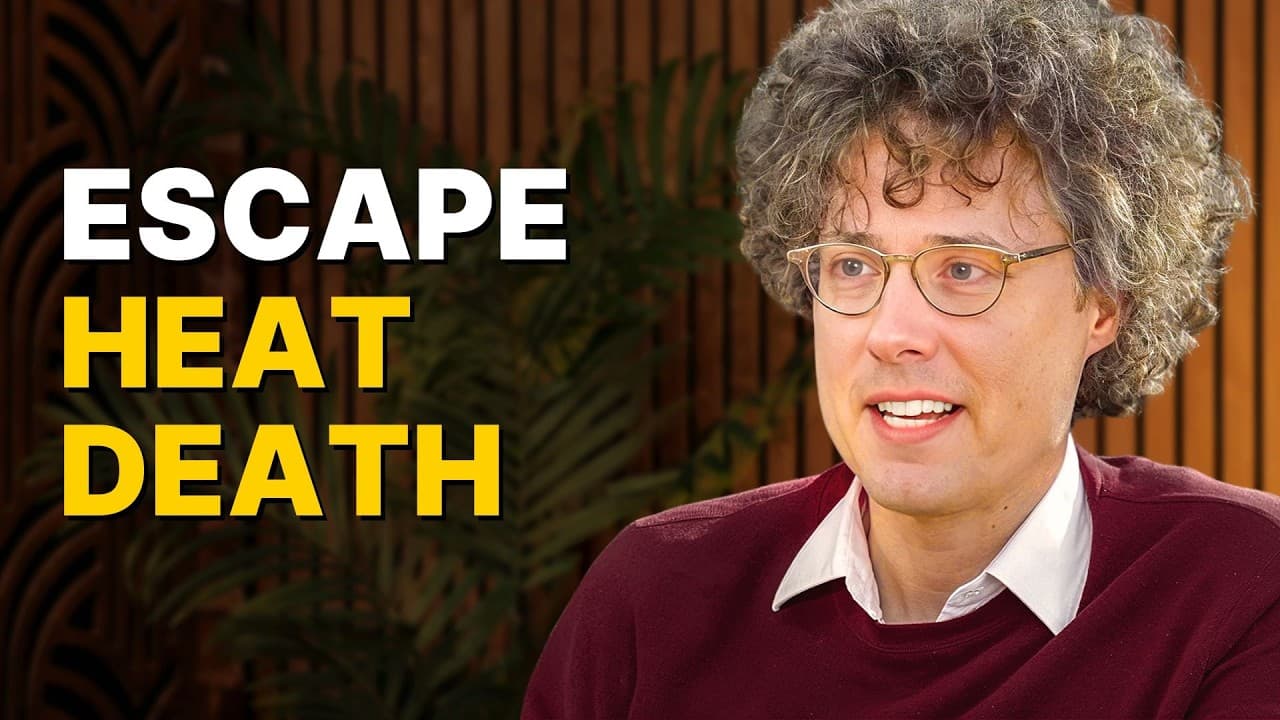
How will the universe end and can we influence it
TL;DR
The universe will not necessarily recollapse or heat death as once thought; current evidence shows accelerated expansion driven by dark energy, leaving a future where distant galaxies drift away. Some theories consider moving to a vacuum with a lower cosmological constant, but achieving that would require advanced physics experiments and is highly speculative. Confidence remains low given unsettled physics and unknown future technologies.
Transcript
Today I'm chatting with Adam Brown, who is a founder and lead of the Blueshift team, which is cracking math and reasoning at Google DeepMind, and a theoretical physicist at Stanford. Adam, welcome. Delighted to be here. Let's do this. Okay, we'll talk about AI in a second, but first, let's talk about physics. First question: What is going to b... Read More
Key Insights
- The fate of the universe is uncertain and historically reinterpreted as our understanding improved. A cosmological constant or dark energy drives accelerated expansion, complicating simple predictions about a final fate.
- The cosmological constant acts like a constant energy density, potentially causing constant acceleration and the dragging away of distant galaxies, which limits usable future energy sources.
- Multiple vacua exist in theory, and transitions between them could, in principle, alter fundamental constants or the energy density of the vacuum.
- A lower vacuum energy state could be reached if our descendants engineered a controlled transition, though this raises enormous technical and safety concerns.
- Vacuum decay would require careful control to avoid catastrophic outcomes like creating black holes or changing essential forces.
- The loss landscape analogy helps visualize how different vacuum states correspond to local minima, with barriers determining transition likelihoods.
- The possibility of changing environmental aspects of physics, rather than the laws themselves, is a nuanced distinction relevant to speculative engineering.
- The discussion remains within the realm of theoretical physics and speculative future capabilities, not established experimental science.
- More videos from this channel:
- More from this channel: Dwarkesh Patel
Install to Summarize YouTube Videos and Get Transcripts
Explore YouTube Video Summarizer or Get YouTube Transcript Extractor
Questions & Answers
Q: What is the ultimate fate of the universe according to the discussion?
The discussion explains that the ultimate fate is not settled and could depend on whether dark energy remains a constant driving accelerated expansion. If the cosmological constant is truly constant, many regions recede forever, potentially leading to a heat death in the far future. However, the speaker notes that this is not guaranteed and could change with future physics discoveries or engineering by distant descendants.
Q: What role does dark energy play in the universe’s expansion?
Dark energy is described as a driver of accelerated expansion, causing the universe to expand faster over time. This accelerates the separation of distant galaxies, potentially limiting future access to resources and making heat death more plausible if the expansion remains unchecked.
Q: What is a vacuum in this context?
A vacuum is described as a possible set of physical laws or a minimum in a higher dimensional space where the universe could reside. Different vacuums imply different cosmological constants and physical conditions, which could in principle be transitioned between.
Q: Why is vacuum decay considered dangerous or risky?
Vacuum decay could drastically alter fundamental constants and physical laws, potentially changing electromagnetic or nuclear forces. The risk is not only theoretical but could have catastrophic consequences for life and matter, if a transition propagates uncontrollably through the universe.
Q: Could humans or descendants ever trigger a vacuum transition?
The speaker suggests it could be conceivable for distant descendants to attempt a controlled vacuum transition to lower the cosmological constant, but emphasizes that this would require advanced engineering like a highly controlled collapse of a field and careful management to avoid creating a black hole or other dangers.
Q: What analogy is used to explain the concept of different vacua?
The water analogy compares phases of water to different vacuum states: steam, water, and ice represent different minima with barriers between them. Transitions can occur naturally through thermal processes or be induced by interventions like cloud seeding, illustrating how vacua could shift in a controlled way.
Q: Are the laws of physics permanent in this view?
The conversation clarifies that the laws of physics are not being changed, but the environment or effective low energy laws experienced in a given vacuum could be different. This means the universe could feel different, even if the underlying true laws stay fixed.
Q: What is the main takeaway about studying these ideas?
The main takeaway is that these questions are speculative and foundational, relying on unsettled physics and future capabilities. The discussion highlights plausible pathways and enormous challenges while grounding them in established concepts like vacuum states, cosmological constants, and the potential for future technological influence.
Summary & Key Takeaways
-
The talk surveys the history of cosmology from static models to accelerating expansion driven by dark energy, highlighting uncertainty about the universe’s ultimate fate.
-
It explains the concept of vacuum states and local versus global minima, using a water analogy to describe how a universe could migrate to a different vacuum with a lower cosmological constant.
-
It discusses the idea that future civilizations might somehow trigger a vacuum transition to avoid heat death, while emphasizing the enormous engineering challenges and the risks involved.
Read in Other Languages (beta)
Share This Summary 📚
Summarize YouTube Videos and Get Video Transcripts with 1-Click
Try YouTube Summary with ChatGPT & Claude or YouTube Transcript Generator
Explore More Summaries from Dwarkesh Patel 📚

Summarize YouTube Videos and Get Video Transcripts with 1-Click
Try YouTube Summary with ChatGPT & Claude or YouTube Transcript Generator